

( Quang Ngai Newspaper) - Quang Ngai has three mountains all beginning with the word "Thien" (Heaven), located within Quang Ngai City. These are Thien An, Thien But, and Thien Ma. Based on the shape of the mountains, they were named, each carrying a meaning, both descriptive and imbued with a sacred spirit. Thien Ma Mountain is no exception. From this mountain, wherever you look, you will encounter the poetic beauty of the misty landscape at the end of the Tra Khuc River.
The Pegasus is always on this side of the river.
Thien Ma – a mountain range that marks the boundary between Tinh Khe and Tinh Long communes. It would be unremarkable if this mountain range didn't resemble a majestic horse, its head slightly raised as if preparing to gallop across the Tra Khuc River. This shape is immortalized in a folk song of the people of My Lai village, Tinh Khe commune: “Only when Thien Ma crosses the river / Will My Lai village be free from the pursuit of high rank and honor.” This refers to the studiousness of this region.
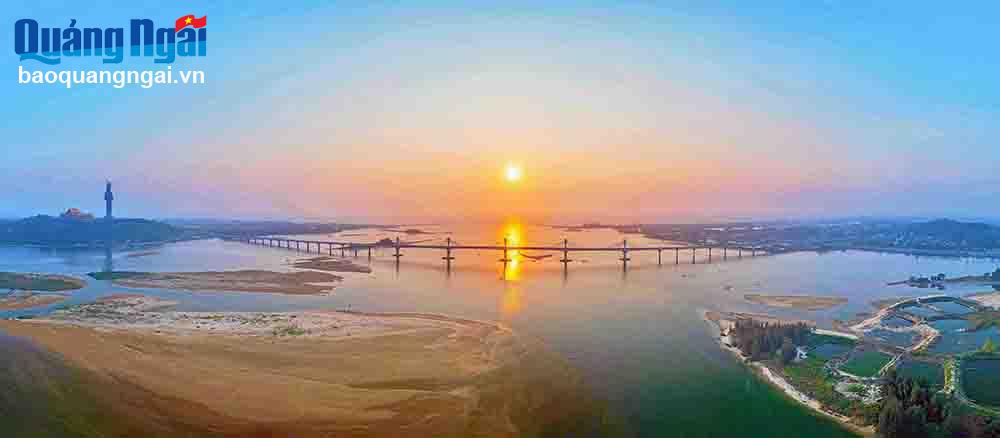 |
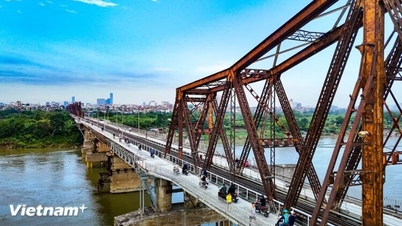
Tra Khuc River (the section passing through Co Luy Bridge).
Photo: HUU THU
The celestial horse never "crossed the river," so in every era, My Lai village has produced people who passed examinations and became officials. The first scholar of Quang Ngai province was Truong Dang Que, from My Lai village. Truong Dang Que passed the provincial examination in the Ky Mao year (1819) and was a renowned official under four emperors: Gia Long, Minh Mang, Thieu Tri, and Tu Duc. He was also a teacher of Emperor Thieu Tri and several famous Nguyen Dynasty nobles such as Tuy Ly Vuong and Tung Thien Vuong. Many descendants of Truong Dang Que became revolutionaries very early on and became famous leaders in the province. A prime example is Truong Quang Giao, the Secretary of the Quang Ngai Provincial Party Committee from the early days of the revolution. It is unknown whether the mountain guarding the southwest of My Lai village has influenced the "land of learning" of this region, but it is certain that Tinh Khe commune has always contributed outstanding individuals to the country.
Surrounded by water on three sides.
Before flowing into the vast ocean, the Tra Khuc River branches into two tributaries: Kinh Giang on the north bank and Phu Tho on the south bank. Viewed from Thien Ma, these two tributaries resemble outstretched arms, as if embracing all the ferocity that the Tra Khuc River has overcome throughout its more than 130km journey to the sea. Kinh Giang runs through Son My village, separating this beautiful village from the East Sea with its lush, evergreen mangrove forests. Once a refuge for guerrillas during the war against the US, it is now a destination for tourists seeking beautiful scenery. If the tourism industry can properly exploit this "gift from nature," the Tinh Khe mangrove forest could attract just as many visitors as the famous mangrove forest in Hoi An (Quang Nam).
The Kinh Giang River, connecting the Tra Khuc River to the Sa Ky estuary, has been a vital waterway for transporting produce from the sea upstream and back to the sea throughout the history of this region. It is also the river that has sustained countless people whose lives have been intertwined with its waters. The fresh fish and shrimp that this river provides have been the source of livelihood for generations of people in this rural area.
On the southern bank of the Tra Khuc River, the Phu Tho River – opposite the Kinh Giang River on the northern bank – was once a place where merchant ships sailed up and down to dock at the Vuc Hong River, a once bustling trading port of the ancient town of Thu Xa. While the Tra Khuc River deposited alluvial soil to create fertile fields along its banks, the Phu Tho and Kinh Giang rivers provided people with brackish water seafood that became local specialties.
Leaning against the Pegasus
On Thien Ma Mountain, there is now a new temple that, once completed, will arguably be unmatched anywhere in Central Vietnam in terms of scale and scenery. The temple is named after a famous monk: Minh Duc - the abbot of Long Buu Temple in Nghia Hanh district.
Venerable Thich Tam Vi, the current administrator of Minh Duc Pagoda, said that he had traveled throughout the central coastal provinces to find a suitable location to build the pagoda, fulfilling his wish to his teacher, Venerable Thich Minh Duc, when he was still alive. Building Minh Duc Pagoda on Thien Ma Mountain was a matter of fate, as he was born and raised in Tinh Long commune, at the foot of Thien Ma Mountain, but only near the end of his life did he "recognize" this auspicious location for the pagoda.
Few places boast such picturesque scenery as Minh Duc Pagoda. This pagoda houses the tallest statue of Avalokiteshvara Bodhisattva in Vietnam, reaching over 125 meters above sea level. With its unique architecture and exquisite carvings on every wall and stone slab, Minh Duc Pagoda is not only a sacred space for Buddhist devotees but also a destination for tourists seeking spiritual guidance. Currently, the pagoda has planted 6 hectares of maple trees on Thien Ma mountain – a species that produces vibrant yellow flowers in late spring and early summer. In addition to the natural beauty, the picturesque Co Luy Bridge is located at the end of the Tra Khuc River. This will be a popular stop for visitors to Quang Ngai once the Thien Ma Cultural Area and Minh Duc Pagoda are completed in the near future.
TRAN DANG
RELATED NEWS AND ARTICLES:
Source: https://baoquangngai.vn/van-hoa/202501/nhin-tu-thien-ma-9b22054/
![[Photo] The heat at the fireworks display site on the opening night of the Da Nang International Fireworks Festival 2026](https://vphoto.vietnam.vn/thumb/1200x675/vietnam/resource/IMAGE/2026/05/27/1779889741485_ndo_br_z7872039145157-fecaba5112f39e8352544099d7ef4738-5140-jpg.webp)
![[Photo] The courage of new recruits of Brigade 144 on the training ground.](https://vphoto.vietnam.vn/thumb/1200x675/vietnam/resource/IMAGE/2026/05/27/1779881651341_anh-man-hinh-2026-05-27-luc-18-32-52.png)
























































Comment (0)