

Journalists covering arts and culture still perform all journalistic duties, from fieldwork and information gathering to interviews, verification, writing, editing, and publishing articles. They not only report on events such as award ceremonies, exhibitions, and performances, but also write in-depth articles, analyze works, reflect on cultural life, or critique deviant phenomena in the art world. The work demands keen insight, aesthetic sense, extensive knowledge, and professional ethics – all core elements of a true journalist.
Mr. Tran Hoang Phuc, a contributor specializing in arts and culture for Ca Mau Newspaper (now Ca Mau Newspaper and Radio-Television Station), writes articles about artists, especially Cai Luong (Vietnamese traditional opera) artists, creating a wide reach among readers. According to him, the arts and culture field is unique, and the writer's approach is more subtle because artists are very emotional but also quite sensitive; they only share if you trust and love them.
“The greatest joy for an arts and culture reporter is listening to the unique stories of the lives of artists. They see me as a friend, sharing their innermost thoughts, revealing their hidden secrets, and discussing their concerns about art and life. The challenge for writers in this field is listening, empathizing, and then gathering the emotions and content of the story to express it in a way that is relatable and closely aligns with the information the artist wants to convey, thereby delivering the message they want to communicate to the public,” Hoàng Phúc shared.
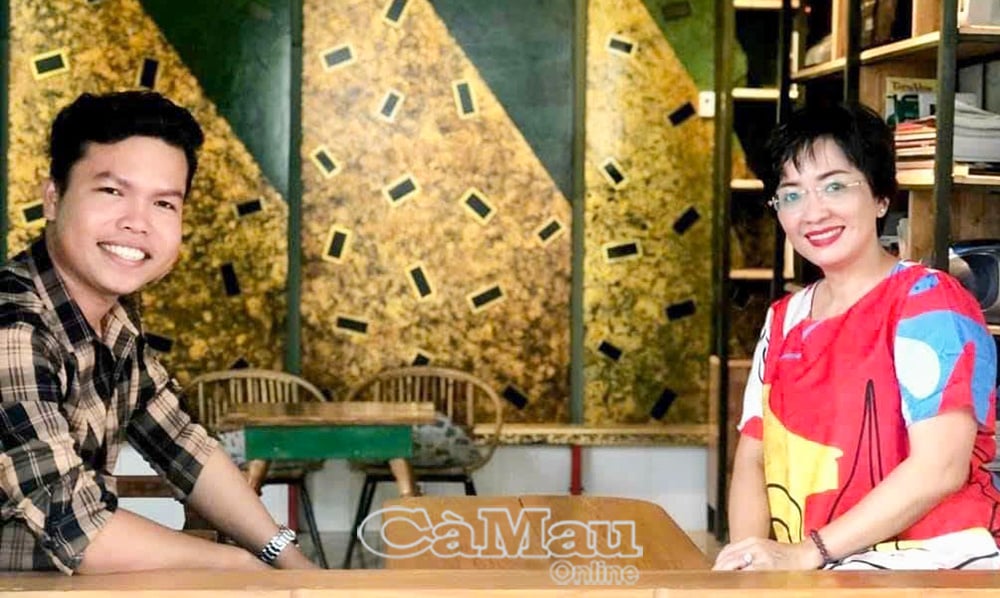
Mr. Tran Hoang Phuc during an interview with MC Xuan Hong.
In the fast-paced world of the digital age, the booming demand for information and entertainment has sometimes led to the commercialization of arts and culture, driven by popular tastes. Therefore, the role of arts and culture journalists is even more crucial. They are not only news providers but also shape aesthetic sensibilities, raise cultural awareness, and contribute to building national identity in the context of integration. An insightful film review, a sharp cultural perspective on youth life, or an article reflecting on deviant behavior in the entertainment industry... all demonstrate the true journalistic value of this field.
Ms. To Nguyet Trang, editor of the Arts and Entertainment Department of Ca Mau Newspaper and Radio and Television Station, said: “Reporters and editors working in the arts and culture field are an indispensable part of the journalism industry. They are the storytellers who tell the story of the beauty and goodness, as well as reflect the less beautiful aspects of people's spiritual lives. While political reporters reflect the nation's movements, arts and culture reporters preserve the soft values – the foundation of national identity. An arts and culture program is also the intellectual work of reporters and editors who collect, synthesize, and filter information, then, from their perspective, form a program script with a clear and engaging theme, creating appeal for viewers watching on radio and television.”
Sharing the same viewpoint, Mr. Tran Hoang Phuc stated: “In the context of globalization and strong cultural exchange, arts and culture journalism also plays a role in preserving and promoting national identity. Journalists in the arts and culture field are the connectors between artists and the public, between heritage and the younger generation, between the past and the present. They are not only chroniclers but also storytellers, inspiring and fostering national pride through each article and feature.”
Similar to reporters and editors in the arts and culture sector, in the context of modern media, presenters of television and radio programs are increasingly appearing on air, taking on the role of hosting diverse programs, from current affairs and entertainment to talk shows and game shows. They are journalists who convey emotions to viewers and listeners through news reports and articles. Even now, in the trend of multimedia journalism, presenters of news programs, reports, documentaries, or thematic discussions on mainstream television channels also take on the role of television editor and presenter. They not only host programs but also directly participate in content creation, script writing, guest interviews, information processing, and sometimes even produce documentaries or short news segments.
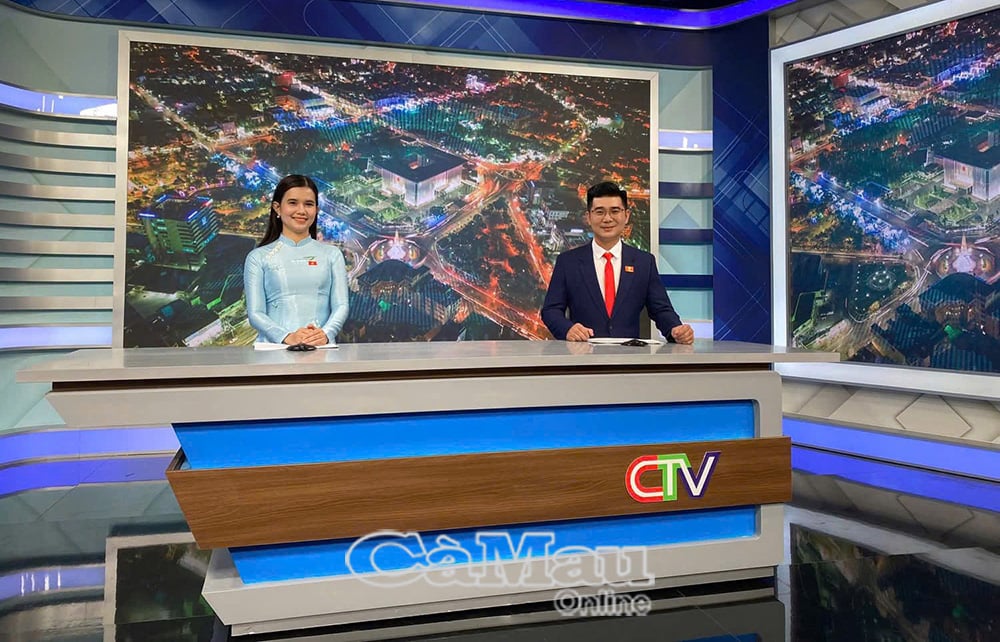
Presenters not only need to learn how to present accurately and engagingly, but also need to pay attention to their appearance.
MC Lieu Tran Bao Duy, from Ca Mau Newspaper and Radio-Television Station, said: “Regardless of the type of television program, the presenter's task is always to create a connection between the different parts of the program. We must guide viewers into each section clearly, easily understandable, and engagingly, keeping them engaged until the end of the news or program.”
According to MC Bao Duy, the skills of an MC become increasingly demanding each day, because news programs have many smaller segments such as news, reports, interviews, and field reporter segments... Therefore, the presenter's role in guiding and connecting the narrative is crucial to maintaining the right pace and building up to a climax at the right moment. To perform this task well, the presenter must make the audience see specific news and articles clearly and coherently within the overall program. "Not to mention, we have to be meticulous about our appearance, from clothing to makeup..., creating a sense of respect for the viewers watching on TV, phones, or laptops...", he shared.
Besides reporting and conveying information in their own unique way, these "special" journalists sometimes transform themselves in diverse ways in contributing information. They embody actors, becoming characters in radio and television dramas... Audiences are familiar with Tran Hoang Phuc's portrayal of characters in the "Uncle Ba Phi" skits on radio and television, or MC Lieu Tran Bao Duy's diverse roles in artistic scripts on radio... All of this contributes to their professional identity, but the core value remains the transmission of information through the realm of arts and culture.
The responsible, serious, and dedicated work ethic of these "exceptional" journalists shows that any labor dedicated to journalism is valuable and worthy of respect!
Lam Khanh
Source: https://baocamau.vn/nhung-nguoi-lam-bao-dac-biet--a39576.html
![[Photo] General Secretary and President To Lam and the President of the Philippines hold talks.](https://vphoto.vietnam.vn/thumb/1200x675/vietnam/resource/IMAGE/2026/06/01/1780286997787_anh-man-hinh-2026-06-01-luc-11-09-43.png)
![[Photo] Reception to welcome General Secretary and President To Lam and his wife on their State visit to the Philippines](https://vphoto.vietnam.vn/thumb/1200x675/vietnam/resource/IMAGE/2026/06/01/1780295488620_vna-potal-chieu-dai-chao-mung-tong-bi-thu-chu-tich-nuoc-to-lam-va-phu-nhan-tham-cap-nha-nuoc-toi-philippines-8798060-7855-jpg.webp)































































Comment (0)