

Our colleagues from the Phu Yen newspaper took us to Mang Lang Church to see the book firsthand. In front of the church, to the right of the courtyard, we were guided into a winding, elaborately designed, mysterious cave nestled within an artificial hill. This is where many artifacts related to the life of Father Andrew Phu Yen, a priest whose missionary work was closely associated with the Phu Yen region, are displayed.
After each hesitant step, in the dimly lit space, a table appeared before us, topped with a glass case. Pointing inside, my friend said, "This is the first book in Vietnamese!" Surprised, curious, and delighted, everyone frantically took pictures of the exhibit with their phones.
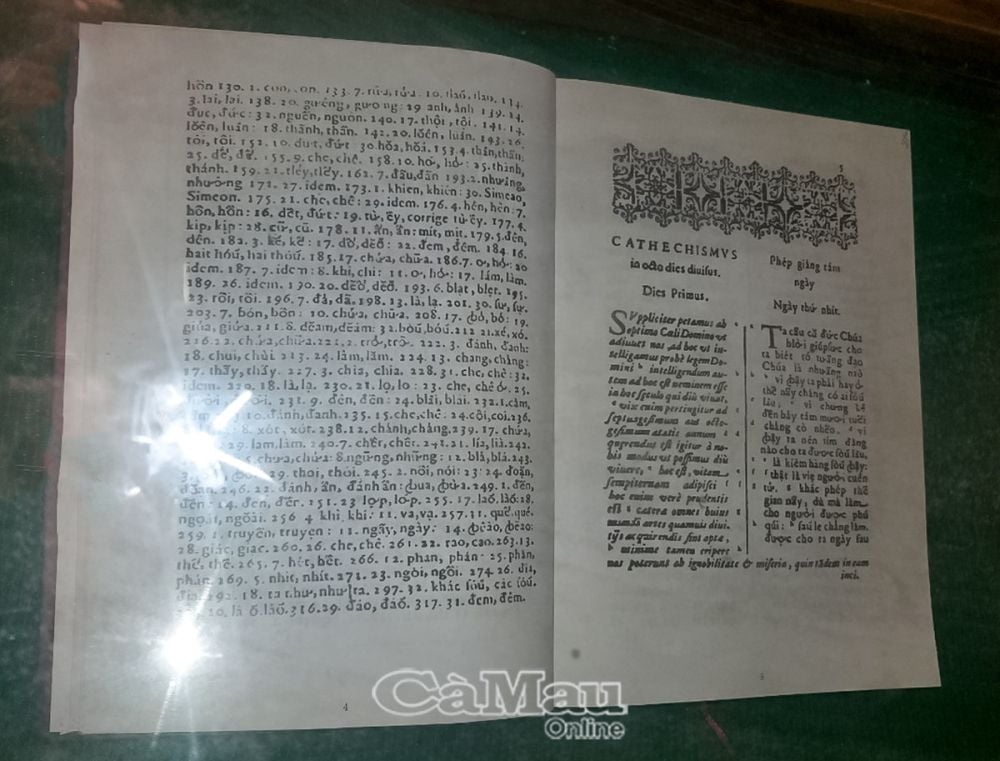
A photocopy of the first Vietnamese-language book is displayed in the basement within the artificial hill at Mang Lang Church.
The book opens to pages 4 and 5. Page 4 contains the proofs, while page 5 has two columns; the left column is written in Latin characters, and the right column is in Vietnamese. At the top is the title "Eight-Day Sermon." Below it reads "Day 2" (meaning "first"). Further down is the content, which includes many words that are correct in modern Vietnamese, many unreadable words, and some words that can be guessed, such as "blời" (meaning sky), "fức" (meaning strength)...
My colleague told me that this is a book containing sermons for priests and missionaries to preach. The author is Alexandre de Rhodes, a Frenchman (whom the parishioners call Father Dắc Lộ). He also mentioned that this is a photocopy; the original is carefully kept by the parish priest in the church. The original has embossed lettering in the margins of the pages. When held up to the sunlight, the lettering becomes visible, similar to the embossing on banknotes. The book was printed in Italy in 1651, meaning it's 372 years old.
Nearly four centuries later, the book has been preserved, and with such modern printing technology, including the use of Vietnamese diacritical marks, it's truly a remarkable achievement. And for our country, this being the first book written in the Vietnamese Quốc ngữ script, it's a real treasure!
Further research reveals that Alexandre de Rhodes was not the creator of the Vietnamese language. Prior to him, several European missionaries had come to Vietnam to spread Christianity. These missionaries came from countries using the Latin alphabet, so they faced difficulties in spreading their faith because at that time, Vietnam used ideographic characters (Chinese characters and Nôm characters). These characters were difficult for them to learn, print, and disseminate. Therefore, to spread their faith effectively, they had no choice but to use the Latin alphabet to represent the sounds of the Vietnamese language.
Alexandre de Rhodes, a later arrival, built upon the Vietnamese language encoding established by earlier missionaries, and he learned and wrote Vietnamese very quickly. Not stopping there, to spread the learning of Vietnamese not only among missionaries but also among the laity, helping them read and understand doctrine, and building upon the existing Latinized Vietnamese, Alexandre de Rhodes compiled two books: a Vietnamese-Portuguese-Latin dictionary and the aforementioned Eight-Day Sermon.
As for why the book is kept at Mang Lang Church, my friend doesn't know. Our speculation is that Mang Lang Church, built in 1892, is the oldest church in Phu Yen; Father Andrew Phu Yen was active in this area and his missionary work was closely associated with Alexandre de Rhodes, so perhaps this is a book he used for preaching and it is kept at this church.

Mang Lang Church (Phu Yen province), built in 1892, houses the first book written in Vietnamese.
It should also be added that, although it originated in the 17th century, due to the Nguyen Dynasty's policy of prohibiting Christianity and considering it a foreign language, the Vietnamese language was not widely disseminated for several hundred years. In the latter half of the 19th century, Mr. Truong Vinh Ky played a major role in spreading the Vietnamese language to the community. He was the first Vietnamese teacher to teach Vietnamese and the principal of the School of Interpreters established by the French (in 1862).
To better serve the popularization of the Vietnamese language, he compiled the first textbook, "Annam Grammar," followed by a series of textbooks, history books, literature books, etc. There were approximately 25 textbooks alone. Following this, the movement to learn Vietnamese, compose poetry and prose, and write articles in Vietnamese flourished; at the same time, Vietnamese was used in administrative documents and officially became the national language of our country.
Thus, although the Vietnamese language was created by foreigners for their own purposes, with its inherent vitality and the additions, adjustments, dissemination, and improvements made by many generations of Vietnamese people, it has become increasingly perfect and is now the "rich and beautiful" language of the Vietnamese nation.
Visit Page
Source: https://baocamau.vn/noi-luu-giu-quyen-sach-tieng-viet-dau-tien-a29306.html

![[Image] Nearly 125,000 Hanoi students completed the Literature exam for the 10th grade entrance exam.](https://vphoto.vietnam.vn/thumb/1200x675/vietnam/resource/IMAGE/2026/05/30/1780117233041_ndo_br_thiet-ke-chua-co-ten-2-png.webp)




















































































Comment (0)