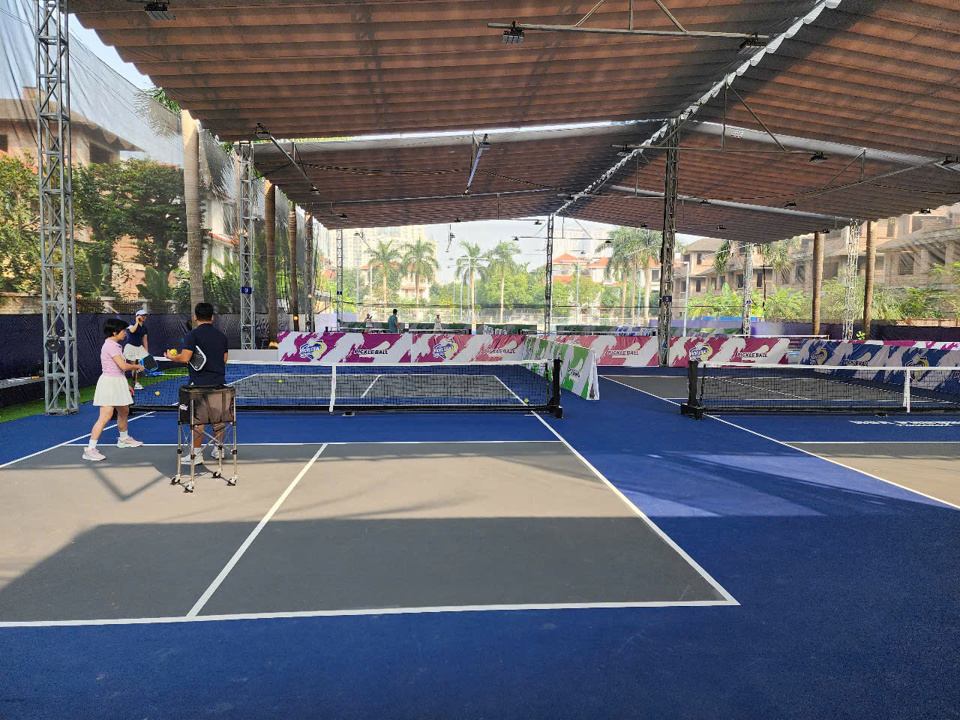
Pickeball courts are springing up like mushrooms after the rain.
"The pickleball phenomenon" or "pickleball craze" are terms that have been widely discussed recently to describe the pickleball training movement – a new sport that has been introduced to Vietnam in the last one to two years.
To meet the ever-increasing demand for this sport, pickleball courts have sprung up "like mushrooms after the rain," and many of them are illegally constructed on agricultural land or project land, causing districts and counties to struggle and face headaches in finding solutions.
In Thanh Tri district, many illegally constructed pickleball courts on agricultural land have been discovered recently. For example, a complex of six courts located on agricultural land at 289 Pham Tu Street, Thanh Liet commune, and a pickleball complex called Family, also situated on agricultural land in Tan Trieu commune. Notably, the pickleball complex in Tan Trieu commune is located only about 200 meters from the commune's People's Committee office.
Besides agricultural land, the illegal construction of pickleball courts on project land is equally common. For example, on plot C/D13, covering more than 7,200m2 in Dich Vong ward, Cau Giay district, this plot was advertised as the site for the Five Star Residence Cau Giay apartment project, with CIRI International Investment and Production Relations Joint Stock Company (CIRI Company), a subsidiary of GFS Group, as the investor. However, a portion of the plot was later discovered to have been transformed into a complex of multiple pickleball courts.
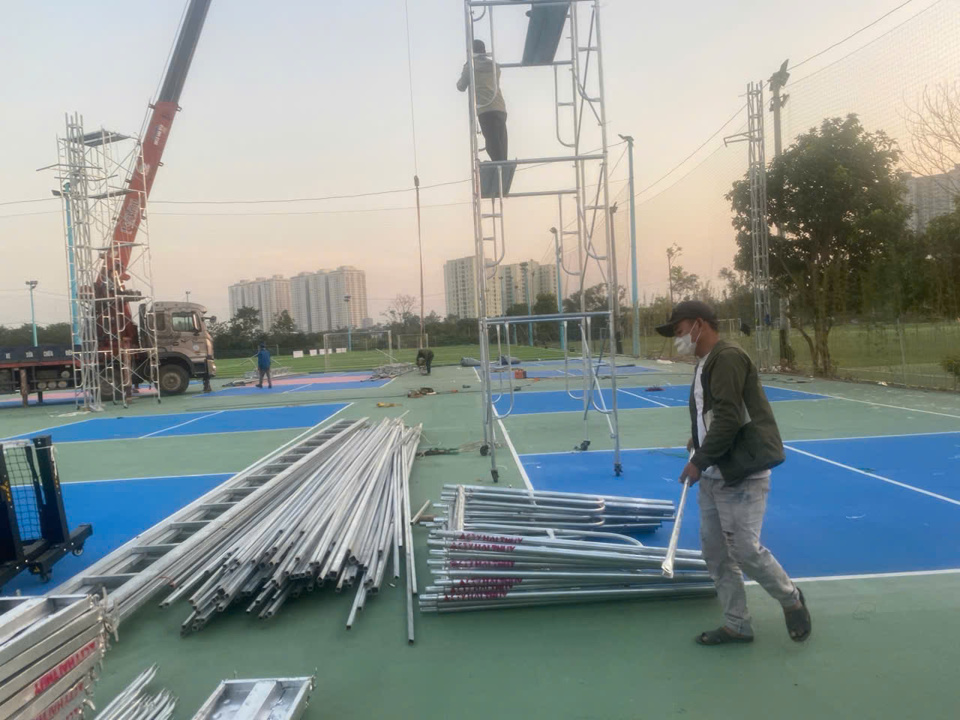
Recently, an illegally constructed pickleball court has appeared on project land in An Khanh commune, Hoai Duc district. According to a reporter from Kinh Te & Do Thi (Economy & Urban Affairs) newspaper, the pickleball court, named "Hoa Phuong," is located within the Hoa Phuong villa complex of the Nam An Khanh urban area. The court is completed, has a roof, and is in use. Right next to it, another pickleball court is under construction. The court's foundation is basically finished, and the steel frame for the roof is being erected.
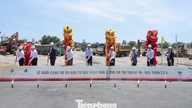


Notably, about 200 meters from the Hoa Phuong pickleball court is another pickleball court called Ha Phuc. This court is also only a few hundred meters from the An Khanh Commune People's Committee headquarters. The court is enclosed, has a roof, is located right next to a complex of workshops and car garages, and has also been put into operation.
Some places are decisive, others are struggling.
In response to the "pickleball craze," many localities have taken decisive action, organizing the dismantling of these illegal structures. A prime example is Thanh Tri district, where on November 11, 2024, at a conference reviewing and addressing violations related to land leveling, waste dumping, land use, and construction order in Tan Trieu and Thanh Liet communes, the Vice Chairman of the District People's Committee, Nguyen Huy Toan, instructed the People's Committees of the two communes to urgently resolve all violations, requiring the restoration of the land to its original state before the violations occurred. This was to be completed by November 2024 for cases of encroachment and misuse of land for pickleball training grounds.
Speaking with reporters from Kinh tế & Đô thị (Economy & Urban Affairs), Chairman of Thanh Liệt Commune People's Committee Trinh Quoc Thang said that, following the directives of Thanh Tri District leaders, Thanh Liệt Commune organized the enforcement of corrective measures against the illegal pickleball court built on agricultural land belonging to Mr. Pham Tu Hai (Dong Thuyen Hamlet). The enforcement work has now been completed.
“This is a cluster of three structures. The People's Committee of Thanh Liet commune has enforced the demolition of all accompanying auxiliary structures,” Mr. Thang said. Regarding the pickleball court belonging to Mr. Tran Trung Hieu in Dong Cua Trai area, the Chairman of the People's Committee of Thanh Liet commune stated that this is a small-scale structure without a roof, and Mr. Hieu had proactively dismantled and rectified it beforehand, so the commune's authorities did not need to organize an enforcement action.
Meanwhile, the handling of illegal pickleball courts in An Khánh commune, Hoài Đức district, is proving quite challenging. Speaking with reporters from Kinh tế & Đô thị (Economy & Urban Affairs), the Vice Chairman of the An Khánh Commune People's Committee, Nguyễn Đăng Lợi, acknowledged that the Hoa Phượng pickleball court was built illegally on public parkland within the Nam An Khánh urban area.
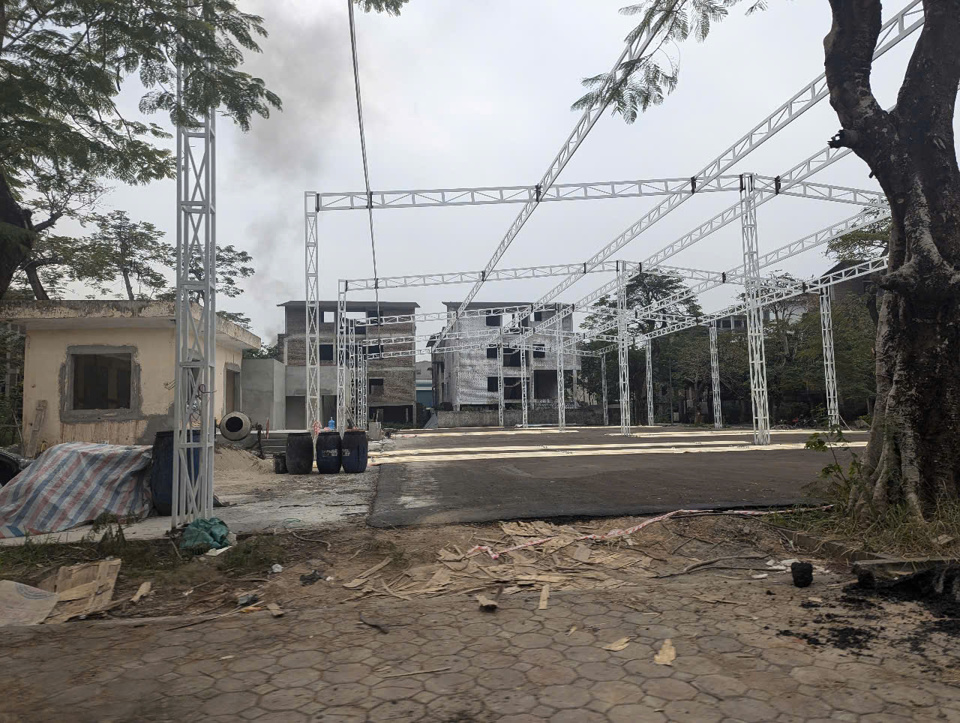
Regarding the Ha Phuc pickleball court, Mr. Loi stated that it was built on land belonging to the An Duong Cooperative. This cooperative operates in various service sectors. Notably, the land currently used by the cooperative, including a portion that has been transformed into a pickleball court, is also leased from the State.



According to the Vice Chairman of the People's Committee of An Khanh commune, the construction of pickleball courts on project land and cooperative land is incorrect, but it stems from the local people's need for sports activities. This is especially true given that pickleball has recently become a popular sport in the community.
When asked about the An Khanh Commune People's Committee's stance on handling the aforementioned pickleball courts, Mr. Nguyen Dang Loi stated that, fundamentally, the locations used for the courts are not agricultural land or public land. "The local authorities will try to arrange and handle the situation appropriately," said the Vice Chairman of the An Khanh Commune People's Committee.
Directive No. 04/CT-UBND of the Hanoi People's Committee on "Strengthening State management of agricultural land and public land in Hanoi" clearly states: The Chairpersons of the People's Committees of wards, communes, and towns must resolutely and promptly handle violations (especially cases of unauthorized land use conversion and illegal construction) within their authority and in accordance with the law from the moment these violations occur; they must compile dossiers for violations exceeding their authority and report them to the district-level People's Committees for handling in accordance with the law. Any locality that allows violations to occur without handling them will hold the Chairperson of the People's Committee of that commune, ward, or town accountable under the law. The Chairperson of the People's Committee of the district or town may decide to temporarily suspend the administrative duties of the Chairperson of the People's Committee of the commune, ward, or town to direct the handling of the violations until they are resolved and rectified.
Source: https://kinhtedothi.vn/chong-bao-pickleball-noi-quyet-liet-cho-hoi-hot.html


![[Photo] Thousands of people participate in a run to show their support for the campaign "Sharing a common determination to build drug-free communes, wards, and special zones".](https://vphoto.vietnam.vn/thumb/1200x675/vietnam/resource/IMAGE/2026/06/27/1782554475933_0673e2a3df7b5e25076a-8283-jpg.webp)































![[Photo] A phone-free summer afternoon at the village library](https://vphoto.vietnam.vn/thumb/1200x675/vietnam/resource/IMAGE/2026/06/27/1782551770949_anh-1-jpg.webp)