

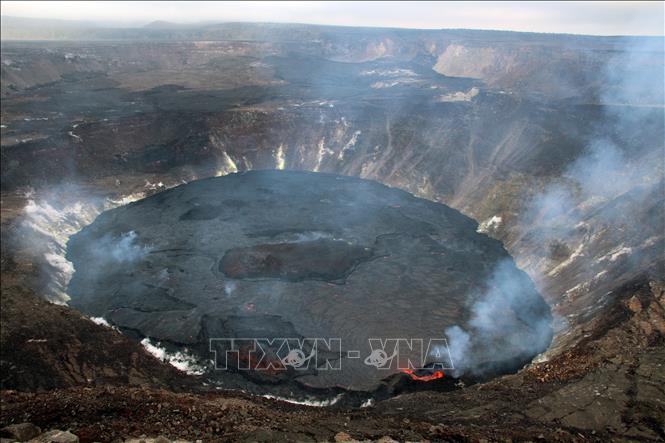
Lava erupts from the Kilauea volcano on the island of Hawaii, USA. (Photo: AFP/VNA)
According to the U.S. Geological Survey (USGS), they began detecting volcanic activity at Kilauea on the morning of June 7. The eruption range is within Hawaii Volcanoes National Park, far from populated centers.
The USGS stated that the level of sulfur dioxide (SO2) released from the Kilauea volcano is a major concern, as it could spread widely in the atmosphere, creating a haze. This type of haze can cause breathing difficulties for humans and animals, and may also affect crops.
Volcanic activity can also cause a phenomenon known as "Pele's hair"—very fine, fiberglass-like structures formed from cooled volcanic lava during an eruption. These fibers can cause skin irritation and eye problems. Pele is the name of the Hawaiian god of volcanoes.
The Kilauea volcano erupted just months after a larger volcano nearby, Mauna Loa, also erupted.
Kilauea is much smaller than Mauna Loa, but far more active and often attracts helicopter visitors to view it from the Big Island of Hawaii. It is one of six active volcanoes in the Hawaiian Islands. The volcano erupted almost continuously between 1983 and 2019.
Source link
![[Video] Sunset at Lap An Lagoon – Where the sun sets over the fishing nets](https://vphoto.vietnam.vn/thumb/1200x675/vietnam/resource/IMAGE/2026/05/31/1780192137701_beach-landscape-sea-water-nature-grass-745871-pxhere-com.jpeg)





![[Video] Sunset at Lap An Lagoon – Where the sun sets over the fishing nets](https://vphoto.vietnam.vn/thumb/800x450/vietnam/resource/IMAGE/2026/05/31/1780192137701_beach-landscape-sea-water-nature-grass-745871-pxhere-com.jpeg)









































































Comment (0)