

- The freshwater filtration system needs to be expanded to schools throughout the province.
- Handover of the tree planting project at Khanh An freshwater lake.
- Naval Region 5 supplies fresh water to residents of Hon Chuoi Island.
The province's freshwater resources for domestic use and production mainly rely on groundwater and rainwater. It is now recognized that groundwater is no longer an inexhaustible resource. Therefore, protecting, rationally exploiting, and sustainably utilizing groundwater aquifers is an urgent issue that Ca Mau province is paying special attention to.
Addressing the shortage of domestic water during the dry season.
At the beginning of 2026, thousands of households in Thanh Tung and Khanh Hung communes were overjoyed as the burden of clean water for daily life was finally resolved. Mr. Dinh Van Thuong, from Thanh Tung hamlet, Thanh Tung commune, emotionally shared that for many years, freshwater during the dry season had always been a heavy burden for the people here, especially those doing business in the market area. Now, clean water not only ensures daily life but also meets the needs of production and business.
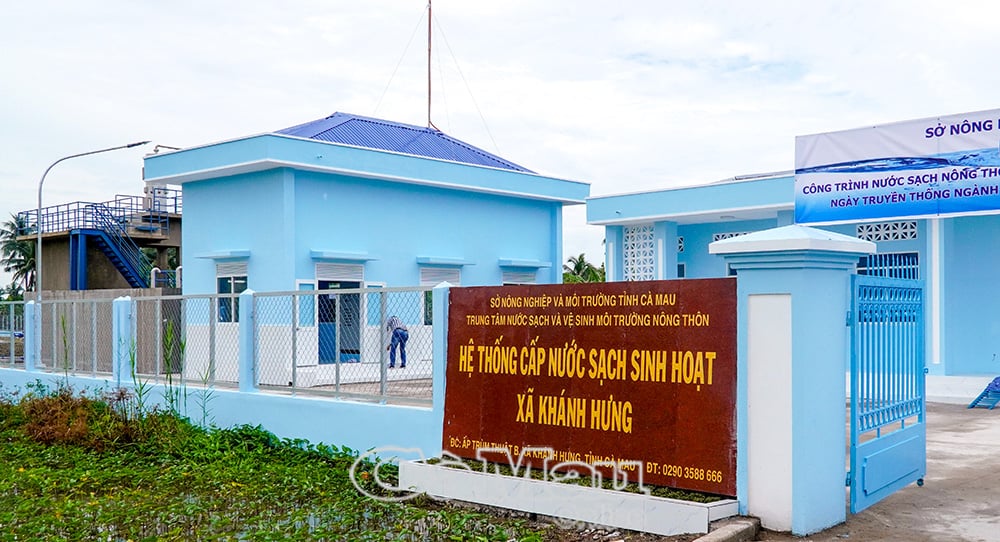 The centralized water supply system in Khanh Hung commune, which has been invested in, has solved the water shortage problem for hundreds of households in the area.
Due to the impact of drought and saltwater intrusion, groundwater in many rural areas is heavily contaminated with alum. Ca Mau frequently experiences shortages of freshwater for daily life and production during the dry season, causing significant difficulties for people's lives and livelihoods.
Over the years, functional departments and localities in the province have implemented many solutions and mobilized various resources to invest in centralized water supply projects, expand the water supply network, and promote and encourage people to use freshwater resources efficiently and economically, gradually resolving the shortage of domestic water during the dry season.
With many solutions implemented synchronously, by now, approximately 98% of the rural population in the province has access to safe water. Mr. Le Cong Nguyen, Deputy Director of the Center for Rural Water Supply and Environmental Sanitation, said that in recent years, the province has focused many resources on investing in water supply projects for people's daily lives. In particular, the rural clean water supply project for the period 2021-2025, with a total investment of approximately 180 billion VND, has proactively addressed the shortage of clean water during drought periods.
 The centralized water supply system in Thanh Tung commune has been invested in, resolving the water shortage problem for hundreds of households in the area.
Despite considerable efforts, approximately 2% of rural and coastal residents in the province still lack access to groundwater, or their groundwater is contaminated with alum or salt, forcing them to rely entirely on rainwater or water purchased from outside sources. Furthermore, while 98% of rural residents have access to safe water, only about 50% use clean water that meets standards.
The long-term challenge for development
Despite achieving many positive results, reaching the goals set for 2030 still requires more investment resources. Mr. Le Cong Nguyen added that, in the short term, the Center will effectively manage and operate the existing centralized water supply system. Simultaneously, it will mobilize resources to upgrade and repair water supply facilities; expand the pipeline network; build centralized water supply points; and provide water storage containers to dispersed residential areas to manage, exploit, and use water resources in the most economical and efficient way. The goal is to increase the percentage of rural households using hygienic water to 98.4% and the percentage of households using safe, clean water according to national standards to 53% by 2026.
In the context of increasing droughts and saltwater intrusion, ensuring access to clean water is not only an immediate necessity but also a long-term challenge for the province's development. Investing in centralized water supply systems is a solution to ensure the protection of groundwater resources while also harmonizing the legitimate rights and interests of relevant organizations and individuals.
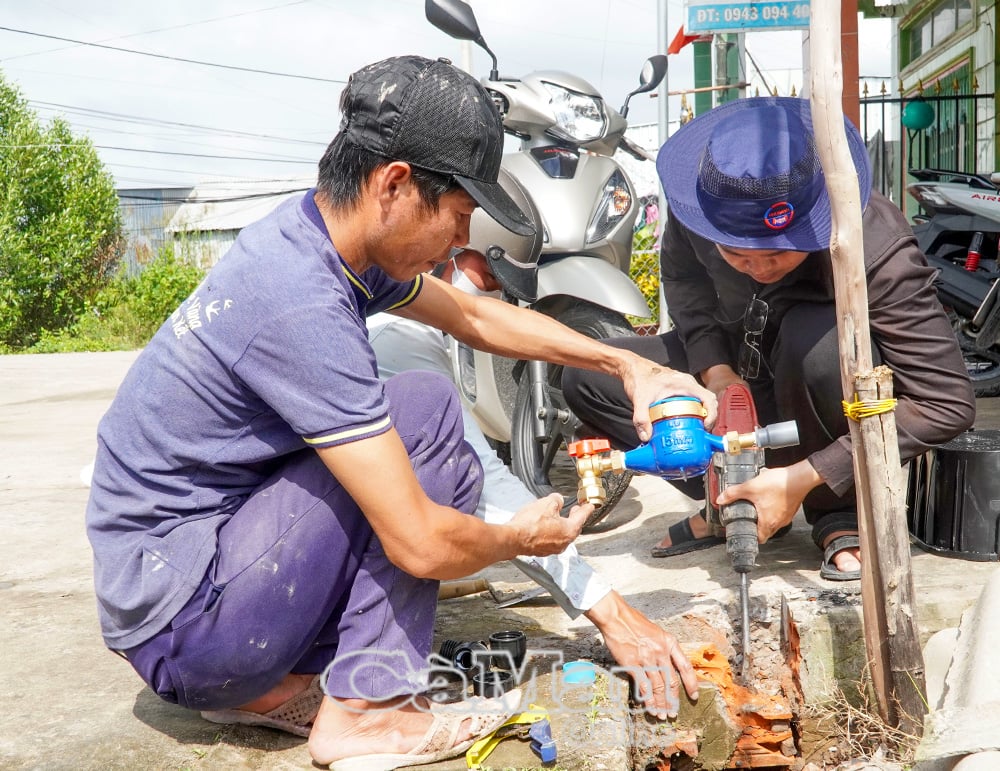 The centralized water supply system in Thanh Tung commune has been invested in, resolving the water shortage problem for hundreds of households in the area.
According to Associate Professor, Dr. Doan Quang Tri, Director of the Multidisciplinary Monitoring Center, Institute of Earth Sciences, Vietnam Academy of Science and Technology, Ca Mau needs to strengthen integrated water resource management and consider water as a development resource. Water resources should be identified as the main structural basis for the distribution of urban population, agriculture , fisheries, and industry. A clearer strategy and policy are needed regarding adaptation to saline and freshwater conditions and ensuring long-term security. Water security should be ensured by diversifying supply sources, increasing rainwater retention, and implementing centralized water supply.
Nguyen Phu
Source: https://baocamau.vn/nuoc-tai-nguyen-cua-su-phat-trien-a129185.html

![[Photo] The courage of new recruits of Brigade 144 on the training ground.](https://vphoto.vietnam.vn/thumb/1200x675/vietnam/resource/IMAGE/2026/05/27/1779881651341_anh-man-hinh-2026-05-27-luc-18-32-52.png)
![[Photo] The heat at the fireworks display site on the opening night of the Da Nang International Fireworks Festival 2026](https://vphoto.vietnam.vn/thumb/1200x675/vietnam/resource/IMAGE/2026/05/27/1779889741485_ndo_br_z7872039145157-fecaba5112f39e8352544099d7ef4738-5140-jpg.webp)





























































Comment (0)