

 |
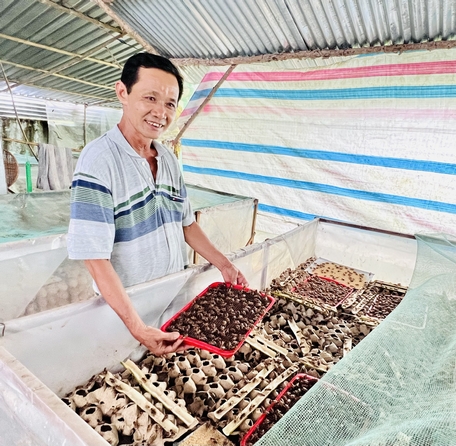
| Mr. Nguyen Van Hung owns a cricket farm with over 40 breeding cages. According to him, raising crickets requires specific techniques to achieve high economic efficiency. |
Taking advantage of the small land area in the city, Mr. Nguyen Van Hung (in Tan Quoi Hung hamlet, Truong An ward, Vinh Long city) raises crickets to increase his income. The model has proven highly effective, so he is renting more land to expand his farm. Currently, the cricket farm generates an income of over 1 million VND per day.
Leading us to his cricket farm with 40 fairly large-scale breeding cages, Mr. Hung happily shared that initially he only raised crickets in 10 cages at home. The success, "plus the experience shared by acquaintances and the introduction of markets," encouraged him to expand. He rented an additional 700 square meters of land next to his house, increasing the number of cages to 40 and planting cassava to feed the crickets.
Introducing the cricket breeding cages of various ages, including two breeding cages, Mr. Hung said: “After one day and one night, each cage produces about 6 nests (about 3 new cages), and after 10 days, baby crickets hatch. As soon as they hatch, they start eating.” Raising crickets from hatching to harvest takes about 30 days, and each kilogram of meat crickets requires about 2 kilograms of feed (the type of feed given to quail), currently priced at 330,000 VND per bag.
During the rearing process, if you feed them plenty of vegetables and leaves, the amount of feed will decrease. Therefore, you can utilize vegetables and leaves from your own garden because "crickets can eat cassava leaves, spinach, sweet potato leaves, water hyacinth, sugarcane... and even banana trees," Mr. Hung explained.
According to Mr. Hung, the best time for raising crickets for high productivity is between January and May (lunar calendar) and July and October (lunar calendar) each year, because crickets prefer weather that is neither too hot nor too cold. In favorable weather, each breeding enclosure yields about 15kg; in unfavorable weather – where crickets are lost – the yield is 7-8kg...
Currently, he sells 15-20kg of live crickets daily, supplying them to customers in Vinh Long City and shipping them to Can Tho, Dong Thap, Ca Mau , etc., at a price of 90,000-100,000 VND/kg. In addition, he collaborates with dozens of other cricket farms to meet customer demand. Besides live crickets, Mr. Hung also sells pre-selected, cleaned, and frozen crickets at a wholesale price of 120,000 VND/kg, which he claims can be thawed and then battered and deep-fried or fried in fish sauce...
Spending all day in the cricket cages feeding and watering them to keep the soil moist, Mr. Hung believes that "crickets are easy to raise and care for. The only cost is buying food; for vegetables, you can find them in the garden or in vacant lots, or collect water hyacinths from the river..."
However, it requires understanding the characteristics and breeding techniques to raise wingless crickets, which fetch a high price; if they have wings, they can only be sold as chicken or bird feed, resulting in lower prices and less efficiency.” “After deducting expenses, the profit is about over 1 million VND per day,” Mr. Hung calculated. He also believes that if the temperature of the breeding enclosure can be controlled, productivity will be high year-round, therefore, he is planning to invest in upgrading to a more modern breeding enclosure.
Ms. Dinh Thi Hong, Chairwoman of the People's Committee of Truong An Ward, said that the cricket farming model has yielded quite high economic efficiency. Besides this model, the ward also has other highly effective urban agricultural models such as: growing cantaloupe, orchids, ornamental flowers, oyster mushrooms… “We plan to expand these models in the near future to further increase people's income,” Ms. Dinh Thi Hong said.
Ms. Nguy Mong Cam, Head of the Economic Department of Vinh Long City, stated that in recent years, the city's agriculture has developed in the direction of increasing productivity, quality, and economic efficiency on cultivated land. The agricultural sector's structure has shifted positively towards urban agriculture, applying science to production. Agricultural extension work has had a positive effect in transferring and applying scientific and technical advancements to production. In particular, the application of high technology in agricultural production has been and continues to be the right direction, helping farmers minimize risks from adverse weather and diseases. At the same time, it contributes to improving productivity and product quality compared to traditional production. |
Text and photos: NAM ANH - NGUYEN XUAN
Source


![[Photo] General Secretary To Lam visits the exhibition space showcasing books, photo exhibitions, and achievements of digital transformation in journalism.](/_next/image?url=https%3A%2F%2Fvphoto.vietnam.vn%2Fthumb%2F1200x675%2Fvietnam%2Fresource%2FIMAGE%2F2025%2F12%2F19%2F1766110879215_1766110240024-jpg.webp&w=3840&q=75)
![[Photo] Enchanting ancient rose garden on the mountainside in Nghe An](/_next/image?url=https%3A%2F%2Fvphoto.vietnam.vn%2Fthumb%2F1200x675%2Fvietnam%2Fresource%2FIMAGE%2F2025%2F12%2F19%2F1766109900916_vuon-hong-chin-do-thu-hut-du-khach-toi-check-in-o-ha-noi-3-20162778-1671624890024-1671624890104198100259.jpeg&w=3840&q=75)



























































Comment (0)