

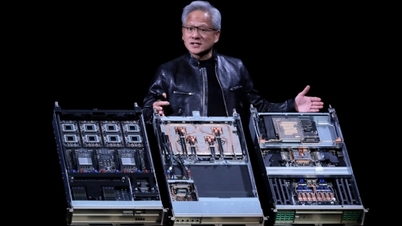
At the GTC Taipei event, Nvidia introduced the Isaac GR00T Reference Humanoid Robot – a humanoid robot platform developed in collaboration with China's Unitree and Singapore's Sharpa. The system is designed as a standard toolkit for universities, research institutes, and businesses developing next-generation robots.
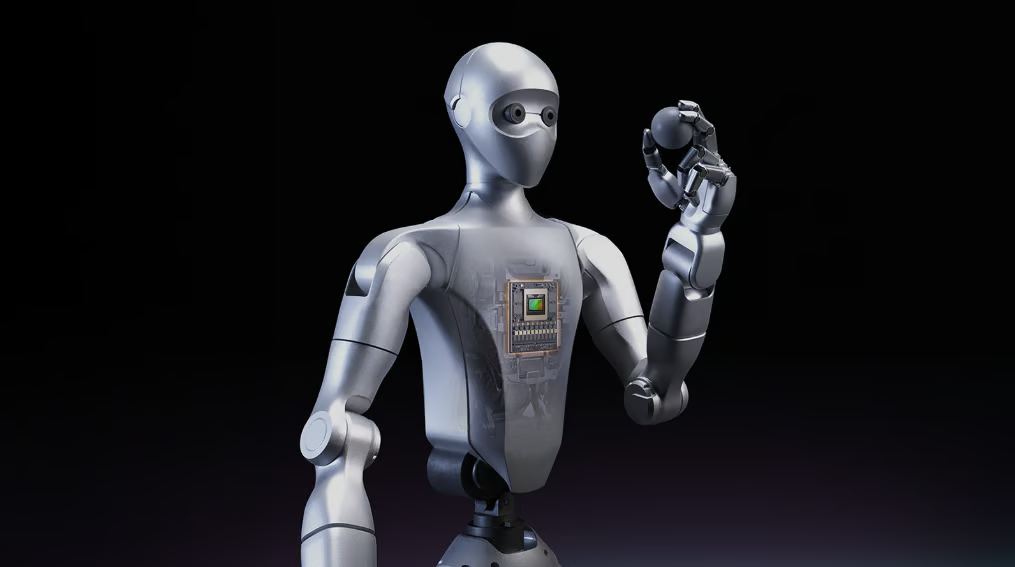
Beyond simply providing AI processors, Nvidia is progressively expanding into software, development processes, and reference hardware to create a common platform for the humanoid robotics industry. According to CEO Jensen Huang, humanoid robots will be a key driver in bringing physical AI into large-scale industries in the future.
The new platform combines Unitree's H2 Plus robot, Sharpa's Wave tactile hand, and Nvidia's Jetson AGX Thor T5000 processor. The robot is approximately 1.8 meters tall, weighs 68 kg, and possesses 31 degrees of freedom in its body and 22 degrees of freedom in each hand, allowing it to perform complex maneuvers.
The system is equipped with a stereo camera on the head, a camera on the wrist, and inertial sensors to track movement. Nvidia says the Jetson AGX Thor T5000 processor, based on the Blackwell architecture, has AI performance of 2,070 FP4 teraflops, meeting the needs for real-time robot processing and control.
One of Isaac GR00T's goals is to simplify the humanoid robot development process. The toolkit includes Isaac Teleop for collecting demonstration data, Isaac Sim and Isaac Lab for simulation and training, and Isaac ROS for deployment to real-world robots.
According to Nvidia, data remains the biggest challenge in robot development. Therefore, the company allows research organizations to manage their own training data, operational data, and system logs to ensure control and security.
Some of the organizations planning to adopt this platform include the Allen Institute for AI (Ai2), ETH Zurich, the Stanford Center for Robotics, and the University of California San Diego. Sharpa representatives believe that the collaboration with Nvidia will help accelerate the process of bringing humanoid robots from the laboratory to the real-world work environment.
In addition to Unitree, Nvidia says it plans to collaborate with robot manufacturers in the US, Europe, and South Korea. The company is also integrating security mechanisms such as source code authentication, secure boot, and secure computing to prevent robots from running malware or leaking data.
According to plan, Unitree will launch Nvidia's reference humanoid robot platform by the end of 2026. Meanwhile, the development process for the Unitree G1 robot will soon be released on GitHub and Hugging Face for wider access by the research community.
(According to eWeek)
Source: https://vietnamnet.vn/nvidia-bat-tay-cong-ty-trung-quoc-phat-trien-sieu-robot-hinh-nguoi-2521806.html

![[Photo] First session of the 14th Congress of the Vietnam Trade Union](https://vphoto.vietnam.vn/thumb/1200x675/vietnam/resource/IMAGE/2026/06/03/1780465947883_ndo_br_img-3852-jpg.webp)
















































![[Video] Sunset at Lap An Lagoon – Where the sun sets over the fishing nets](https://vphoto.vietnam.vn/thumb/1200x675/vietnam/resource/IMAGE/2026/05/31/1780192137701_beach-landscape-sea-water-nature-grass-745871-pxhere-com.jpeg)








































Comment (0)