

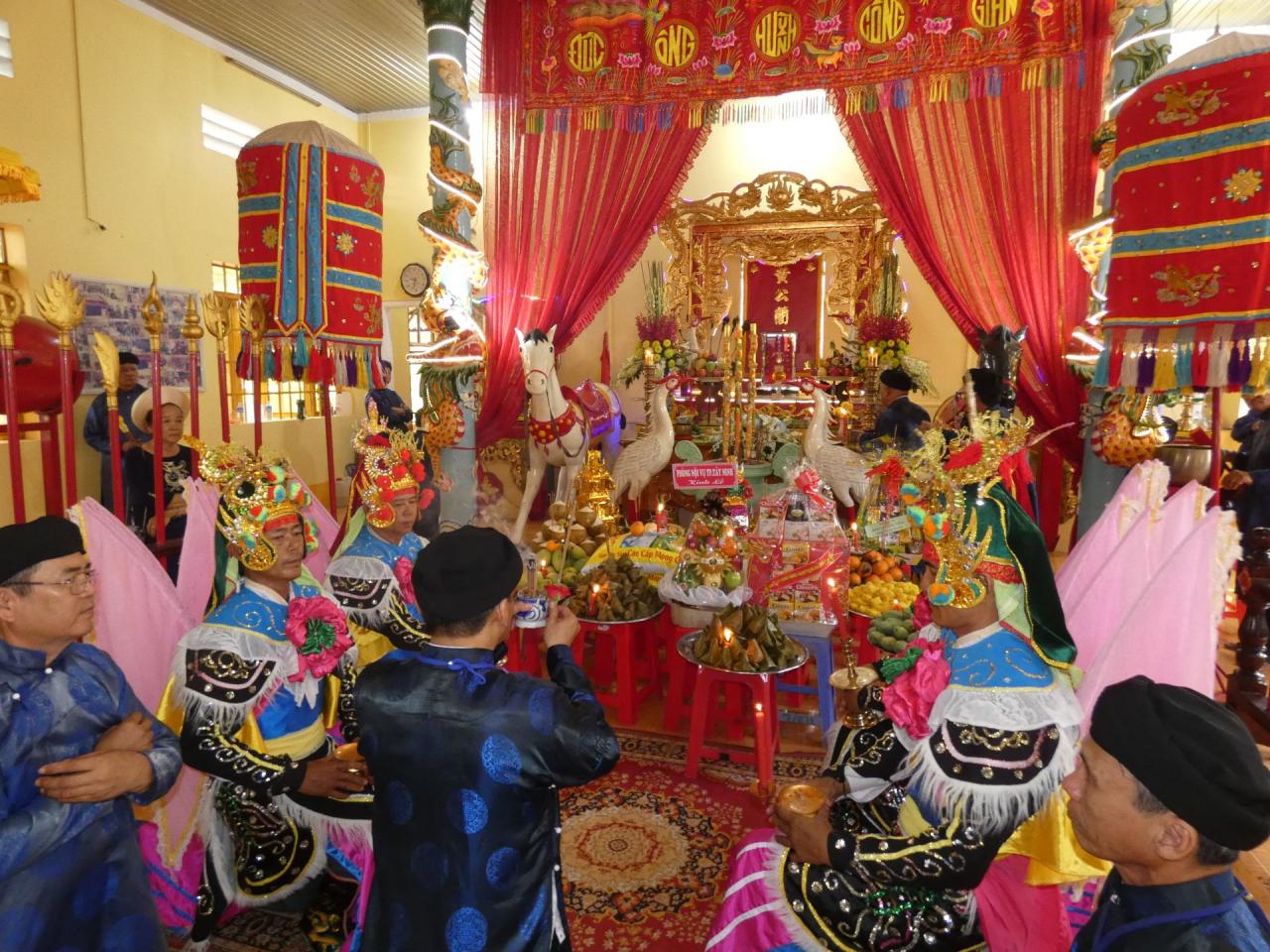
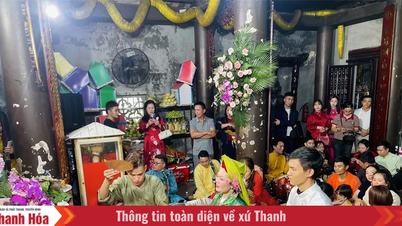
Offering prayers at the shrine of Quan Lon Tra Vong Huynh Cong Gian, Ward 1, Tay Ninh City.
On the map of Tay Ninh, the Tra Vong stream can still be seen originating from the present-day Mo Cong commune, flowing through Hamlet 3, Tra Vong – where the tomb and temple of Quan Lon Tra Vong are located. The stream then flows to Tra Hiep hamlet, bordering Thanh Tan commune (Tay Ninh City), where it merges with the Ta Hop stream, which originates from the Ky stream, to become the Tay Ninh canal, gently winding through the city.
But this is only a picture of the central area of the base. Because according to the description in the book "Tay Ninh: 30 Years of Loyalty, Courage, and Resilience," the scale of the base was truly "vast." It was described as follows: "The boundaries of the Tra Vong area: in front is the South, about 18 km as the crow flies from the center of Tay Ninh town, with small forests interspersed with open fields, sparse oil palm forests to dense pine forests bordering Cambodia."
"To the right, there are interspersed grasslands, with National Highway 22 running through it, about 8 km as the crow flies from Tra Vong. To the left, also interspersed grasslands, there is the Kedon dirt road to Ka Tum (now Provincial Road 785), about 12 km from the Tra Vong forest..."
The book also describes the functional areas within the base, such as the military zone (office of the 11th Detachment), the provincial government offices, and the residential area. And, if we consider the dependent areas that also served as defenses for the base, the scale of the base was enormous, even extending across National Highway 22B and Provincial Road 785.
That's the area from Suoi Tra Vong hamlet, extending through Truong hamlet of Duoc Hoa Binh (now Hao Duoc) to the right of the center. The old and new Tra Vong hamlets are situated right in front. Behind are the hamlets of Dau Lon Trong, Ky hamlet, and up to Bau Van Lich, now belonging to Thanh Dong commune, Tan Chau district. To the left are the hamlets of Khedol Thuong, Khedol Duoi… connecting to Ba Hao hamlet, now belonging to Tan Thanh commune, Tan Chau district.
Thus, the base area encompassed a vast region, now part of the districts of Tan Bien, Tan Chau, Chau Thanh, and even Tay Ninh city. Except for Tan Chau, the remaining districts and cities all have numerous temples and shrines dedicated to Quan Lon Tra Vong. Most notably, since 1997, thanks to the discovery by the people and the attention of the Department of Culture and Information, the tomb of Mr. Huynh Cong Gian has been constructed in Hamlet 3, Tra Vong commune.
The shrine dedicated to Huynh Cong Gian (the high-ranking official of Tra Vong) on Phan Chau Trinh Street, Thai Vinh Dong hamlet of the former Thai Hiep Thanh commune (now Tay Ninh City), has a pair of couplets written in Chinese characters:
- Nhật Tảo produced a talented man who sacrificed himself for his country, leaving behind a lasting legacy known as the Bamboo Grove.
- The setting sun eradicates barbarian bandits, the army suffers fatal blows, and a majestic sense of righteousness permeates the mountains and rivers.
The pair of willow trees were donated by the late physician Nguyen Ngoc Diep. And a poet from Tay Ninh, Mr. Hy Dam, translated them into Vietnamese as:
- Nhat Tao displayed divine power, heavy with water but light with flesh, its glorious name recorded in history books.
- Tra Vong repelled the invaders, his loyalty and integrity were unwavering, his righteous spirit soaring throughout the land.
(Old Tay Ninh, 1972).
Comparing the original Chinese text with the translation, readers may find some inaccuracies. However, both authors were contemporaries, born around the beginning of the 20th century, so the translation likely captures the authors' original intentions. Furthermore, they lived in an urban area controlled by Saigon, so their writing had to be careful and subtle to avoid arousing suspicion from the authorities.
The couplet above is likely related to the biography of the great mandarin of Tra Vong, also kept in the temple. According to it, Huynh Cong Gian was born in the year of the Water Tiger (1722) and died in the year of the Water Tiger (1782) at the Tra Vong fortress. His hometown was Nhat Tao village, Tan An province (now Long An ). At the age of 27, he, along with his younger brother (Huynh Cong Nghe) and some militiamen, went to the mountainous region of Tay Ninh to settle and establish a village.
In this new land, they established three hamlets: Tan Hoi, Tan Hiep, and Tan Lap. When the imperial court established the new administrative system (Tay Ninh Prefecture - 1836), this Tra Vong area belonged to Thai Binh commune, Hoa Ninh district of Tan Ninh county.
If the aforementioned biography is accurate, then Huynh Cong Gian was 27 years old in 1749. This means that approximately 200 years had passed since the Tay Ninh revolutionary forces established their base in Tra Vong (1749-1948). During those two hundred years, countless stories of the people of Tay Ninh fighting against foreign invaders have been recorded.
From the very distant past, when "Tra Vong resisted the French invaders," to the Treaty of Nham Tuat (1862) which ceded three eastern provinces to the French, there was Kham Tan Tuong who disobeyed orders, leading his troops into the forest to establish the An Co prefecture to resist the French. Then, just four years later (1866), the Truong Quyen - Pu Kom Po troops inflicted a crushing defeat on the French army right in Tra Vong.
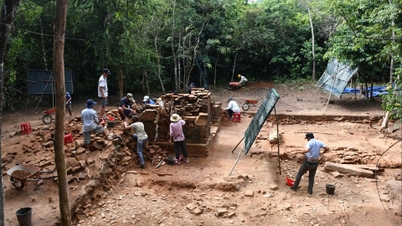
At the seminar on October 17, 2023, many veteran revolutionaries and historical witnesses raised valuable points. Many ancient landmarks of the heroic Tra Vong forest were mentioned, such as May Rac clearing, Ca Ngua pond, and Sen Rung pond… After the delegates conducted a field survey, the conference unanimously agreed to choose May Rac clearing as the site.
This location currently has land managed by the Tay Ninh City Military Command. Based on this result, the District Party Committee will soon submit a proposal to the relevant authorities to recognize the historical and cultural relic "Location of the Provincial Party Committee's base in Tra Vong forest (1948-1950)". This site is currently located in Thanh Xuan hamlet, Mo Cong commune.
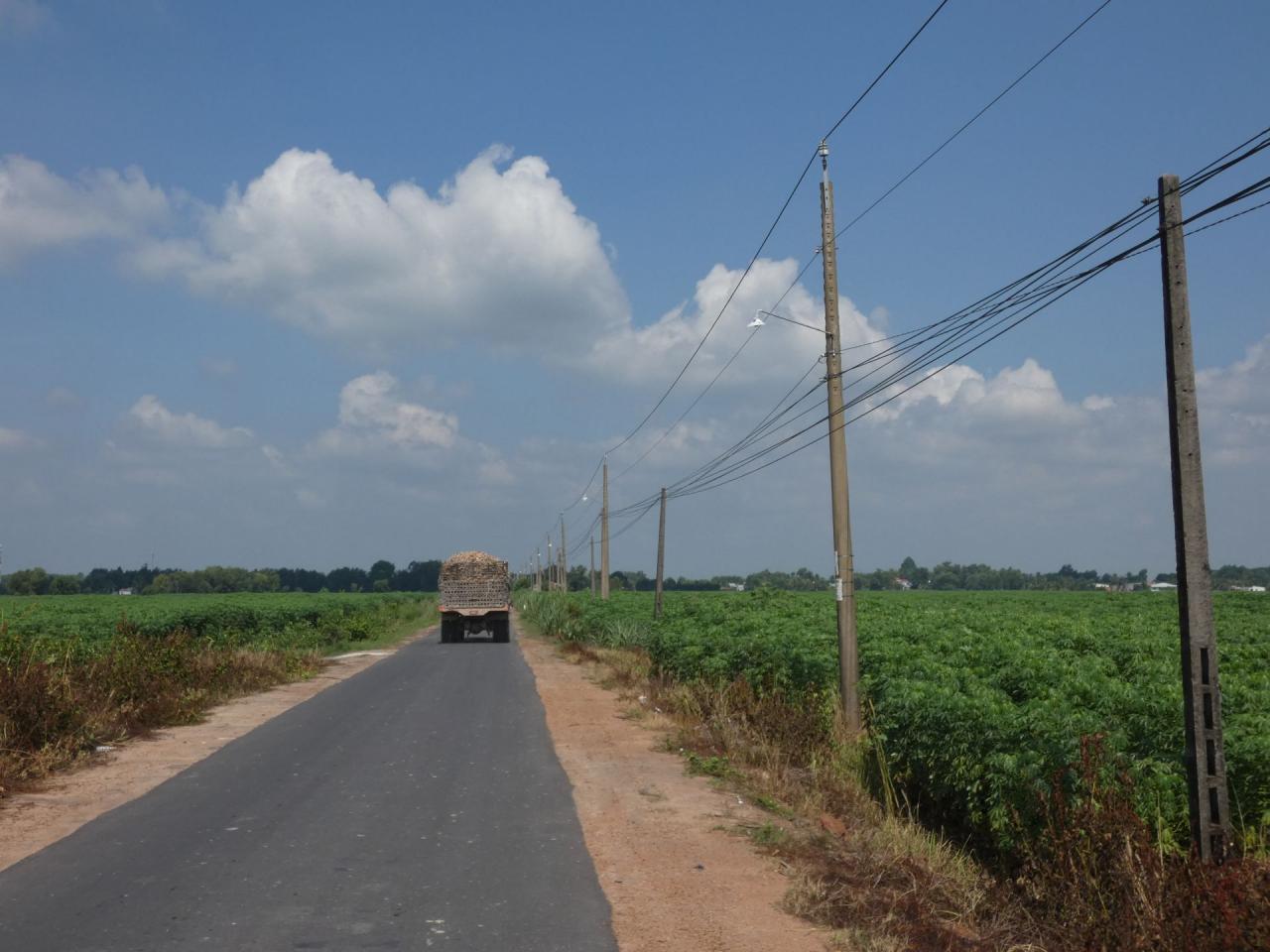
The road through Hamlet 3, Tra Vong.
Let's revisit the research papers from the conference "Revolutionary Base Areas in Tay Ninh during the Liberation War (1945-1975)" (People's Army Publishing House, 2002). Among them is a paper by Mr. Nguyen Thanh Long, former Standing Deputy Secretary of the Provincial Party Committee. The paper is titled: "The Tay Ninh Provincial Party Committee's leadership in building and defending the Tra Vong base area during the resistance against French colonialism." Here, the author clearly refers to it as the Tra Vong base area (not just the Provincial Party Committee base).
It is worth remembering that in 1999, the Department of Culture proposed and received recognition from the Ministry of Culture, Sports and Tourism for the "Tay Ninh Provincial Party Committee Base at Boi Loi" as a national historical site. It wasn't until 2020, when the Trang Bang Town Party Committee published the book "The Legendary Boi Loi Base," that the significance of the "Boi Loi Secret Zone" or "Legendary Boi Loi Base" became apparent.
This incident suggests that the person compiling the site's documentation may have fallen into the trap of "seeing the trees but not the forest." Therefore, the Bời Lời Base Area was not included in the list of historical and cultural relics in Tây Ninh. If so, in the future, naming the site "Provincial Party Committee Base in Trà Vong Forest" might overlook a more important site: the Trà Vong Base Area.
This is precisely what was correctly directed in a document sent by the Tan Bien District Party Committee to the District People's Committee and the District Party Committee's Propaganda Department (dated November 4, 2022). That is: "Determine the location and site of the Tra Vong Base to provide a basis for preparing a dossier to propose its classification as a historical relic and to establish the Tra Vong Base Historical Site."
Tran Vu
Source









![[Photo] Prime Minister Pham Minh Chinh receives the Chinese Ambassador to Vietnam](https://vphoto.vietnam.vn/thumb/1200x675/vietnam/resource/IMAGE/2026/04/05/1775397481797_ndo_br_dsc-5512-jpg.webp)








































![[Infographic] Key indicators for the period 2026-2030 to achieve "double-digit" growth targets](https://vphoto.vietnam.vn/thumb/402x226/vietnam/resource/IMAGE/2026/04/06/1775450004801_fb4e219c8aa77c339a75ff13c44b2e595f8db215db15da7b4648b200deade68240d89ec5e4bd2e86c42f5ed9eeb-_ndo_br_chi-tieu-2-con-so-thumb-1.jpeg)














Comment (0)