

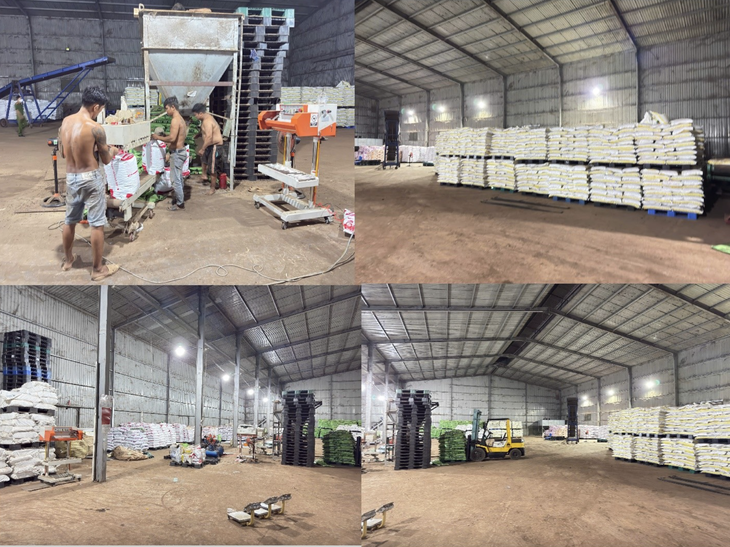
Factory and evidence of counterfeit fertilizer production discovered by Dong Nai Police - Photo: Provided by the Police
From production to distribution and consumption, every stage is meticulously and tightly organized, like a professional underground system.
The dark side of the underground fertilizer market.
In June 2025 alone, authorities nationwide dismantled numerous cases of counterfeit fertilizer production and distribution. From North to South, organized groups operating on a large scale and employing sophisticated methods were exposed.
On June 1st, the Phu Tho Provincial Police (formerly part of Hoa Binh Province) dismantled a large-scale counterfeit fertilizer production facility in Lac Thuy District. The raid uncovered a warehouse containing nearly 250 tons of fake fertilizer, over 300 tons of unlabeled goods without invoices or documentation, and 100 tons of raw materials of unknown origin.
Just over half a month later, on June 17th in An Giang (formerly part of Kien Giang province), Market Management Team No. 3 continued to discover serious violations at a fertilizer business. Upon inspection, two out of three product samples failed to meet quality standards. The infringing shipment, consisting of 200 bags of NPK and NP fertilizers worth 140 million VND, was suspended from circulation.
Notably, these incidents are not limited to small-scale operations. On May 29th, the Dong Nai Provincial Police caught An Phuc Khang Import-Export Trading and Service Company Limited red-handed while repackaging counterfeit fertilizer. The shipment was "disguised" under the label "organic fertilizer of Belgian origin" to deceive consumers. Authorities seized 292 tons of goods and 260,000 counterfeit packaging bags.
According to the Plant Protection Department (Ministry of Agriculture and Rural Development), the widespread use of counterfeit fertilizers is partly due to the repercussions of the COVID-19 pandemic and the Russia-Ukraine conflict, which disrupted global supply chains. Since the end of 2021, fertilizer prices have doubled, putting many farmers in a difficult situation, forcing them to seek cheaper fertilizers and creating opportunities for unscrupulous traders to operate freely.
A study by the Vietnam Fertilizer Association also indicated that: "Every year, farmers nationwide lose approximately 2.5 billion USD - equivalent to 57,000 billion VND - due to using counterfeit or substandard fertilizers." The consequences are not only economic, but also include soil degradation, reduced agricultural productivity and quality, and direct impacts on the environment and national brand reputation.
A leader of a major fertilizer company in Ho Chi Minh City once recounted a heartbreaking scene: "I once witnessed farmers in remote areas sitting on the ground in their fields, their tears mixing with the mud because they had lost their entire crop due to using counterfeit fertilizer. If management is not transparent and decisive, those tears will continue to fall on these once fertile fields."
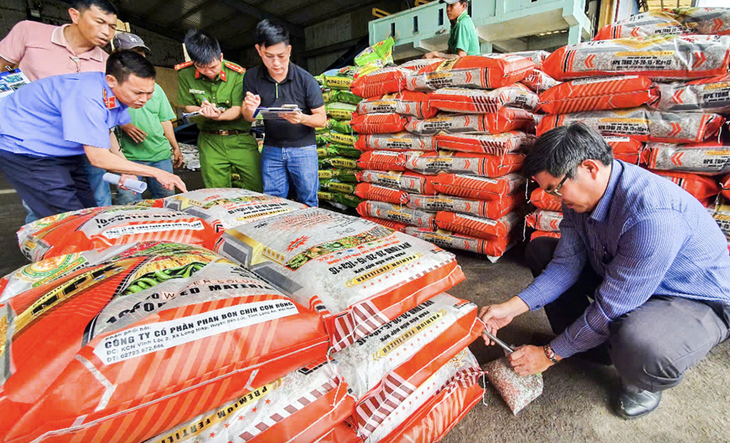
Authorities took fertilizer samples for testing and confirmed that all products manufactured by Chanh and My were counterfeit fertilizers - Photo: Sy Duc
Eradicating counterfeit fertilizers using technology.
While authorities are working hard to crack down on counterfeit fertilizers, from a market perspective, many large businesses have proactively erected their own "defense mechanisms." Many businesses have stated that the problem of counterfeit fertilizers not only directly harms farmers but also seriously affects the reputation and revenue of legitimate producers and businesses.
One of the first "shields" that businesses erect is a product authentication system using electronic labels. Instead of easily counterfeited paper labels, many manufacturers have invested in SMS and QR code labels.
With SMS labels, users simply scratch off the coating to reveal the code, then text it to the verification hotline. With QR codes, the process is even simpler: scan the code with a smartphone, and all information about the origin, ingredients, and production process will be clearly displayed. Each code is unique, and the system will automatically alert if a duplicate scan is detected.
Going beyond simply verifying individual products, many businesses are going further by building comprehensive traceability systems, combining QR codes and RFID (radio frequency identification) technology. With this solution, the entire journey of each bag of fertilizer, from raw materials, production process, packaging to distribution, is digitized, stored, and easily accessed as a complete and transparent "electronic record."
Besides traceability technology, product packaging is also a crucial "layer" that many businesses invest in to enhance their anti-counterfeiting capabilities. Beyond simply changing the design, new packaging is printed using modern technology, utilizes distinctive materials, and incorporates numerous unique identifying features.
For example, Duc Thanh Company has changed the packaging for its Vua Vao Gao foliar fertilizer product to enhance brand recognition and prevent counterfeiting. Similarly, GoldTech International Organic Fertilizer Company Limited has also implemented new packaging for its GOLDTECH G05 product line, making it easier for consumers to identify genuine products.
In the fight against counterfeit fertilizers, technology is no longer merely a supporting tool, but has become an extension that helps businesses control quality, protect their brands, and maintain consumer trust. Pioneering businesses are not only proactively protecting themselves but also contributing to creating a new standard for the entire industry.
Source: https://tuoitre.vn/phan-bon-gia-bam-re-nganh-nong-nghiep-2025072115363971.htm




























































Comment (0)