

The origins of fireworks are believed to date back to China or India, approximately 1,000 years ago, along with the discovery of gunpowder.
Initially, fireworks were simply designed to create loud explosions to ward off evil spirits, much like modern-day firecrackers. After the explorer Marco Polo brought gunpowder back to Europe, Italian artisans developed the "aerial shell" technique, allowing the firework to fly into the air and explode, while also adding metals to create gold and silver sparks and metal salts to produce a variety of colors.
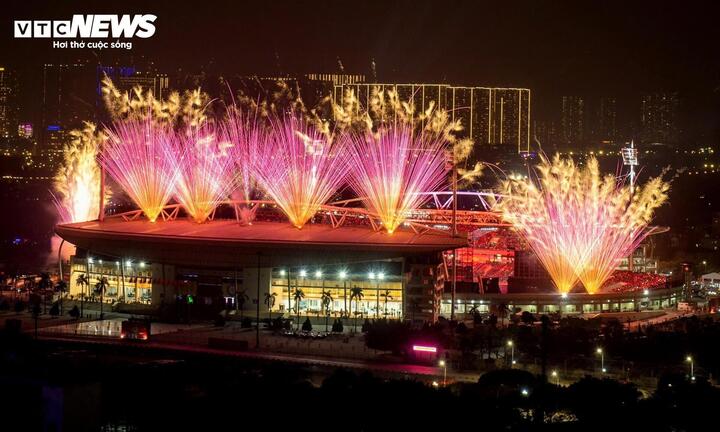
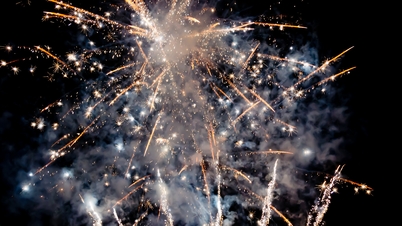
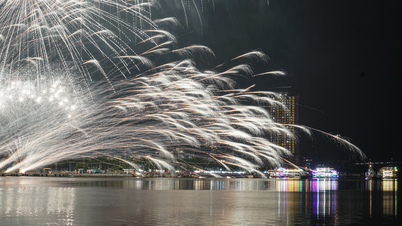
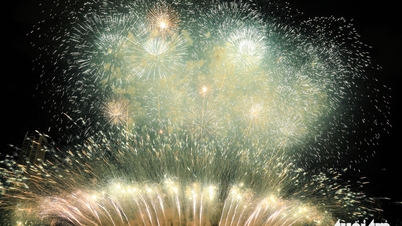
The moment the dazzling fireworks lit up the festival sky, it was a testament to the sophisticated blend of science and art in each performance.
Today, professional fireworks displays are used in large festivals. Unlike regular fireworks, each fireworks display consists of several components: propellant to launch the firework into the air, and explosive material to create the force of dispersion.
Specifically, the tiny "star" particles contain chemicals that burn brightly. The arrangement of these stars determines the shape of the fireworks when they explode.
For example, to create a smiley face, the designer arranges stars in a circle (the face), adds a few more stars for the eyes, and a curve for the mouth. When the firework explodes, the stars fly out, maintaining their relative positions, forming a smiley face in the sky.
However, there are some limitations when viewers are standing at different angles, so the shape can sometimes be distorted or difficult to recognize. To overcome this, experts often detonate multiple fireworks simultaneously, each rotated differently. This ensures that at least one firework displays the correct image for the audience.
Thanks to this meticulous planning, the fireworks displays are not just random light effects, but are actually the result of an elaborate design process, combining science and art to bring viewers dazzling moments in the sky.
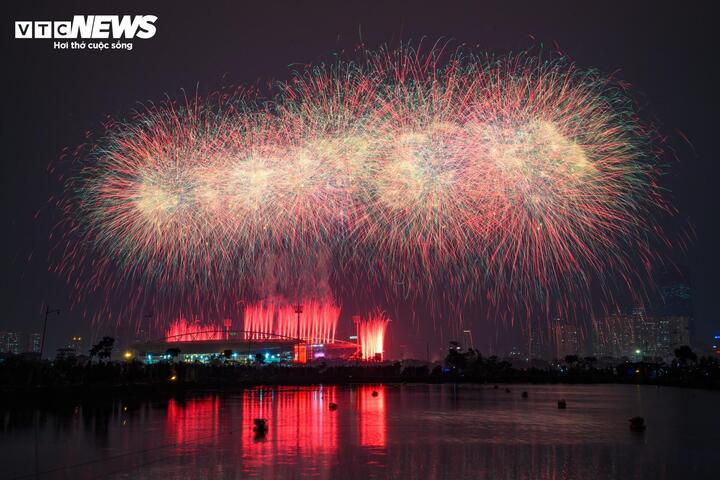
Fireworks illuminated the sky over Hanoi .
The colors of fireworks come from metallic compounds: strontium creates red, barium green, sodium yellow, and copper combined with chlorine creates blue – which is the most difficult color to achieve.
Each star contains oxidants, fuel, pigments, and binders, ensuring it burns brightly at the right time.
Besides aerial fireworks, there are also "set pieces" of fireworks mounted on fixed frames on the ground, forming images like flags or letters. These use small tubes called lances, which burn continuously for about a minute to create the shapes. However, this type is more expensive and labor-intensive, making it less common.
Source: https://vtcnews.vn/phao-hoa-va-bi-mat-tao-hinh-tren-bau-troi-ar1001634.html

![[Photo] Delegation attending the 14th Congress of the Vietnam Trade Union visits the Mausoleum of President Ho Chi Minh.](https://vphoto.vietnam.vn/thumb/1200x675/vietnam/resource/IMAGE/2026/06/03/1780451842301_ndo_br_img-3824-jpg.webp)







































































Comment (0)