

Risk of disease outbreaks from weather fluctuations
During the peak rainy season of 2025, brackish water shrimp farming areas in the province are facing many challenges. Rainwater reduces salinity, pH, alkalinity, and causes water stratification, making shrimp susceptible to shock, reduced appetite, weakened immunity, and increased risk of intestinal diseases, hepatopancreatic necrosis, or microsporidiosis.
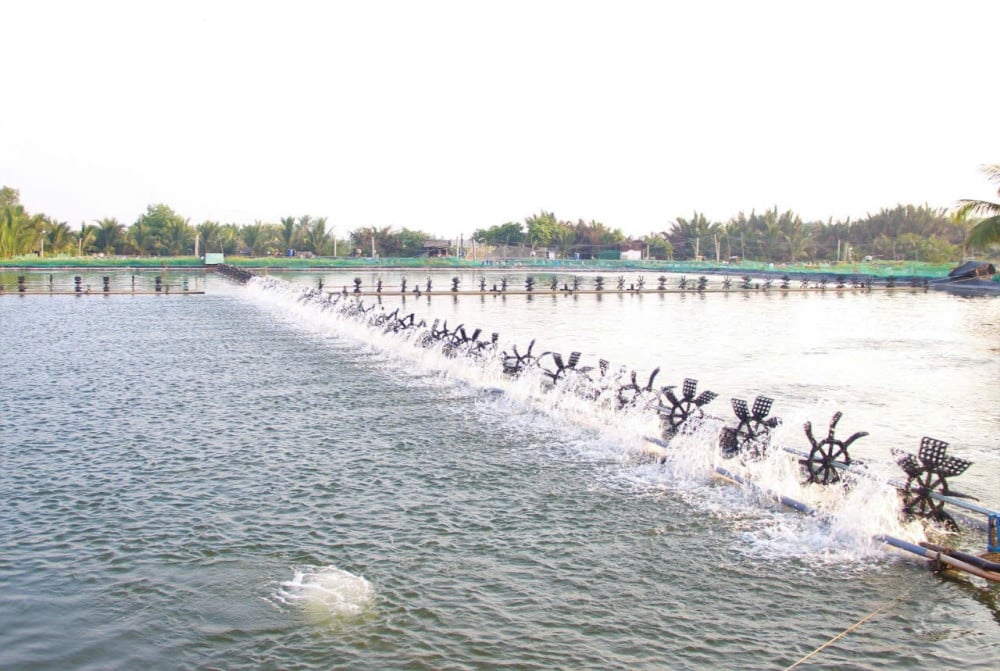
Shrimp farmers need to increase the use of water aerators to maintain dissolved oxygen and limit water stratification in the pond.
According to statistics from the Provincial Department of Agriculture, the province has approximately 5,700 hectares of brackish water shrimp farming area, concentrated mainly in Can Duoc, Phuoc Vinh Tay, Vam Co communes and some riverside communes. Of this, nearly 4,650 hectares of shrimp have been harvested, yielding over 18,000 tons.
However, forecasts indicate that between September and mid-October 2025, the province will experience several periods of heavy rainfall lasting 2-4 days. This rainfall will affect the quality of aquaculture ponds, reducing salinity below the appropriate threshold and increasing the risk of generating toxic gases such as NH₃, NO₂, and H₂S in the pond water.
According to Deputy Head of the Provincial Department of Agriculture Nguyen Vo Thi Ngoc Giau, during the rainy season, the water environment changes erratically, and if farmers do not manage it well, diseases can easily break out. The specialized agency is strengthening monitoring and promptly providing information on salinity, pH, and other environmental factors so that farmers can make adjustments. In addition, farmers need to pay attention to maintaining the water level in their ponds at 1.4-1.6m, increasing the use of aerators to prevent stratification, and maintaining dissolved oxygen above 5mg/liter.
To minimize risks, experts recommend that farmers apply a comprehensive set of technical solutions. First and foremost, seed selection must be prioritized. Seedlings should be purchased from reputable establishments with quarantine certificates, ensuring they are free from at least three common and dangerous shrimp diseases: white spot disease, acute hepatopancreatic necrosis, and EHP microsporidiosis. Black tiger shrimp seedlings should be at least post-larvae (post-15) and whiteleg shrimp seedlings at least post-larvae (post-12), swimming actively and uniformly, with a deformity rate below 0.5%.
Regarding pond management, farmers should allocate at least 15% of the area (for earthen ponds) and 50% (for lined ponds) for settling ponds and water storage ponds. The settling ponds should be 2-2.5m deep to store enough water for regulation during the rainy season. In addition, about 10% of the area should be allocated for wastewater and sludge storage ponds to avoid direct discharge into the environment.
During heavy rains, shrimp farmers should reduce feed quantities by 30-50%, depending on the shrimp's appetite, and simultaneously spread lime (CaO or CaCO₃) around the pond banks to neutralize the acid in the rainwater. Increase the continuous operation of water aerators to prevent stratification and periodically supplement with beneficial microorganisms to limit the growth of harmful bacteria.
Mr. Tran Van Cuong, a shrimp farmer in Can Duoc commune, shared his experience: “Whenever there is prolonged rain, I usually apply lime around the pond; I reduce feeding to prevent the shrimp from being shocked. Before adding new water, I always check the salinity, only adding water when it reaches 5‰ or higher, and alkalinity above 120mg/liter. Thanks to this, for several consecutive seasons, my pond has not been affected by disease, and the shrimp have achieved good yields.”
Towards a safe and efficient farming season.
The Department of Agriculture and Environment has directed its subordinate units to strengthen inspection and monitoring of aquaculture areas. The water environment monitoring and warning system is regularly maintained in key districts to provide timely information to aquaculture farmers.
Deputy Director of the Department of Agriculture and Environment, Dinh Thi Phuong Khanh, emphasized: “During the rainy season, the risk of shrimp diseases is very high. Therefore, the department continues to coordinate with local authorities, cooperatives, and aquaculture cooperatives to provide technical guidance, distribute documents, and issue early warnings to farmers. We encourage farmers to link together in cooperatives and aquaculture cooperatives to share experiences, reduce costs, and better manage diseases.”
Furthermore, the province is also calling on businesses to invest in deep processing and develop a supply chain from breeding stock, feed, farming techniques to consumption. This will not only help stabilize selling prices but also create conditions for farmers to confidently apply biosafety measures, limit the use of antibiotics and chemicals, and move towards sustainable production.
“Farmers must absolutely not discharge untreated wastewater from their ponds into canals and ditches, as this both pollutes the environment and spreads diseases. The relevant authorities will continue to support them, but the most important thing is the proactive awareness of the farmers. When farmers master the techniques and follow recommendations, the risk of disease outbreaks will decrease, and productivity will be more stable,” advised Ms. Dinh Thi Phuong Khanh.
Thanh Tung
Source: https://baolongan.vn/phong-chong-dich-benh-tren-tom-trong-mua-mua-a201932.html

![[Photo] Ba Lang An Lighthouse - the "eye of the sea" amidst the "rock museum" of Quang Ngai province.](https://vphoto.vietnam.vn/thumb/1200x675/vietnam/resource/IMAGE/2026/05/29/1780038698840_anh-man-hinh-2026-05-29-luc-14-10-42.png)
![[Image] Pleasant weather helps students enter the 10th grade entrance exam with confidence.](https://vphoto.vietnam.vn/thumb/1200x675/vietnam/resource/IMAGE/2026/05/29/1780034401612_ngay-1-thi-lop-10-minh-duy-8-5009-jpg.webp)










































































Comment (0)