

A Russian ISS module leaked coolant on October 9th, less than a year after two other Russian spacecraft docked with the station and experienced similar incidents.
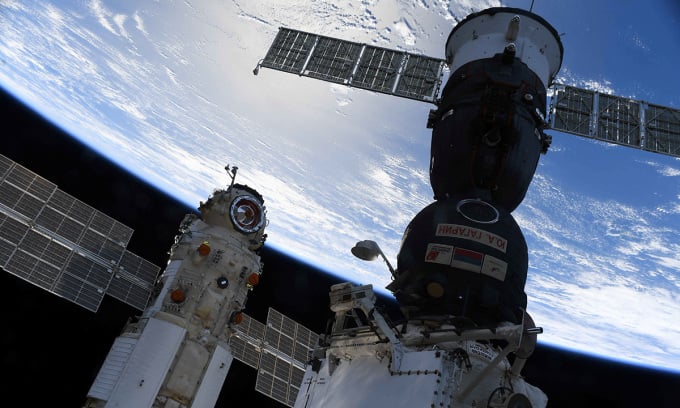
The Nauka module docked with the International Space Station (ISS) alongside the Soyuz MS-18 spacecraft on July 29, 2021. Photo: Oleg Novitskiy/Roscosmos/Reuters
During a NASA live broadcast of the International Space Station (ISS) on October 9th, experts detected fragments of frozen coolant ejected from the station into space. The incident was confirmed during a radio conversation between the mission control team in the US and the astronauts.
"The Nauka module, part of the Russian ISS, experienced a coolant leak from its (backup) external radiator," the Russian space agency Roscosmos wrote on Telegram. The agency added that temperatures in the affected area remained normal and the astronauts were safe. Nauka, meaning " science " in Russian, also known as the Multipurpose Laboratory Module (MLM), launched into space in 2021.
This is the third coolant leak from a Russian spacecraft in less than a year. On December 15, 2022, images broadcast by NASA showed snow-white particles erupting from the rear of the Soyuz MS-22 spacecraft (which was docking with the ISS). The incident was believed to be a collision with a micrometeorite. Soyuz MS-22 subsequently had to return to Earth without crew. Several months later, another spacecraft was launched to replace it. The incident caused the two Russian astronauts and one American astronaut to extend their mission beyond the planned schedule and remain on the ISS for a year.
In February 2023, a similar leak occurred with the Russian cargo ship Progress MS-21. This ship had docked with the ISS since October of the previous year.
According to space analyst Jonathan McDowell, the fact that there were three leaks means it wasn't a coincidence but a systemic problem. He suggests the fault may lie with a subcontractor. "This underscores the declining reliability of Russian space systems. Add to that the context of the failed lunar exploration mission in August, and things don't look good," McDowell said.
Thu Thao (According to Guardian )
Source link




















![[Photo] Prime Minister Pham Minh Chinh holds a phone call with the CEO of Russia's Rosatom Corporation.](/_next/image?url=https%3A%2F%2Fvphoto.vietnam.vn%2Fthumb%2F1200x675%2Fvietnam%2Fresource%2FIMAGE%2F2025%2F12%2F11%2F1765464552365_dsc-5295-jpg.webp&w=3840&q=75)

















































Comment (0)