

A cooperation agreement on sending and receiving seasonal workers in South Korea has just been signed between Ninh Binh province and Asan city, Chungcheonam province (South Korea), opening up job opportunities with high incomes for workers.
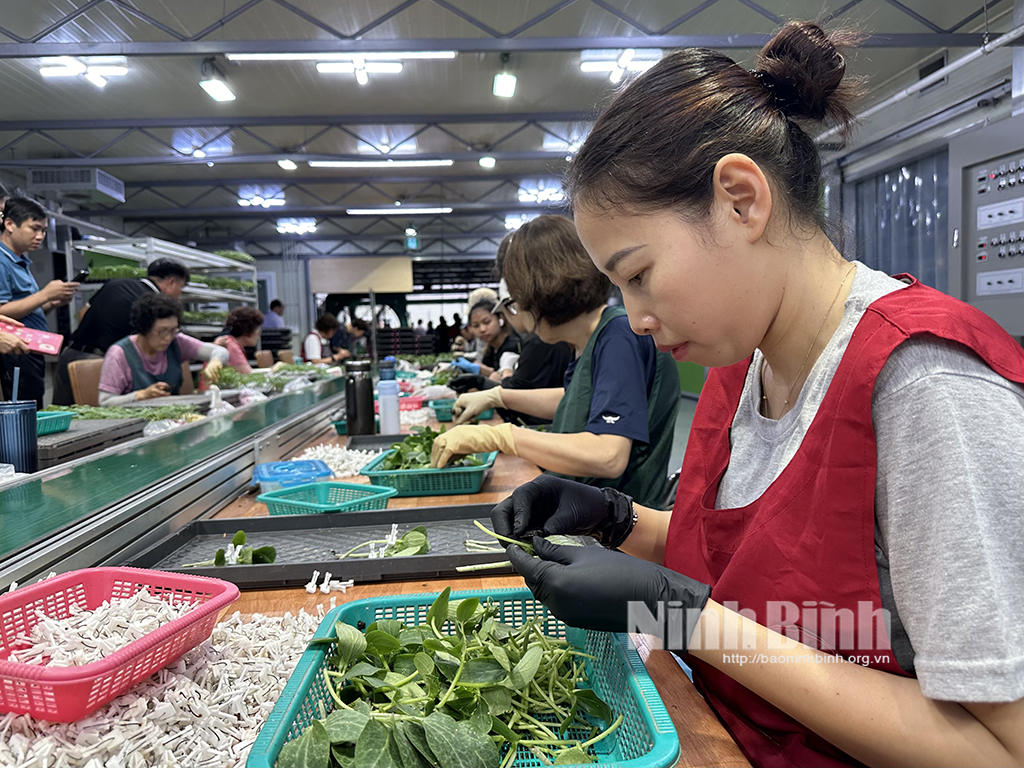
Vietnamese workers employed at PPS Seed nursery (Asan city)
South Korea is facing a severe shortage of agricultural workers.
"During each pear harvest season, we need a large workforce, approximately 120-150 people. There is a shortage of domestic labor, so the company has to recruit seasonal workers from Vietnam and Thailand. The salary we pay each worker is about 90,000 Won/day (approximately 1,700,000 Vietnamese Dong), not including lunch or overtime pay," Mr. Nam Hyun Dai, representative of the pear processing center in Asan city, shared with a reporter from Ninh Binh Newspaper.
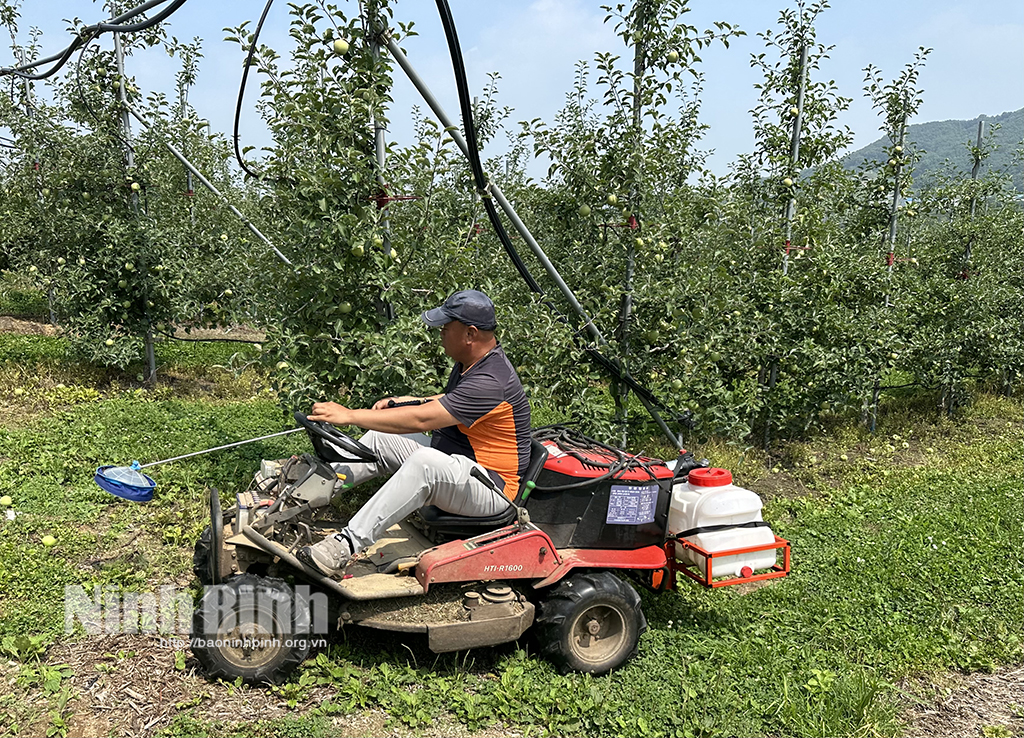
According to some apple farmers in Asan, the apple growing season starts in March and lasts until October. Besides tasks that can be replaced by machinery, many jobs require manual labor such as pruning, leaf removal, harvesting, and packaging. Meanwhile, each farming household here currently owns an average of 1.5-2 hectares, so at many times they cannot manage the workload without hiring additional laborers.
It is known that Asan City has a total agricultural land area of over 15,000 hectares, while the number of farming households is only over 8,000, with approximately 17,000 farmers. Thus, on average, each farming household has two people cultivating about 1.8 hectares. It is noteworthy that the aging population is a serious problem in South Korea in general, especially in the agricultural sector. In Asan City alone, statistics show that the percentage of farming households with members over 65 years old reaches 23.5%.
A representative from the Asan City Agricultural Technology Center stated: To address the rural labor shortage, the Center has supported farmers in promoting mechanization in production for many years by operating a rental bank of agricultural machinery with nearly 600 machines of various types. However, many processes still require human labor. Therefore, the Center invites approximately 500 seasonal foreign workers to assist farming households.
Simple application process, low cost, high income…
Since 2018, the South Korean government has allowed local authorities to recruit foreign workers to address labor shortages during peak harvest seasons in the agricultural and fisheries sectors. This program is implemented through a partnership between a South Korean local authority and a Vietnamese local authority to recruit workers.
Many localities such as Da Nang, Dong Thap, Ha Tinh, Hau Giang, Thai Binh, Thua Thien Hue, Ha Nam, Ca Mau, Quang Binh... have signed agreements with localities in South Korea to send seasonal workers. The program is highly rated for its effectiveness, with simple application procedures, low costs, suitable jobs, and high salaries.
For Ninh Binh, a favorable factor is that since 2015, the Provincial People's Committee has signed a Friendship and Cooperation Agreement with Asan City, Chungcheonam Province (South Korea). Based on this, many comprehensive cooperation, exchange, and collaboration activities have taken place in the fields of industry, culture, and labor. In particular, last July, the two sides signed a cooperation agreement on the dispatch and reception of seasonal workers in South Korea, with the number of recruits ranging from 50 to 100 people per year.
According to this agreement, the conditions for working seasonally in South Korea are quite simple. Workers must be Vietnamese citizens residing long-term (12 months or more) in Ninh Binh province, working in agriculture, aged between 30 and under 50 years old. They must have full legal capacity; have no criminal record and not be subject to any travel bans or temporary travel suspensions as stipulated by law; and be in good health to work abroad.
Workers are paid according to the minimum wage applied in South Korea, which is a minimum of 2,050,880 won per month (approximately 39 million VND). In addition, workers are entitled to working hours and rest periods; guaranteed working conditions, accommodation, living expenses, insurance, and medical care costs as regulated by South Korea. Workers are responsible for complying with the instructions of the sending local authorities and the laws of the host country, and returning home immediately after completing their labor contract so that they can return to work again.
Mr. Pham Ngoc Phuc, Head of the Labor-Employment-Vocational Education Department of the Provincial Department of Labor, War Invalids and Social Affairs, said: With quick procedures, low costs, a relaxed age range, no high requirements for vocational training or foreign languages, simple and suitable agricultural work, short duration (90 days for C-4 visa or 5 months for E-8 visa), and relatively high income, the seasonal labor program has many advantages.
According to Mr. Phuc, Asan requires the recruitment of 50-100 people per year, with 2-4 recruitment rounds planned annually (approximately from February to October). Therefore, the Department is currently urgently preparing the workforce by coordinating with relevant departments, agencies, and localities to widely publicize the program; and encouraging members and affiliates whose children meet the eligibility criteria and wish to work abroad in the agricultural sector to participate in the selection process.
Coordinate with the Provincial Police and relevant agencies and units in verifying the qualifications of selected candidates. In addition, organize Korean language training and orientation for workers... The goal is to select and introduce candidates to participate in the Cooperation Agreement ensuring quality, transparency, and targeting the right individuals.
The successful implementation of the seasonal labor program in Asan (South Korea) will have significant implications. Besides creating jobs and increasing income, it will also provide Ninh Binh workers with the opportunity to learn and grasp advanced technologies in production and business (especially in the agricultural sector) in South Korea, thereby contributing to socio-economic development and strengthening friendly cooperative relations between the two localities.
See the details of the agreement and plan here:
rong-cua-sang-han-quoc-lao-dong-thoi-vu-e6c4b.pdf
Text and photos: Nguyen Luu
Source: https://baoninhbinh.org.vn/rong-cua-sang-han-quoc-lao-dong-thoi-vu/d20240816100027761.htm
![[Photo] Closing Ceremony of the 10th Session of the 15th National Assembly](/_next/image?url=https%3A%2F%2Fvphoto.vietnam.vn%2Fthumb%2F1200x675%2Fvietnam%2Fresource%2FIMAGE%2F2025%2F12%2F11%2F1765448959967_image-1437-jpg.webp&w=3840&q=75)

![[Photo] Prime Minister Pham Minh Chinh holds a phone call with the CEO of Russia's Rosatom Corporation.](/_next/image?url=https%3A%2F%2Fvphoto.vietnam.vn%2Fthumb%2F1200x675%2Fvietnam%2Fresource%2FIMAGE%2F2025%2F12%2F11%2F1765464552365_dsc-5295-jpg.webp&w=3840&q=75)



































![[OFFICIAL] MISA GROUP ANNOUNCES ITS PIONEERING BRAND POSITIONING IN BUILDING AGENTIC AI FOR BUSINESSES, HOUSEHOLDS, AND THE GOVERNMENT](https://vphoto.vietnam.vn/thumb/402x226/vietnam/resource/IMAGE/2025/12/11/1765444754256_agentic-ai_postfb-scaled.png)






































Comment (0)