Sa Lôn is called by its Vietnamese transliteration, while the French transliterated it into Latin as Saloun. Regarding the meaning of the name, the K'Ho village elders in Dong Giang commune explain that Sa Lôn means "Mother Water" or "a winding stream like a dragon".
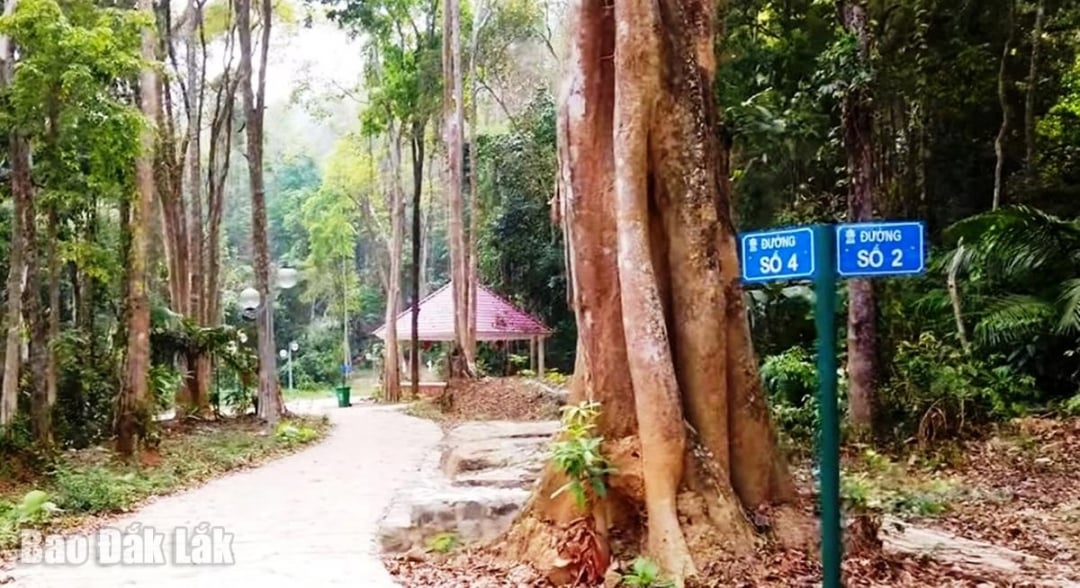
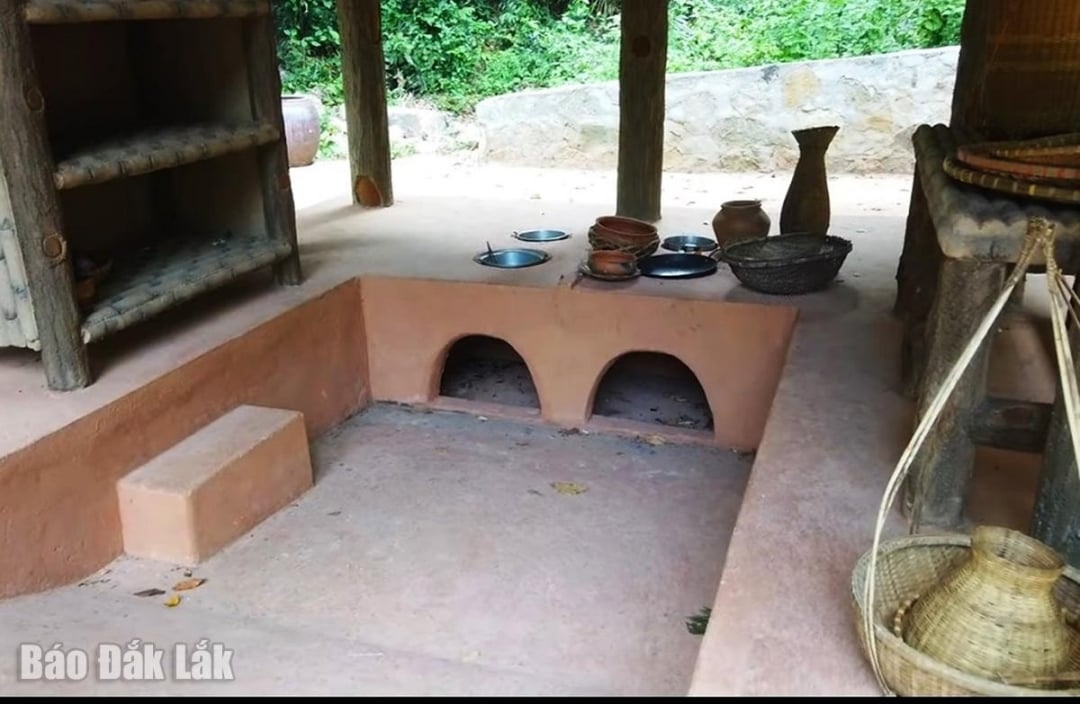
The Sa Lon base is nestled amidst rolling mountains, creating a wild and majestic natural landscape. Red dirt trails wind around the hillsides, meandering through dense forests. The Sa Lon stream flows gently, its clear water reflecting the gray, gnarled rocks. The air here is surprisingly fresh and peaceful. The wind carries the scent of plants, of the ancient forest, and a unique sense of nostalgia. At the foot of the hill, the remaining ruins of huts, shelters, and the Hoàng Cầm kitchens are covered in moss, silently witnessing the story of a glorious and heroic era of those who "defended the green forest to fight the enemy."
|
The entrance to the historical site today. |
Standing amidst the vast forests of the Southern Truong Son Mountains, where the Sa Lon base stands today, few can imagine that more than half a century ago, this place endured horrific carpet bombing raids by B-52 "flying fortresses" of the US Air Force. The deafening sound of the bombs echoed all the way to Phan Thiet back then! But Sa Lon still stood firm and fought tenaciously until the liberation of the South and the reunification of the country.
During the period 1954-1975, the former Binh Thuan Provincial Party Committee established its base in Sa Lon three times: from December 1954 to June 1957, from mid-1961 to December 1964, and from September 1968 to August 1970. Many important historical events took place here, such as: the founding conference of the National Liberation Front of South Vietnam in Binh Thuan province (October 1962), the first and second congresses of the Provincial Women's Union (1962, 1964), the first Provincial Emulation Fighters Congress (September 1964), and the first Provincial Party Congress during the resistance war against the US (July 1970).
Besides the events taking place in Sa Lon, this was also the location where many units, agencies, and committees were established, based, and operated, such as: Cao Thang Military Ordnance Factory, Tran Phu Party School, Security Committee, Economic and Financial Committee, Logistics Committee, Military Medical Committee, Propaganda Committee, Military Committee, Station F5 (press publishing agency)...
Today, the Sa Lon base has been restored and recognized as a provincial-level historical site. The site includes structures such as bomb shelters, a meeting hall, a Hoang Cam kitchen, and a memorial house, all aimed at preserving and educating the younger generation about revolutionary traditions. The revolutionary historical site has been renovated and restored to a spacious and modern state, while still retaining its traditional features. The memorial house contains many valuable artifacts such as homemade guns, mines, manual printing presses, equipment used by soldiers and militia, and production tools… and numerous photographs documenting the combat and production activities of our army, people, and the K'Ho ethnic group in the mountainous region of Dong Giang.
|
The signature of Hoang Cam's kitchen. |
During that trip back to our roots, we had the opportunity to meet with veterans – those who had lived, fought, and been closely associated with the Sa Lon base during the most brutal years of the resistance war against the US. They are now old, their hair gray, but their voices are still strong, and their eyes still shine brightly as they recount those unforgettable days. “Back then, the jungle was dense, and American bombs rained down like a storm. Sometimes, right after a meeting, artillery fire would come, and we had to scatter and run into every rock crevice and every shelter. But no one was afraid. Life and death were separated by only a hair's breadth, but our faith in the revolution and in a peaceful future for the country was the motivation that helped us overcome everything,” one veteran recounted.
The road back to the base was no longer as treacherous as before; it was now smooth and wide. The flagpole in the forest had been re-erected, soaring high against the blue sky, beneath which stood a memorial plaque inscribed with the names of those who had fallen… We stood silently in the Sa Lon forest, letting the forest wind blow through us, like a call from the past echoing back. It felt as if we were touching the very heartbeat of the land, of the people, of those years that would never return but would forever live in the memory of the nation…
Hai Ho
Source: https://baodaklak.vn/du-lich/202507/sa-lon-dau-xua-bat-khuat-038108b/






















![[Photo] Reception to welcome General Secretary and President To Lam and his wife on their State visit to the Philippines](https://vphoto.vietnam.vn/thumb/1200x675/vietnam/resource/IMAGE/2026/06/01/1780295488620_vna-potal-chieu-dai-chao-mung-tong-bi-thu-chu-tich-nuoc-to-lam-va-phu-nhan-tham-cap-nha-nuoc-toi-philippines-8798060-7855-jpg.webp)




















































Comment (0)