

South Korea's proactive push to resume the stalled Sino-Japanese-South Korean summit mechanism, which has been inactive since 2019, demonstrates an effort to break the deadlock on the North Korean issue and a desire to leave a lasting legacy for President Yoon Suk Yeol.
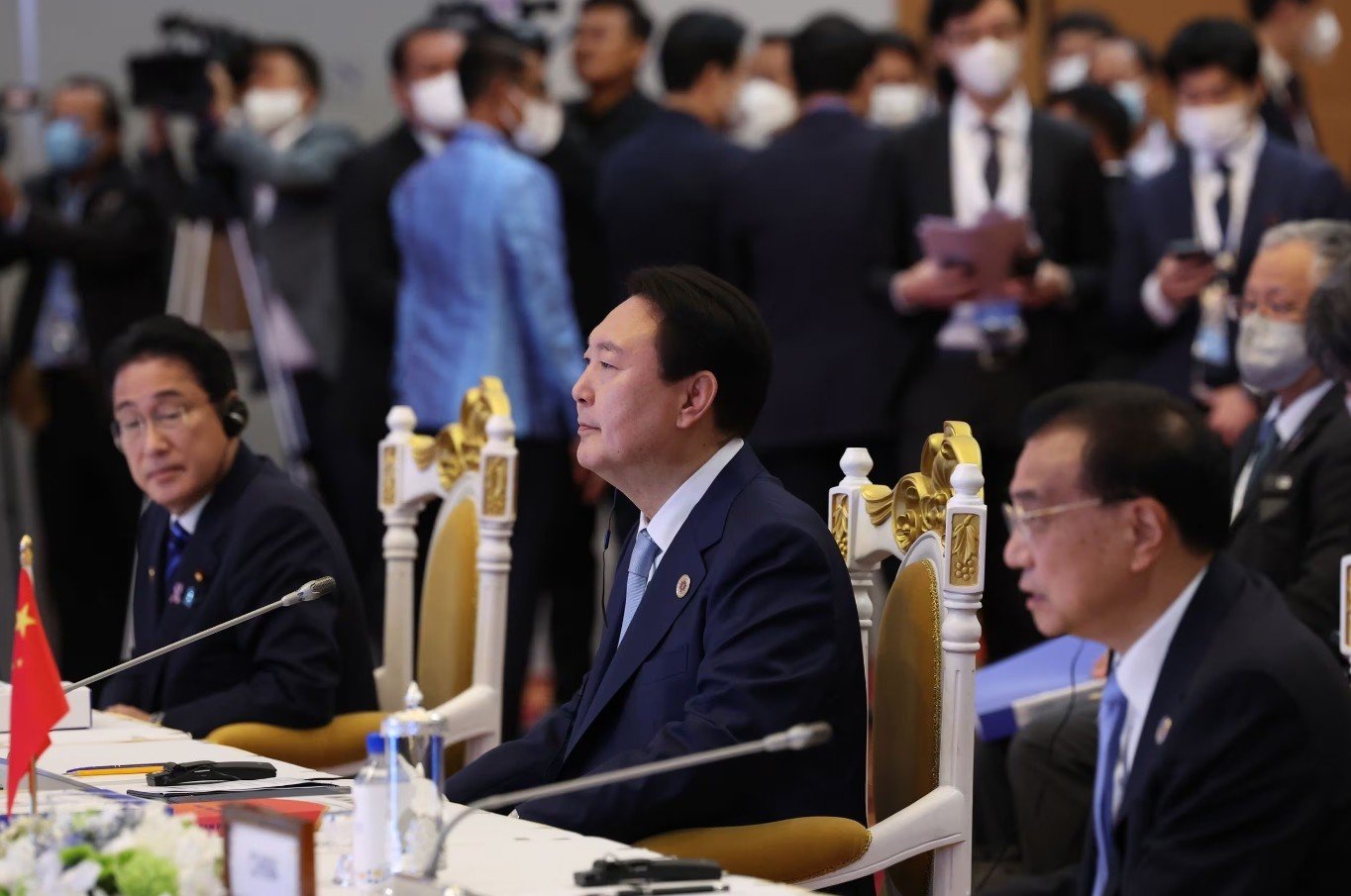 |
| South Korean President Yoon Suk Yeol (center), Japanese Prime Minister Kishida Fumio (left), and Chinese Premier Li Keqiang attend the ASEAN+3 Summit in Phnom Penh, Cambodia, in November 2022. (Source: The Chosun Daily) |
After more than four consecutive years of postponement, the 9th China-Japan-South Korea Summit will finally be held in Seoul, South Korea on May 26-27. This summit will be attended by Japanese Prime Minister Kishida Fumio, Chinese Premier Li Qiang, and South Korean President Yoon Suk Yeol.
Reviving the tradition
This event was originally expected to be held in 2020 following the 8th Summit in Chengdu, China, in December 2019. However, the rapid and widespread outbreak of the Covid-19 pandemic and strained Japan-South Korea relations over compensation for South Korean forced labor victims made it difficult to hold the event. Hosting the 9th Trilateral Summit after a hiatus demonstrates the diplomatic success of President Yoon Suk Yeol's administration and more clearly reflects his "multi-basket" approach to the North Korean issue.
Beginning in 2008 in Fukuoka, Japan, the trilateral China-Japan-South Korea Summit was established with the intention of holding annual meetings to promote regular exchanges and cooperation among the three Northeast Asian countries. Each country takes turns chairing the summit each year, in the order of Japan, China, and South Korea. However, this mechanism has been interrupted three times, each time for about 3-4 years.
In 2012, the 5th summit, chaired by China, was held in Beijing. Amidst rising tensions between the three countries over historical issues and territorial disputes, it took three years for the next chair, South Korea, to host the 6th summit in Seoul in 2015, thanks to lobbying efforts by former South Korean President Park Geun Hye.
Later, when Japan hosted the 7th Summit in Tokyo in 2016, the three countries decided to postpone it amidst the impeachment of President Park, leading to political instability in South Korea. In 2017, the THAAD crisis (the US deployment of the Terminal High Altitude Area Defense missile system in South Korea) once again caused the mechanism to be delayed due to serious tensions in Sino-Korean relations.
It wasn't until Park's successor, former South Korean President Moon Jae-in, took power with his "three no's" policy on the THAAD issue that the 7th summit in Tokyo was officially held in 2018.
Make an extra impression
It can be seen that the two interruptions of the China-Japan-South Korea Summit mechanism both occurred when it was South Korea's turn to chair, and the third postponement was essentially a consequence of political instability in South Korea. Meanwhile, South Korea proactively proposed the establishment of the Trilateral Cooperation Secretariat (TCS) in 2009, contributing to its official establishment in 2011, headquartered in Seoul.
The TCS is an intergovernmental organization aimed at promoting long-term cooperation among China, Japan, and South Korea through policy recommendations. The establishment of the TCS marks a significant milestone in institutionalizing trilateral cooperation, which began in 1999. Given this, South Korea's ability to resume the China-Japan-South Korea Summit, which had been delayed since 2019, can be considered a diplomatic success and a notable achievement in President Yoon Suk-Yeol's five-year term.
Beyond its diplomatic significance, this event also represents South Korea's attempt to send a message regarding the North Korean issue. Faced with the nuclear threat and the prospect of war on the Korean Peninsula, President Yoon Suk Yeol is pursuing a "diversified approach," engaging with a diverse range of partners in both Southeast Asia and Northeast Asia.
Previously, President Yoon needed to devote significant attention and resources to the South Korean parliamentary elections on April 10th. After the elections, he was able to focus more on the North Korean issue. South Korea has been pushing for the formal upgrading of ASEAN-South Korea relations to a Comprehensive Strategic Partnership by the end of this year, coinciding with the 35th anniversary of the Dialogue Partnership between the two sides. Recently, South Korea and Cambodia also upgraded their relationship to a Strategic Partnership during Cambodian Prime Minister Hun Manet's four-day visit to South Korea starting on May 15th. More recently, South Korea made a notable move by sending Foreign Minister Cho Tae Yul to Beijing to meet with his Chinese counterpart Wang Yi (the first time in six years), amidst China's relatively "quiet" stance on the current tensions on the Korean Peninsula.
Efforts to create a breakthrough
The aforementioned series of diplomatic activities reflects South Korea's efforts to find a "way out" of the current stalemate on the Korean Peninsula. Instead of changing its hardline approach (which includes strengthening its alliance with the US and promoting cooperation with Japan within the trilateral framework of the US-Japan-South Korea), Mr. Yoon sought to lobby various countries in the region to influence North Korea, bringing it back into the denuclearization negotiation process.
By restarting the trilateral summit mechanism between China, Japan, and South Korea just nearly two weeks after Foreign Minister Cho's trip to Beijing and the visit of the Cambodian Prime Minister – a close partner of China in Southeast Asia – to Seoul, South Korea is implicitly sending a rather clear message to China that it should play a larger role in preventing war on the Korean Peninsula.
While former President Park Geun Hye was unable to continue the annual China-Japan-South Korea summit mechanism after 2015, whether President Yoon can continue this annual practice after 2024 remains an open question. However, at least for now, certain progress can be seen in President Yoon's "multi-basket" strategy since the April 10th parliamentary election.
With the resounding victory of the Democratic Party of Korea (DPK), President Yoon's administration will face many challenges in implementing domestic policies until the end of his term in 2027. Therefore, to achieve more success in the remaining three years of his presidency, Yoon needs to push harder on the foreign policy front. And the 9th Sino-Japanese-Korean Summit in Seoul is an effort within that overall direction.
Source: https://baoquocte.vn/sach-luoc-tiep-can-nhieu-gio-cua-tong-thong-han-quoc-272570.html

![[Photo] Admire the coral "masterpiece" amidst the million-year-old heritage of Dak Lak province.](https://vphoto.vietnam.vn/thumb/1200x675/vietnam/resource/IMAGE/2026/05/30/1780107638639_y25-jpg.webp)





































































Comment (0)