

Agricultural production is the sector most severely affected by climate change, with extreme weather patterns such as severe cold spells, frost, thunderstorms, tornadoes, hailstorms, heavy rains causing flash floods, localized flooding, and landslides... which degrade natural ecosystems and destroy crops and livestock, making the agricultural sector vulnerable.
To ensure balanced agricultural development, food security, and environmental protection, research into smart farming methods that adapt to climate change and diseases is an urgent requirement. In recent years, Phu Tho province has implemented many models and methods of agricultural production adapted to climate change to ensure people's livelihoods, contribute to economic growth, and maintain social stability.
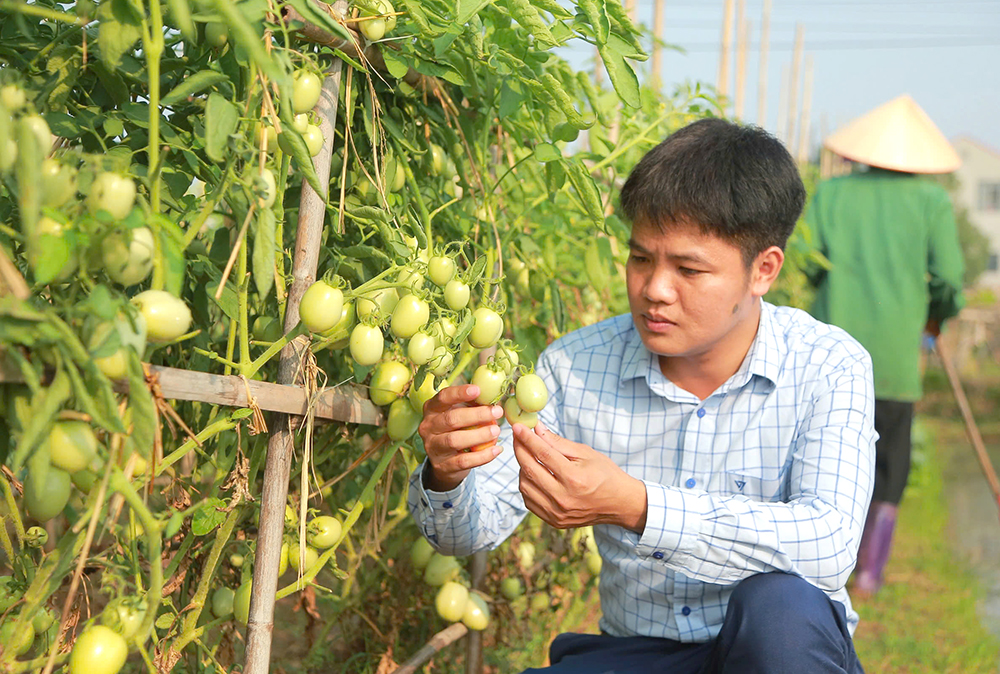
The model of crop variety transformation, planning, concentrated planting, and the formation of specialized vegetable production areas in Lam Thao has yielded high and sustainable economic efficiency, adapting to climate change.
In particular, in the field of crop production, the Department of Agriculture and local authorities have intensified on-site inspections of production, directed the adherence to seasonal schedules, and provided guidance on technical measures for caring for rice and other crops, including fruit trees, during the flowering and fruiting stages. Simultaneously, they have promoted the restructuring of the crop production sector, developed and improved the quality of key crops, focusing on applying safe production processes; and organized large-scale, concentrated production along the value chain. The entire province has 2,400 hectares of crops certified under VietGAP standards and 29 hectares certified as organic.
Notably, the provincial Department of Agriculture has also researched and introduced several new high-quality rice varieties with good growth and development potential and high economic value on a large scale. According to statistics, the percentage of high-quality rice varieties planted throughout the province reaches 55%; the province has 157 high-quality rice growing areas with an area of 9,600 hectares. Simultaneously, to enhance agricultural production value, adapt to climate change, and focus on developing key crops and converting less efficient rice land to other crops, solutions have been applied effectively. To date, the province has established 445 concentrated farming areas for key products with competitive advantages, covering an area of 19,600 hectares.
Along with climate-adaptive rice production, models for producing safe and organic vegetables in greenhouses and net houses using hydroponics and drip irrigation are gradually becoming popular in the province. In Lam Thao district, many climate-adaptive agricultural production models have been actively implemented and have yielded high efficiency. According to Ms. Dang Thi Thu Hien, Deputy Head of the Agriculture and Rural Development Department of the district: The District Party Committee issued Resolution 04 dated January 8, 2021, of the District Party Committee on the development of commercial agricultural production near urban areas in the 2020-2025 period. This is the foundation for the district to implement sustainable agricultural production models with high economic efficiency and climate change adaptation. The district has focused on directing the development of high-quality rice and vegetable production areas on a concentrated scale towards commercial production; Promoting mechanization in production processes, using drones for pest control... aims to free up labor, reduce costs, protect the environment, and improve production efficiency; strengthening linkages in the production and consumption of safe vegetables... To date, Lam Thao has built and developed commodity production areas and established brands for its strong agricultural products such as high-quality rice and safe vegetables.
Furthermore, in forestry production, the implementation of large-timber forest models also plays a significant role in adapting to climate change. Mr. Truong Quang Dang, Head of the Forest Development Department of the Forest Protection Sub-Department, stated: With a 10-year business cycle, large-timber forests yield 18 m³/ha/year, generating a value of 190-200 million VND/ha/10-year forest business cycle. The economic efficiency is many times higher than planting small-timber forests. Large-timber forests also have the ability to absorb a lot of carbon, contributing to environmental protection and combating climate change. Currently, this model is being replicated throughout the province, with a total area of 18,900 hectares dedicated to large-timber forest development, including 15,300 hectares of intensively cultivated large-timber forests and 3,600 hectares of converted plantations for large-timber production.
In the coming period, along with raising community awareness and community-based disaster risk management, the province will continue to focus on solutions for disaster prevention and adaptation to climate change in agricultural production. The development and replication of livelihood models that meet the needs of producers according to the socio-economic characteristics of each locality, developing towards commodity-based production linked to product consumption, and applying technical measures to produce products according to VietGAP, organic, and circular practices will minimize the impact of climate change. Localities need to accelerate the restructuring of the agricultural sector towards increasing added value and sustainable development, shifting from traditional production methods to climate change adaptation, and forming smart agricultural models to reduce risks and ensure environmental sustainability.
Le Oanh
Source: https://baophutho.vn/san-xuat-nong-nghiep-thich-ung-bien-doi-khi-hau-226481.htm


![[Image] Close-up of the newly discovered "sacred road" at My Son Sanctuary](/_next/image?url=https%3A%2F%2Fvphoto.vietnam.vn%2Fthumb%2F1200x675%2Fvietnam%2Fresource%2FIMAGE%2F2025%2F12%2F13%2F1765587881240_ndo_br_ms5-jpg.webp&w=3840&q=75)


































































Comment (0)