

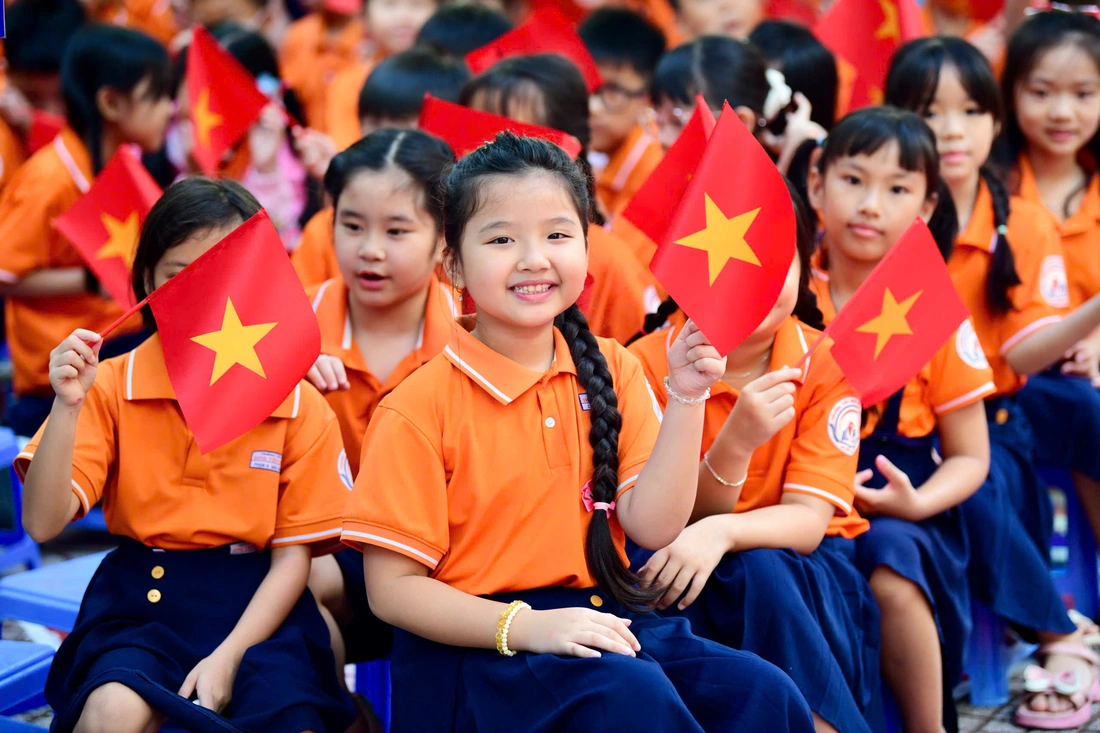
Students of Dinh Tien Hoang Primary School, Hiep Phu Ward, Ho Chi Minh City, on the opening day of the school year, September 5th - Photo: QUANG DINH
Unlike previous years, the opening ceremony of the 2025-2026 school year also commemorated the 80th anniversary of the education sector's tradition. The ceremony took place at the National Convention Center (Hanoi), was broadcast live on VTV1 - Vietnam Television, and connected online with all educational institutions nationwide from 8:00 AM to 9:30 AM.
Prior to the opening ceremony, many schools across the country organized diverse and meaningful activities for teachers and students, solemnly welcoming students in grades 1, 6, and 10 at all levels, and honoring students with outstanding achievements…
Students in border and mountainous regions wake up early to attend the opening ceremony of the school year.
From 6 am, students dressed neatly and arrived at Tak Po school in Tra Tap commune, Da Nang city, a school that once "went viral" on social media with its simple and unpretentious opening ceremony in 2019.
The school is situated on a hilltop overlooking a green meadow, beneath the lush green canopy of palm trees. Students arrive at the school while clouds still hang over the mountainside, each holding a bright red national flag, eagerly awaiting the opening ceremony.
Ms. Tra Thi Thu, a teacher at Chu Van An Ethnic Boarding Primary School, said that the Tak Po school branch has two classes: a preschool class taught by two teachers from Phong Lan Kindergarten with 22 children, and a primary school class taught by Ms. Thu with 16 students. This morning, a simple, unpretentious, and pure opening ceremony was organized by the teachers for 38 children in this peaceful highland area.
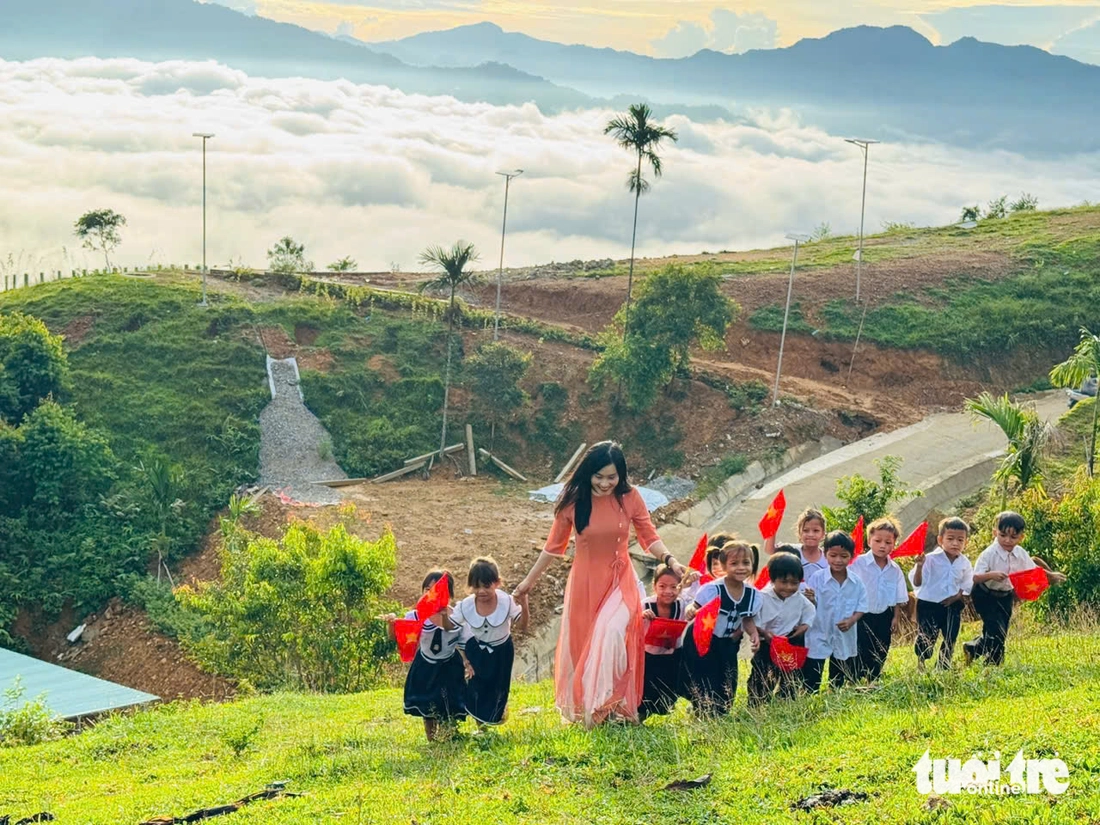
Ms. Tra Thi Thu and her students at Tak Po school before the opening ceremony - Photo: LE TRUNG
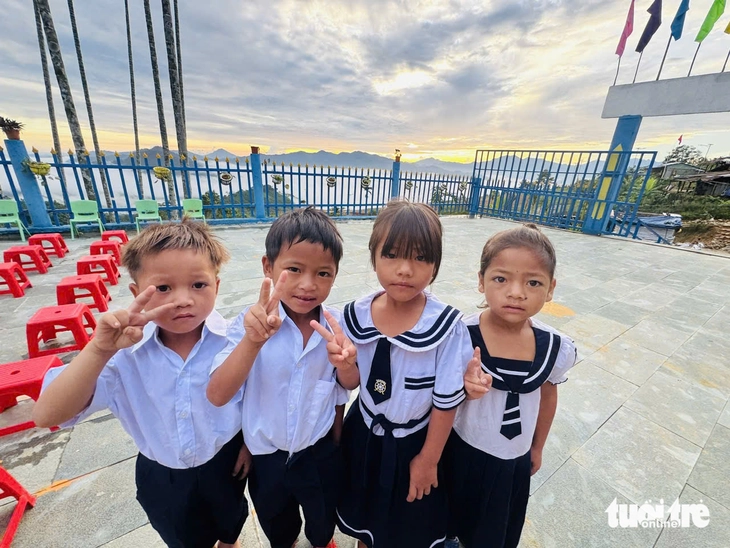
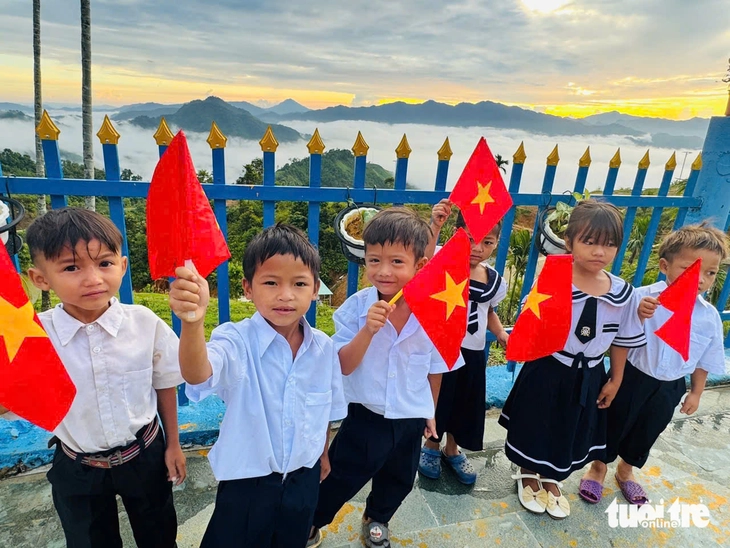
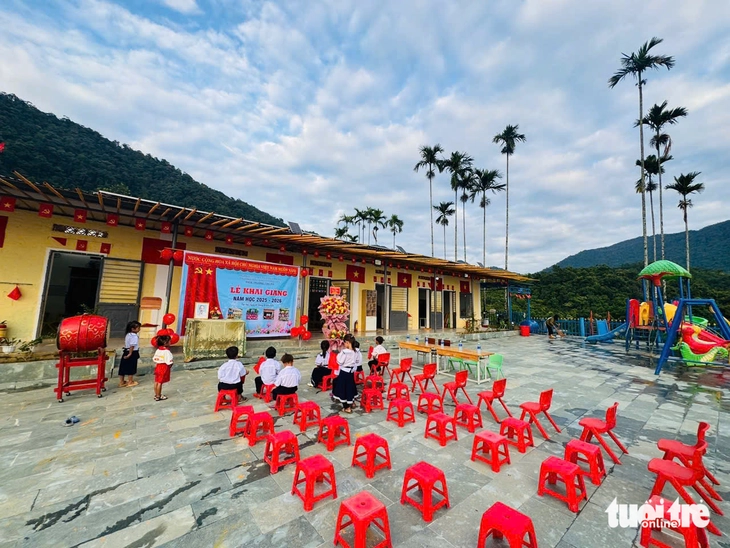
Students at Tak Po school await the opening ceremony - Photo: LE TRUNG
At Vo Thi Sau Secondary School (Buon Don commune, Dak Lak province), students were also present in large numbers from early on. This is the only school in the province located near the border, and it also serves as a direct connection point to the National Convention Center.
According to Mr. Thai Van Loc, the school principal, this direct connection is an opportunity for students in remote and border areas to participate in a very special and memorable opening ceremony. "This is also an opportunity for the school to convey its thoughts and aspirations to the leaders of the Ministry and the Government," he shared.
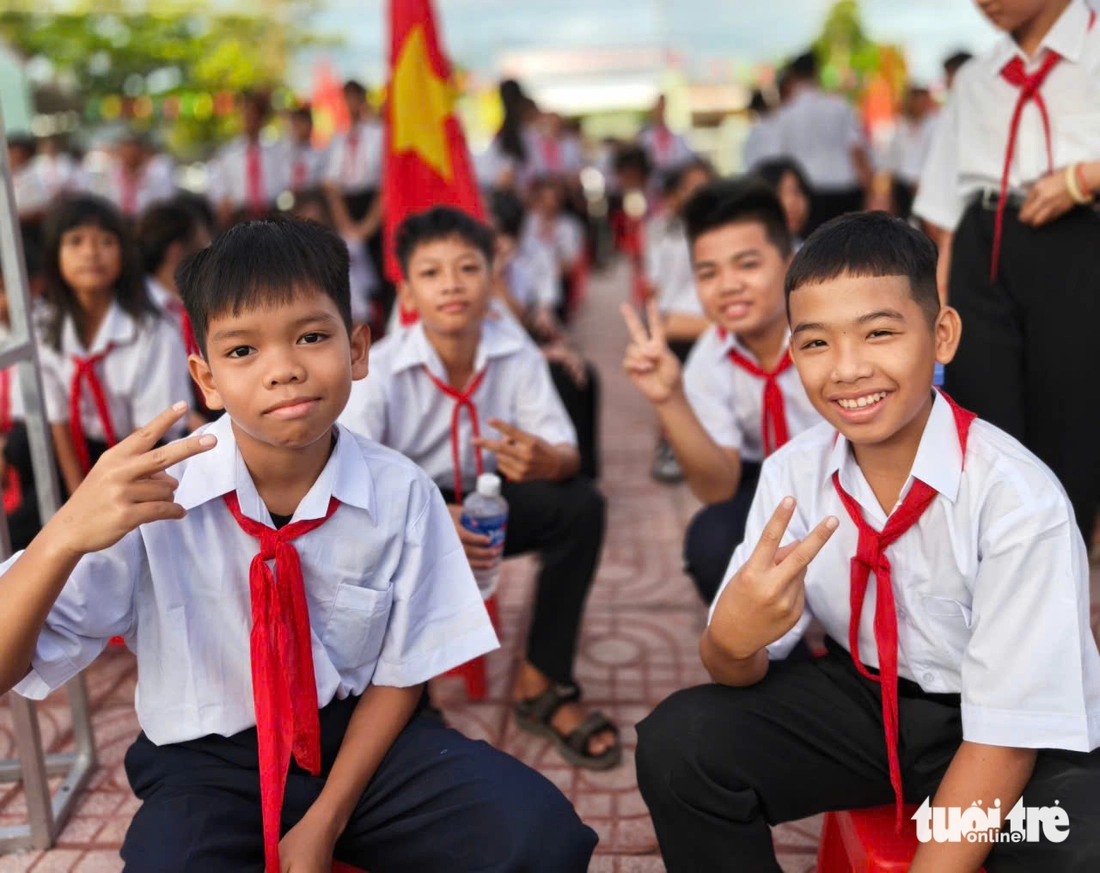
Students at Vo Thi Sau Secondary School in Buon Don border commune, Dak Lak province, prepare for the opening ceremony - Photo: Trung Tan
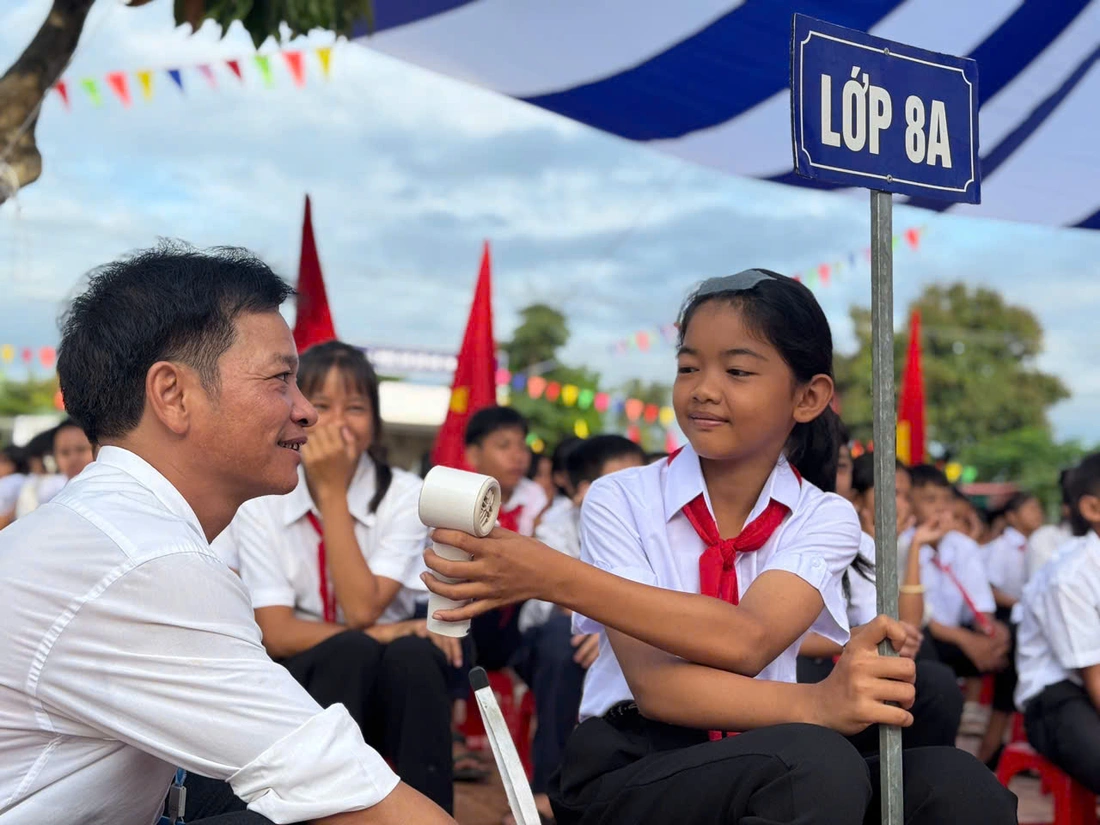
The weather in Buon Don commune, Dak Lak province is quite hot and humid; a young student uses a hand fan to fan her teacher - Photo: MINH PHUONG
This morning, the opening ceremony for the new school year took place at Primary School No. 1 in Dat Mui commune, Ca Mau province, known as the southernmost point of the country.
Dat Mui commune has approximately 3,300 students across 7 school locations. This new school year, although many areas have developed rural roads, several hundred students still have to travel to school by water due to difficult access. Those whose homes are along the main routes travel by ferry, while students on smaller side roads are transported to school by their parents using small boats (watercraft) and then picked up afterwards.
Phan Gia Huy, a student in class 3D at Primary School 1 in Dat Mui commune, said he wakes up at 5 am to travel about 7 km by waterway to school. His father, Nguyen Van Teo, shared that he spends about 300,000 VND each day on gasoline, food, and transporting his two children.
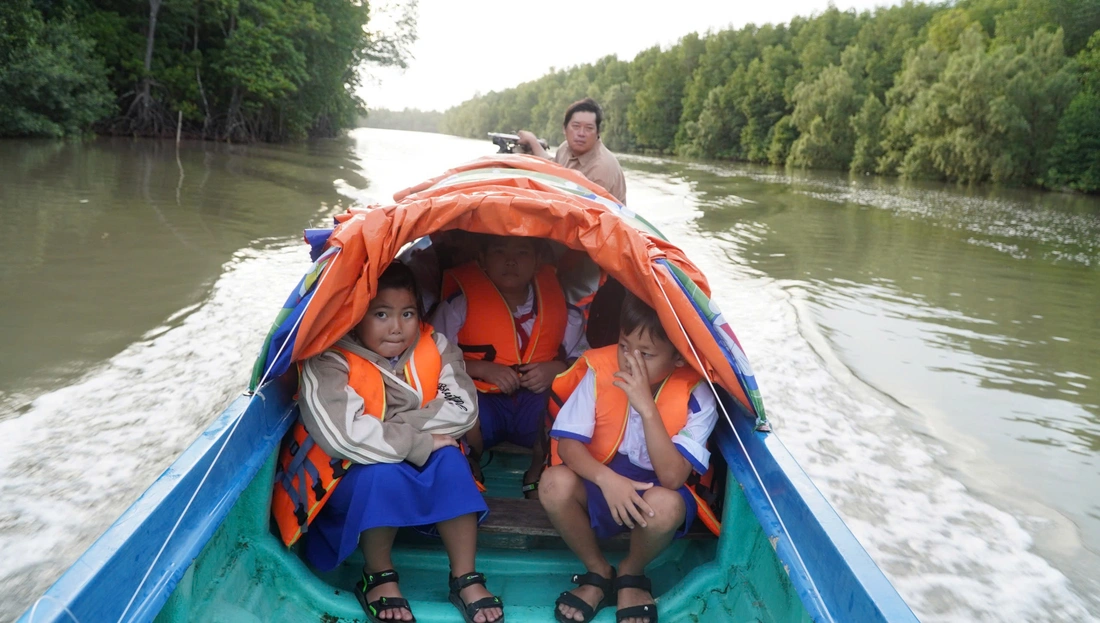
Many students in Ca Mau have to wake up at 5 am and go to school by boat or small motorboat belonging to their families... - Photo: THANH HUYEN
A school year of innovation
The 2025-2026 academic year marks the implementation of several major policies and guidelines, including the enactment of four laws on education: the Law on Teachers, the Law amending and supplementing certain articles of the Law on Education, the amended Law on Higher Education, and the amended Law on Vocational Education.
This year also saw the implementation of the national target program for the development of education and training, including tuition fee exemptions and support, organizing semi-boarding meals, and building school systems in land border communes…
Going back in time, immediately after the success of the August Revolution, the Ministry of National Education was established (August 28, 1945) with the task of building a completely new education system, of the people, by the people, and for the people.
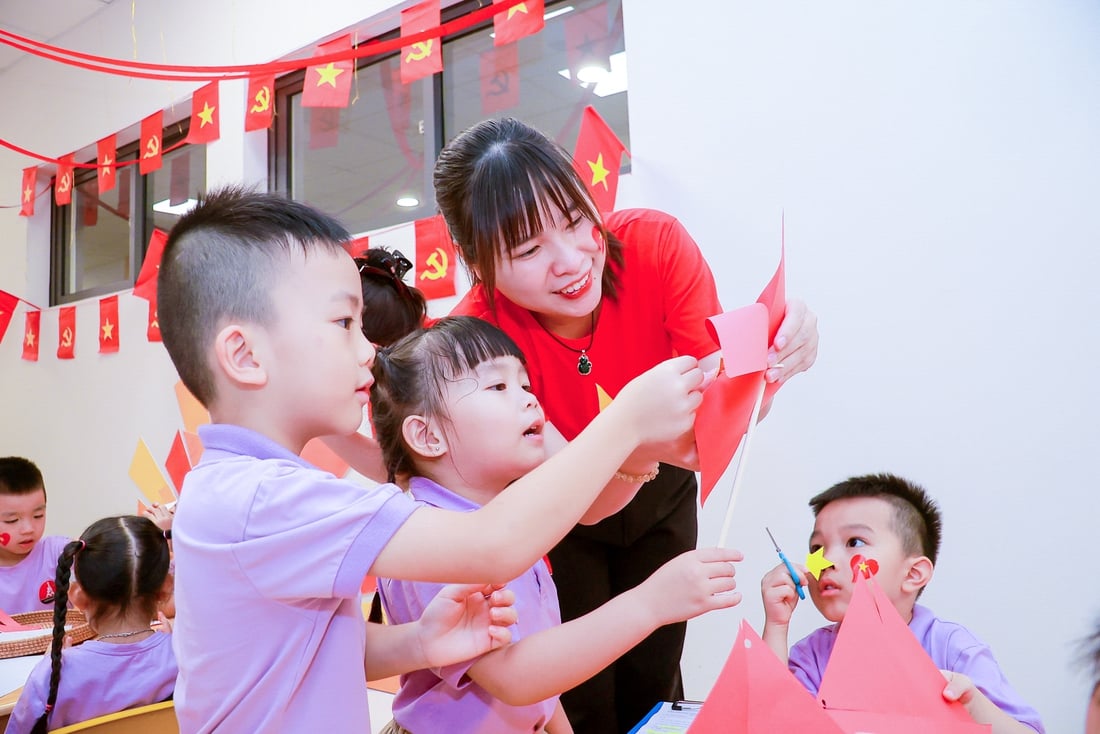
Teacher and students on the first day of the new school year - Photo: NGUYEN LAM
During the period 1945-1954, the Popular Education and Adult Education movement was a miracle, eradicating illiteracy for millions and raising the general level of education. The school system was continuously expanded to train key human resources for the cause of "resistance and national reconstruction".
Building upon the achievements of the previous period, from 1954 to 1975, North Vietnam essentially eradicated illiteracy. Tens of thousands of cadres, intellectuals, engineers, doctors, and teachers were trained both domestically and abroad in socialist countries, becoming the key force in building North Vietnam and providing support to South Vietnam.
In the South, in the liberated zones, revolutionary education proved its flexibility and resilience, building a network of democratic schools and training cadres to serve the resistance.
The most outstanding achievement of education during the period 1975-1986 was the successful unification of the national education system. The network of schools from preschool to university was maintained and expanded; success was achieved in eradicating illiteracy and raising the general level of education. This was also the period for building a comprehensive system of educational guidelines and policies, which became the guiding principles for the sector's activities for a long time.
From 1986 to the present, the system of policies and laws on education has been continuously improved, clearly demonstrating the viewpoint that "education and training is a top national priority." In particular, Resolution No. 29-NQ/TW identifies fundamental and comprehensive reform of education and training, shifting from primarily equipping students with knowledge to developing their comprehensive qualities and abilities...
Source: https://tuoitre.vn/sang-nay-thay-tro-ca-nuoc-don-le-khai-giang-dac-biet-20250904215152619.htm








![[Photo] General Secretary and President To Lam, Party and State leaders attending the 11th National Congress of the Vietnam Fatherland Front](https://vphoto.vietnam.vn/thumb/402x226/vietnam/resource/IMAGE/2026/05/12/1778554897970_cf48ede3-c862-4633-89a7-ff86d87cab94.jpeg)









































































Comment (0)