

The workshop attracted the participation of more than 200 experts, doctors, medical staff, and researchers in the fields of oncology, biotechnology, precision medicine, etc., from both domestic and international backgrounds.
At the workshop, speakers and delegates discussed and updated on advancements in technology and the practical application of liquid biopsy in cancer screening and early diagnosis; supporting drug selection, targeted therapy regimens, and treatment monitoring and prognosis.
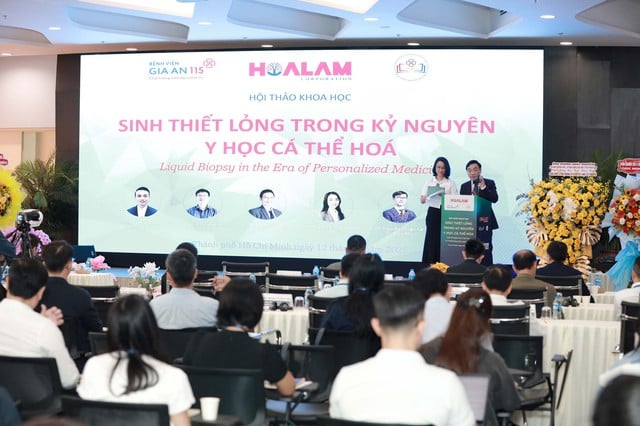
Dr. Nguyen Duc Loc, Acting Executive Director of Gia An 115 Hospital, delivered the opening remarks at the workshop.
Photo: T. Ha
Presenting an overview of liquid biopsy in cancer, Dr. Meng Earn Lim from QIAGEN Singapore Pte. Ltd stated that liquid biopsy is a minimally invasive method for detecting and analyzing biomarkers in the body such as blood, serum or plasma, urine, saliva, and cerebrospinal fluid. Liquid biopsy has diverse applications in cancer research and diagnosis, non-invasive prenatal screening, neurodegenerative metabolic diseases, and organ transplantation research. Specifically in cancer research, liquid biopsy is used to supplement tissue biopsy and overcome limitations such as: insufficient tumor tissue, difficult-to-access tumors, the need for frequent monitoring, and the need for more information about the molecular mechanisms of heterogeneous cancer cells (tumor heterogeneity).
According to Dr. Meng Earn Lim, the most common markers in liquid biopsies include: circulating free DNA in blood and secretions (cfDNA), circulating free tumor cell-derived DNA in blood and secretions (ctDNA), microRNAs, free RNA (cfRNA), extracellular vesicles (EVs), circulating free tumor cells (CTCs), and associated components.
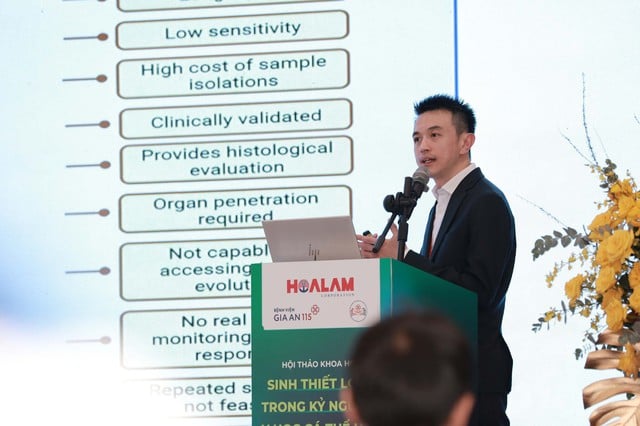
Dr. Meng Earn Lim - QIAGEN Singapore presented the following:
Dr. Nguyen Thuan Loi, from the Gene-Stem Cell Unit, Center for Nuclear Medicine and Oncology, Bach Mai Hospital, stated that cfDNA is DNA released into the bloodstream from both normal and tumor cells, primarily originating from non-tumor cells. CtDNA is tumor DNA circulating freely in the blood (a subset of cfDNA) that can be used for genotyping or MRD detection (minor cancer residue).
According to Dr. Nguyen Thuan Loi, ctDNA is present in many different types of cancer. Approximately 70 cancer-related genes exist in ctDNA form from late-stage patients who have been treated, and about 50 types of cancer are associated with ctDNA.
Dr. Nguyen Thuan Loi also cited several reports showing that monitoring with ctDNA allows for the early assessment of the response of some types of cancer, such as non-small cell lung cancer and colorectal cancer, in the context of distant metastasis. ctDNA can also reveal the presence of genetic mechanisms causing resistance during targeted therapy (for example, secondary EGFR T790M mutations in non-small cell lung cancer causing resistance to first-generation EGFR TKIs).
The presentations at the conference provided a multifaceted perspective on the technology and practical applications of liquid biopsy in clinical practice. Some notable presentations included: “Methylation-Based Breast Cancer Screening: Genomic DNA from Stem Tissue and Circulating Free DNA” by Dr. Luu Phuc Loi - Head of Scientific Research Department, Institute of Applied Health Sciences and Aging, Thong Nhat Hospital; “Application of Next-Generation Sequencing in Target Gene Identification from Liquid Biopsy Samples” by Ms. Pham Thi Tuong Oanh - Biomedic Scientific Materials Joint Stock Company; and “Liquid Biopsy Solution for Solid Tissue Cancers from Genemind” by Dr. Qin Lu - Genemind Biosciences.
At the end of the workshop, participants not only received updated in-depth professional knowledge but also received a Certificate of Continuing Medical Education (CME) issued by the Gia An 115 Institute for Medical Research and Training.
Source: https://thanhnien.vn/sinh-thiet-long-huong-tiep-can-moi-trong-chan-doan-va-dieu-tri-ung-thu-185250412160445677.htm


![[Photo] Prime Minister Pham Minh Chinh presides over a meeting on private sector economic development.](/_next/image?url=https%3A%2F%2Fvphoto.vietnam.vn%2Fthumb%2F1200x675%2Fvietnam%2Fresource%2FIMAGE%2F2025%2F12%2F20%2F1766237501876_thiet-ke-chua-co-ten-40-png.webp&w=3840&q=75)





























































Comment (0)