


A lesson in the school's program that is in collaboration with external organizations (Photo: Huyen Nguyen).
Rectify improper joint venture activities.
The information session took place amidst concerns and questions from parents in many localities regarding joint programs in public schools, especially following General Secretary To Lam 's directive to prevent schools from becoming "service establishments."
Earlier, at a meeting with voters in Hanoi , General Secretary To Lam requested that Hanoi investigate and address the situation of schools partnering with companies, bringing in outside teachers, and charging more tuition fees than the amount waived by the State.
According to the General Secretary, the State manages and is responsible for education and the universal education program. If educational institutions lack teachers, they must organize training and allocate them scientifically and rationally; they cannot bring in outside teachers to teach and collect fees from parents.
"Schools cannot be turned into service establishments," the General Secretary said, and demanded that Hanoi investigate and take action, as this "is contrary to the nature of education and causes public outrage."
In Ho Chi Minh City, many parents have recently complained that joint programs are not fully disclosed, with ambiguous information, and that students who do not participate are forced to go to the library or attend separate activities, raising concerns about unfairness in education.
Clarifying these issues, Mr. Ho Tan Minh, Chief of the Office of the Ho Chi Minh City Department of Education and Training, affirmed: "There is no concept of 'jointly affiliated subjects' or 'voluntary subjects' in schools. There is only the school's educational program, and collaboration is merely a method of organization when the school lacks sufficient resources."
According to Mr. Minh, extracurricular educational activities are conducted in accordance with Clause 1, Article 6 of Government Decree 24/2021, aiming to develop students' qualities and abilities, and meet the needs of families and society.
The first principle is to make the most of the school's available resources: teachers, facilities, clubs, and experiential activities.
Mr. Minh emphasized that schools are only allowed to contract with external organizations to organize activities if they lack the necessary resources, for example, a shortage of teachers specializing in foreign languages, sports, or arts.
Representatives from the Ho Chi Minh City Department of Education and Training frankly admitted that some school principals had not implemented the program correctly, handing over the entire curriculum to partner units, lacking professional evaluation, and failing to fully disclose the content and finances.
"The Department will strengthen inspections and require schools to publicly disclose their programs, partner organizations, participating teachers, and ensure that foreign teachers have the necessary work permits," Mr. Minh said.

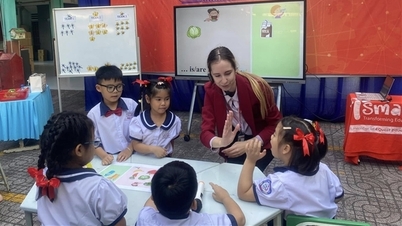
Students in Ho Chi Minh City learn foreign languages with native speakers (Photo: Huyen Nguyen).
Financially, all income and expenses from collaborative activities must be publicly disclosed, budgeted and settled according to regulations, no cash payments are accepted, and the information must be supervised by the planning and finance department and publicly available on the school's portal.
According to Official Letter 4567/BGDĐT-GDPT, the average number of lessons per week in many schools is currently higher than stipulated in the 2018 General Education Program. This has led to schools organizing additional educational activities.
These free activities include: tutoring for underperforming students, enrichment programs for gifted students, and preparation for the 10th grade entrance exam and high school graduation exam, all funded by the State budget.
Other activities such as STEM/STEAM, life skills, financial education, digital literacy, AI, foreign languages, sports, arts, etc., can be funded through social mobilization or voluntary contributions from parents.
The Ho Chi Minh City Department of Education and Training stated that it has stipulated detailed regulations on the list of fees, ensuring the principle of collecting enough to cover expenses, using the funds for the intended purpose, and setting fee levels that are affordable for the majority of parents. Any adjustments to increase fees will not exceed 15% compared to the previous school year.
Even those who don't pay tuition should have equal access to education.
Notably, the representative from the Department emphasized the need to ensure fairness in education. For students who do not register for paid activities, schools must arrange for them to participate in free clubs or other suitable activities within the same time frame, absolutely ensuring that no student is left "outside" of educational activities.
The Chief of Staff of the Ho Chi Minh City Department of Education and Training emphasized that the educational collaboration activities being implemented in the city are not for commercial purposes within schools. The ultimate goal is to improve the quality of education and develop students' abilities, not to serve business interests.
To avoid the situation of "only disclosing information after parents react," the Ho Chi Minh City Department of Education and Training said it is accelerating digital transformation. In the near future, 3,500 educational institutions in the city will have to connect their data to the Department's information portal so that management agencies and parents can directly monitor information 24/7.

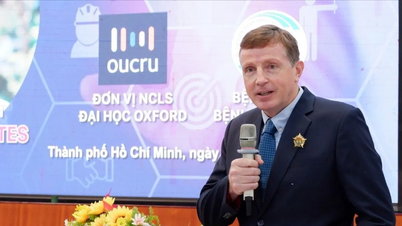
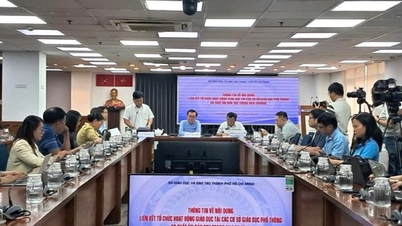
Deputy Director of the Department of Education and Training Nguyen Bao Quoc shared this information at the press briefing on the afternoon of December 18 (Photo: Huyen Nguyen).
According to Nguyen Bao Quoc, Deputy Director of the Ho Chi Minh City Department of Education and Training, the Department has organized six inspection teams to conduct on-site checks at schools. The results showed that many places implemented the program very well, but some units were still struggling with disclosing information or handling unforeseen situations.
Mr. Quoc emphasized: "The school must make the most of available resources to organize free cultural, sports, and skills-building activities for students who do not participate in the socialized program. Under no circumstances should there be discrimination or leaving any student behind simply because they haven't paid the affiliation fee."
According to Mr. Quoc, mobilizing social resources is only a supplementary solution when the school lacks the necessary resources, based on the principles of voluntariness, openness, transparency, and aiming for the holistic development of students, absolutely without commercializing education within the school.
For cases of misconduct that cause public outrage, the Department will issue reprimands and even consider disciplinary action against principals who do not comply with the guidelines.
Deputy Director Nguyen Bao Quoc hopes that the press and parents will continue to cooperate and report existing problems so that the education sector can make timely adjustments, with the ultimate goal of building a stable, high-quality school environment that approaches international standards.
Source: https://dantri.com.vn/giao-duc/so-gddt-tphcm-noi-gi-ve-chuong-trinh-lien-ket-trong-truong-hoc-20251218175158527.htm


![[Image] Central Party Office summarizes work in 2025](/_next/image?url=https%3A%2F%2Fvphoto.vietnam.vn%2Fthumb%2F1200x675%2Fvietnam%2Fresource%2FIMAGE%2F2025%2F12%2F18%2F1766065572073_vptw-hoi-nghi-tong-ket-89-1204-jpg.webp&w=3840&q=75)





































































Comment (0)