

(NLĐO) - Researchers from Harvard University (USA) have discovered an "era of life" that lasted for 200 million years on Mars.
According to a paper published in the scientific journal Nature Communications, a research team led by Dr. Sarah Steele from Harvard University (USA) discovered that Mars' magnetic field may have lasted up to 200 million years longer than previously calculated.
That provides a crucial factor for the evolution of extraterrestrial life.
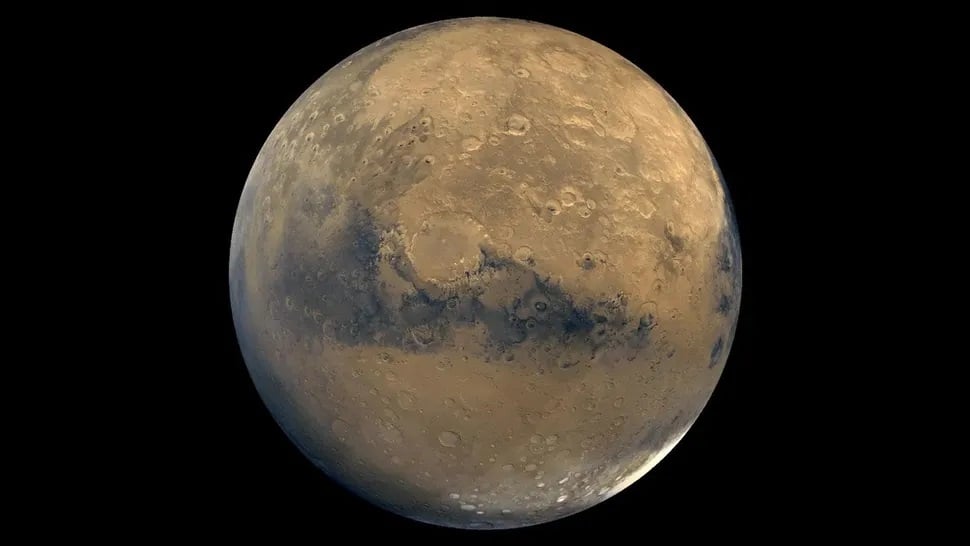
Mars may harbor life that is more advanced than we previously thought - Photo: NASA
Many previous studies suggest that Mars was born much like Earth, including abundant liquid water and a magnetic field strong enough to protect everything—including life—from the harmful effects of cosmic radiation.
According to Space.com , planetary scientists once thought that Mars' global magnetic field died out more than 4.1 billion years ago. This was due to large impact basins formed during the bombardment period between 4.1 and 3.7 billion years ago.
However, Dr. Steele and her colleagues argue that those signs have been misinterpreted.
Their analysis of parts of the famous Allan Hills 84001 meteorite on Mars indicates evidence of magnetic field reversal recorded by ferromagnetic minerals.
A computer model has reinforced this hypothesis, showing that the lack of a magnetic field at the time of the formation of the impact basins was not because the magnetic field was switched off, but simply a temporary weakening due to a magnetic pole reversal, a phenomenon that has also occurred many times with Earth.
The study also indicates, based on the new data, that Mars' magnetic field must have existed as far back as 3.9 billion years ago.
This is very important because these 200 million years overlap with the period when the planet's river and ocean systems were submerged in water.
Thus, life here had an additional 200 million years living in a favorable environment, and may have had enough time to evolve to a higher level than we previously thought.
Furthermore, if the magnetic field had disappeared later, the Martian atmosphere would have remained in a state similar to Earth's for significantly longer.
"This means that scientists' timelines of changing conditions on Mars may need a slight refinement," the research team said.
Source: https://nld.com.vn/su-song-sao-hoa-co-the-da-tien-hoa-hon-chung-ta-nghi-196241112081405851.htm

























































































Comment (0)