

 |
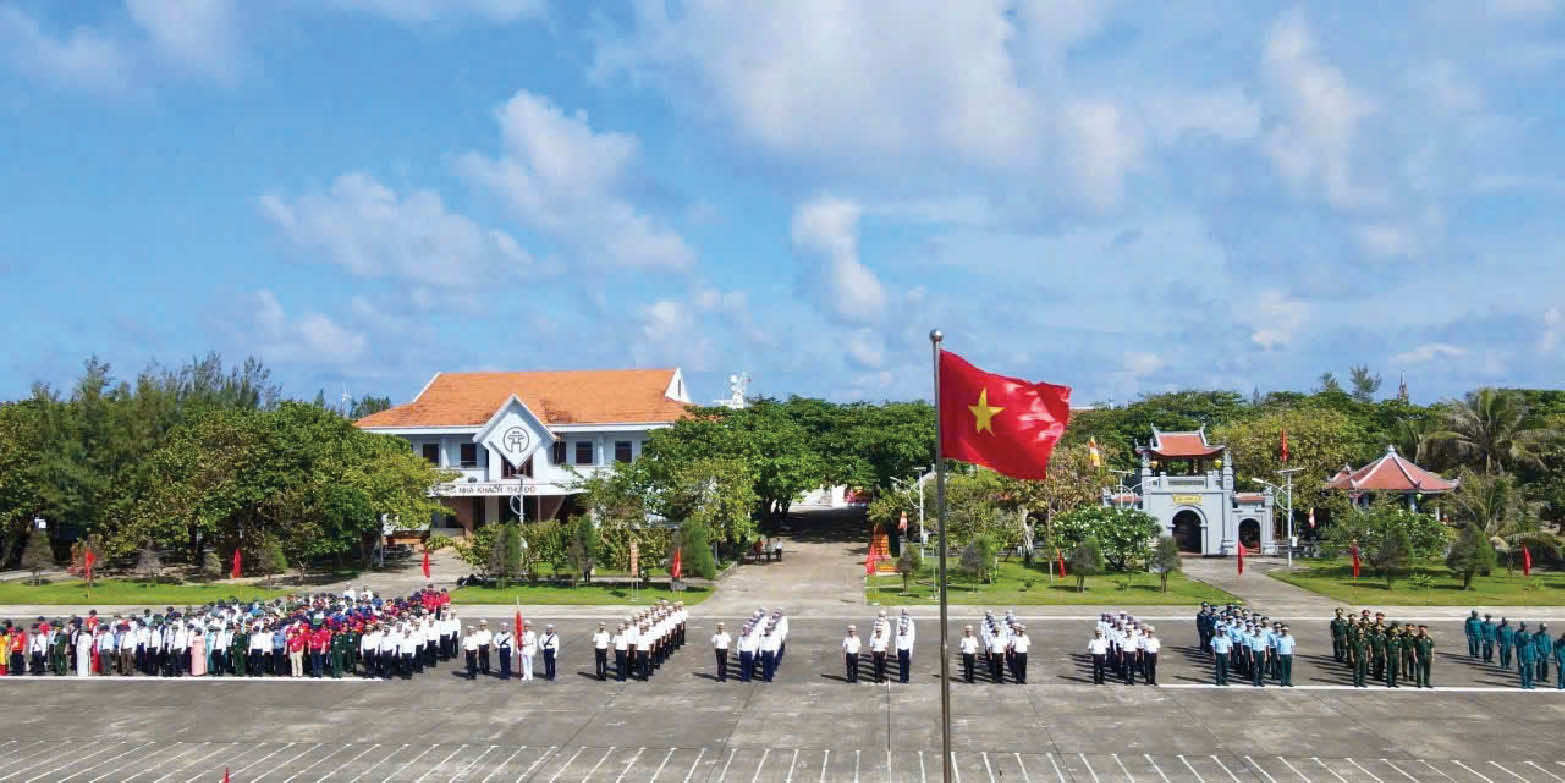
| A delegation of officials from Hue City visits Truong Sa Town (April 2025). Photo: Le Hoang Tung |
During the Spring Offensive of 1975, culminating in the Ho Chi Minh Campaign, the Party determined the strategic direction of the offensive at sea to liberate the beloved Truong Sa archipelago of our Fatherland. This policy reflects the Party's strategic vision in its determination to regain all territorial sovereignty on land as well as on the islands and in the sea and airspace of our Fatherland.
In early April 1975, acting on secret orders from the Commander-in-Chief of the campaign, General Vo Nguyen Giap, the Naval Command urgently prepared a highly elite special force, closely monitoring the situation and mobilizing the maximum number of transport ships to carry troops and combat equipment to the battlefield. While the land forces of the Ho Chi Minh Campaign began their offensive against the puppet regime's defenses at the eastern and southern gateways to Saigon, the naval forces silently braved the rough seas and strong winds to liberate the islands of the Spratly Archipelago. This was the Vietnam People's Navy, which traveled hundreds of nautical miles, avoiding radar and enemy aircraft, maintaining silent communication. Transport ships disguised as fishing vessels crossed the open sea, secretly bringing special forces to approach the islands occupied by the Saigon army.
On April 14th, naval troops landed, attacked, and took control of Song Tu Tay Island. Under favorable conditions, forces from Song Tu Tay Island landed and opened fire to liberate Son Ca Island. Following this, seizing the opportunity, we quickly liberated and took control of Nam Yet Island, the enemy's command center in the Spratly Islands. With a spirit of rapid attack, our troops quickly liberated Sinh Ton Island, and by the morning of April 29th, 1975, completed the landing and take control of Truong Sa Lon Island. The liberation of Truong Sa contributed to completing the offensive strategy involving land, sea, and air in the campaign to completely liberate the South and unify the country. This victory affirmed Vietnam's undeniable sovereignty over the Spratly Islands, ushering the archipelago into a new phase.
Since its liberation, Truong Sa has gradually transformed from a poor, remote sea area into a strategic, economic, and cultural region of Vietnam. Anyone who has had the opportunity to visit Truong Sa in the past decade and today has witnessed the remarkable changes in the appearance of the Truong Sa island district.
With the spirit of "The whole nation for Truong Sa, Truong Sa for the whole nation," Truong Sa today boasts a fairly well-developed and increasingly modern infrastructure. The islands such as Truong Sa Lon, Song Tu Tay, Sinh Ton... all have housing, clinics, schools, administrative offices, radio stations, and solar power systems. The vibrant green of vegetables, flowers, and trees like the Barringtonia and Terminalia catappa trees is full of life. The submerged and rocky islets, strategically important for protecting maritime sovereignty, have also been developed with sturdy housing, radar stations, lighthouses, and sovereignty markers... standing firmly in the open sea.
The modern defense system has been strengthened, ready to protect sovereignty in all situations. The large Truong Sa airport has been expanded with a 1,300m runway to serve transport aircraft and helicopters. The island district has four harbors at Song Tu Tay, Da Tay, Truong Sa, and Sinh Ton, with the capacity to accommodate hundreds of large vessels for anchorage, rest, and shelter from storms.
Schools and clinics have been built in a modern and spacious manner. Memorials to President Ho Chi Minh, martyrs' memorials, pagodas, and cultural centers on the islands serve as places for educating the military and civilians about revolutionary traditions and national culture, bringing the island district closer to the mainland. The government and people of the island district actively and proactively overcome difficulties, boost production, and improve the efficiency of fishing and aquaculture, contributing to raising the economic living standards of the military and civilians. At the same time, special attention is paid to creating favorable conditions for local fishermen to exploit and fish in the Truong Sa archipelago, providing a solid foundation for fishermen to confidently venture out to sea and contribute to building the island district into one that is "strong in defense, good in lifestyle, beautiful in environmental landscape, and exemplary in military-civilian solidarity."
Mr. Le Hoang Tung, Head of the Party Organization and Membership Department of the Hue City Party Committee's Organization Board, recently had an emotional trip to the Truong Sa archipelago, saying: “We had heard about and learned through the media about the changes in Truong Sa district. But in the past few days, seeing it firsthand, each of us couldn't help but feel special emotions about the transformation, modernization, and yet profound peace of the Truong Sa archipelago in the middle of the ocean.”
During the same trip, Ms. Hong Nga from the Propaganda and Mass Mobilization Department of the City Party Committee shared her feelings: “It was an honor to visit the island district right on the occasion of the 50th anniversary of the liberation of the South and the reunification of the country. We were moved to walk amidst the green trees and fruit trees, to watch children running and playing with their clear laughter under the flag, and to see modern public works alongside the square-leaved mangroves, sea grapes, and sea almond trees... We felt even more strongly the vibrant and resilient spirit of Truong Sa amidst the vast ocean.”
Fifty years after its liberation, the Truong Sa archipelago is not only a symbol of sacred sovereignty but also a vivid testament to the unwavering will, aspiration for peace, and strategic vision of our Party and State. These days, along with the rest of the country, the military and people of the Truong Sa archipelago joyfully celebrate the 50th anniversary of its liberation. With the support of the entire nation, Truong Sa district is determined to rise to become a political, cultural, and social center at sea, a solid bulwark protecting the sovereignty of the Fatherland's maritime territory.
Source: https://huengaynay.vn/chinh-polit-xa-hoi/suc-song-moi-o-truong-sa-153021.html

![[Image] National Assembly discusses the implementation of the socio-economic development plan.](https://vphoto.vietnam.vn/thumb/1200x675/vietnam/resource/IMAGE/2026/04/20/1776696707422_ndo_br_img-20260420-185419-jpg.webp)
![[Photo] General Secretary and President To Lam meets with National Assembly delegates from ethnic minorities.](https://vphoto.vietnam.vn/thumb/1200x675/vietnam/resource/IMAGE/2026/04/20/1776696701056_a1-bnd-8331-3342-jpg.webp)



















































Comment (0)