

Extending the life cycle of straw.
In the cool weather of late year, along the rural roads in the suburban and upstream areas of Can Tho City, are lush green rice fields, thriving with the winter-spring crop. Farmers are busy tending to and protecting their rice crop for the 2025-2026 winter-spring season, hoping for a successful harvest.
Mr. Nguyen Van Thanh, from Thanh Quoi commune, happily stated: “This year's winter-spring rice crop is developing well, thanks to favorable weather, plenty of sunshine, and abundant water resources. My family sowed over 10 acres following the large-scale field model. Thanks to thorough field cleaning, the application of the '3 reductions, 3 increases' principle, and the use of organic fertilizer from rice straw as a base dressing, the rice is healthy, and production costs have decreased…”

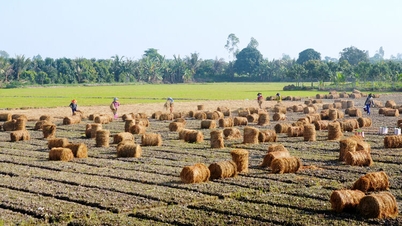
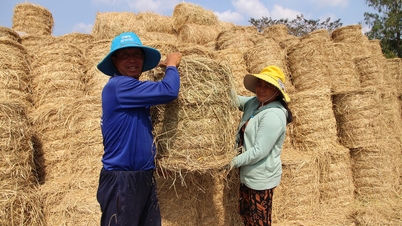
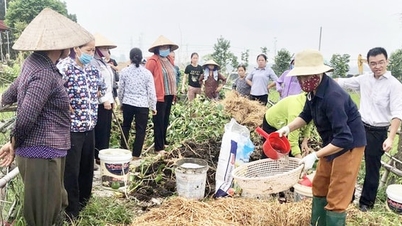
Rice straw is collected and transported to processing facilities for recycling after the rice fields in Can Tho City are harvested.
According to the Department of Crop Production and Plant Protection ( Ministry of Agriculture and Environment ), the Mekong Delta produces more than 24 million tons of rice annually, generating approximately 24 million tons of rice straw – a significant byproduct of agricultural production. In Can Tho City alone, by 2025, over 718,000 hectares of rice will be planted, yielding over 4.7 million tons, corresponding to approximately 4-4.7 million tons of rice straw.
In recent years, a large amount of rice straw left over from rice harvests in Can Tho City and the Mekong Delta has been burned or buried, causing waste, affecting biodiversity, and increasing greenhouse gas emissions. Effectively utilizing this byproduct not only reduces environmental pressure but also represents a sustainable path towards circular agriculture . In practice, managing and using rice straw in a circular manner is an effective solution to reduce emissions, enhance the rice value chain, and increase farmers' income. In Can Tho City, many localities have reduced rice straw burning and shifted to utilizing the byproduct for sale, mushroom cultivation, composting, or other production activities.
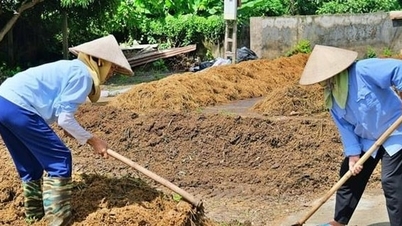
With the support of the International Rice Research Institute (IRRI) and the Department of Agriculture and Environment of Can Tho City, Minh Duc Circular Agriculture Cooperative (Thuan Hoa commune, Can Tho City) has implemented a circular economy model using rice straw. Accordingly, straw is collected after harvest to cultivate straw mushrooms; the straw residue from mushroom cultivation is then used to produce organic fertilizer, which is then applied back to the rice fields.
The Minh Duc Cooperative currently cultivates over 450 hectares of rice with 13 participating households. The first straw mushroom production season was implemented both indoors and outdoors with 2,300 bales of straw, estimated to yield approximately 100-120 tons of organic fertilizer for production. This model contributes to reducing the use of chemical fertilizers, improving soil, protecting the environment, and reducing greenhouse gas emissions.
Prospects for circular agriculture
The project to sustainably develop 1 million hectares of high-quality, low-emission rice in the Mekong Delta by 2030 (the 1 Million Hectare Project) is being implemented, not only contributing to increasing people's income but also affirming the position of the Vietnamese rice industry's value chain; in which rice straw is utilized for mushroom cultivation and organic fertilizer production, increasing value from the fields.
Mr. Le Thanh Tung, Vice President of the Vietnam Rice Industry Association, stated: “Rice straw management should focus on utilizing it as a raw material for mushroom cultivation, construction materials, energy production, and organic fertilizer. Applying on-site rice straw decomposition technology increases efficiency; building circular agriculture models, collecting and reusing rice straw not only contributes to increasing income per unit area of cultivation but also minimizes environmental impact and adapts to climate change in agricultural production.”
The 1 million hectare project aims to collect and reuse 100% of rice straw by 2050, along with building a database and software to support straw management. Simultaneously, it will apply environmentally friendly straw processing technologies, encourage circular agriculture models, and utilize rice straw as a raw material for high-quality agricultural production.

In the large-scale rice farming model in Can Tho City, rice straw is collected after the rice is harvested.
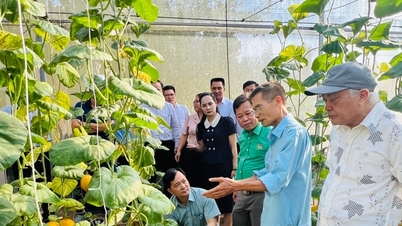
To achieve the above goal, in Can Tho City, the Department of Agriculture and Environment, in coordination with other departments, agencies, associations, organizations, scientists, and the International Rice Research Institute (IRRI), is implementing in-depth activities to enhance the capacity of technical staff, meeting the requirements of the new situation. Ms. Nguyen Thi Giang, Deputy Director of the Department of Agriculture and Environment of Can Tho City, said: “With the attention of the City Party Committee, the People's Committee, and various departments and organizations, many policies and guidelines for developing circular agriculture and adapting to climate change have been implemented, contributing to improving the lives of farmers and developing rural areas. Through this, businesses are increasingly closely linked with farmers, investing in supplies and guaranteeing product purchase at favorable prices; farmers are confidently producing safely, improving the quality of agricultural products, meeting export requirements, and gradually raising the status of Can Tho City's agricultural products.”
Ms. Nguyen Thi Giang emphasized that for circular agriculture to be effective, it is necessary to reorganize production along the value chain, apply sustainable farming processes to increase the value of the rice industry, adapt to climate change, and reduce greenhouse gas emissions, contributing to fulfilling Vietnam's international commitments. Accordingly, it is necessary to focus on developing technologies that have proven economic and environmental effectiveness, especially those outlined in Decision 248/QD-TT-CLT on circular agriculture from rice straw; and simultaneously develop a plan to strengthen capacity, replicate models of circular rice straw management, promote training, and increase the rate of application of safe, sustainable, high-quality rice production, meeting the criteria of the 1 million hectare rice project.
Mr. Tran Chi Hung, Vice Chairman of the People's Committee of Can Tho City, affirmed: "Based on the achievements, Can Tho City is committed to accompanying localities, businesses, and farmers in developing an innovative agricultural ecosystem; promoting technology transfer, removing difficulties for businesses, and aiming to build a green, sustainable, circular agriculture that adapts to climate change…".
*
* *
These "green and healthy" winter-spring and summer-autumn cropping seasons are opening up a new path for the development of circular agricultural production models, instilling new confidence in farmers and the Can Tho agricultural sector about a future of higher-value and more sustainable development.
Text and photos: HA VAN
Source: https://baocantho.com.vn/tai-sinh-phu-pham-uom-mam-xanh-a198838.html
![[Photo] Admire the coral "masterpiece" amidst the million-year-old heritage of Dak Lak province.](https://vphoto.vietnam.vn/thumb/1200x675/vietnam/resource/IMAGE/2026/05/31/1780221235105_anh-man-hinh-2026-05-31-luc-16-53-27.png)

![[Photo] Solemn bathing ceremony and Buddha procession in Hue](https://vphoto.vietnam.vn/thumb/1200x675/vietnam/resource/IMAGE/2026/05/31/1780228263543_1-jpg.webp)

![[Photo] The General Secretary, President and his wife begin their state visit to the Philippines.](https://vphoto.vietnam.vn/thumb/1200x675/vietnam/resource/IMAGE/2026/05/31/1780230559452_anh-man-hinh-2026-05-31-luc-19-28-11.png)












![[Video] Sunset at Lap An Lagoon – Where the sun sets over the fishing nets](https://vphoto.vietnam.vn/thumb/340x192/vietnam/resource/IMAGE/2026/05/31/1780192137701_beach-landscape-sea-water-nature-grass-745871-pxhere-com.jpeg)


































![[Photo] Admire the coral "masterpiece" amidst the million-year-old heritage of Dak Lak province.](https://vphoto.vietnam.vn/thumb/402x226/vietnam/resource/IMAGE/2026/05/31/1780221235105_anh-man-hinh-2026-05-31-luc-16-53-27.png)


























Comment (0)