

In the Mai Anh Tuan Temple in Nga Thach commune (Nga Son district), ancient steles are still preserved, praising Mai Anh Tuan, the first Thám hoa (third-ranked scholar) of the Nguyen dynasty, a hero who embodied the "four golden virtues": filial piety, loyalty, righteousness, and courage.
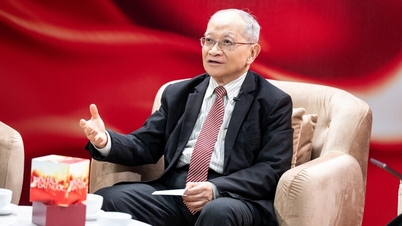
 Mr. Mai Thế Kiệm stands beside ancient stone tablets at the temple dedicated to Thám hoa Mai Anh Tuấn. Photo: Vân Anh.
The Mai Anh Tuan Temple, dedicated to the scholar Mai Anh Tuan, was classified as a National Historical and Cultural Monument in 1991. It is known by its Chinese name, "Thám hoa quan từ," but is popularly called the Temple of the Scholar Mai Anh Tuan. This is because the temple was built to honor him. He was the first person of the Nguyen Dynasty to pass the Imperial Examination, achieving the highest rank (Thám hoa) in the First Class of the Imperial Examinations, in the year of Quy Mao, the 3rd year of the Thieu Tri reign. After his death, the people erected a temple in his honor, calling it the Temple of the Scholar Mai Anh Tuan.
The temple dedicated to Thám hoa Mai Anh Tuấn is located in Hậu Trạch village (Nga Thạch commune, Nga Sơn district). The temple covers an area of 544 square meters. To the east, it borders Thạch Tuyền pagoda (an ancient pagoda built during the Lý dynasty), and to the south, it borders the Lèn river.
According to historical sources and information from the Mai family, Mai Anh Tuan's father was Mai The Trinh, the district chief of Thanh Tri, and his mother was Duong Thi Lan, from Thinh Hao village. Mai Anh Tuan's real name was Mai The Tuan, originally from Hau Trach village, Nga Thach commune. He was born in 1815 in Lang Mien village, Thinh Hao ward, Hoan Long district (now part of Hoang Cau area, O Cho Dua ward, Dong Da district, Hanoi ).
Born into a scholarly family, Mai Thế Tuấn showed exceptional intelligence from a young age. He was very studious, diligently studying the classics, often forgetting to eat because he was so engrossed in reading. At the age of 19 (1834), he passed the Tú tài (Bachelor's degree) examination, and at the age of 22 (1837), he passed the Hương examination, achieving first, second, and third place in all three stages. Unfortunately, he failed the final examination, but thanks to the "special favor" of Emperor Minh Mệnh, Mai Thế Tuấn was allowed to pass again. At the age of 25 (1840), he finally passed the Hương Tiến examination, which was a true Cử nhân (Bachelor's degree). In the third year of Emperor Thiệu Trị's reign (1843), he passed the First-Class Tiến sĩ examination, ranking third (Thám hoa). King Thieu Tri regretted that the Nguyen dynasty's law did not allow for the conferment of the title of First Laureate: "I know that Mai The Tuan's essay is far superior to the essays of the doctoral graduates of this year and many previous years," and ordered the title changed to Anh: Mai Anh Tuan to commemorate his talent (according to the book "Famous Scholars of Thanh Hoa and Learning in the Past," Thanh Hoa Publishing House).
After passing the imperial examination and achieving the rank of Thám hoa (third-highest rank), Mai Anh Tuấn was appointed to the Han Lam Academy as a writer and served as an attendant. Later, he was transferred to the position of Thị độc (a high-ranking official) in the cabinet's secretarial office, which can be understood as a secretary or representative of the cabinet, assisting the king with official documents... He was then promoted to Thị độc học sĩ (a high-ranking official scholar).
In 1851, rebellions were spreading throughout the Lang Son region, and everyone feared danger, but he eagerly accepted the king's order to take up his post in the border area. In just over a month, he led his troops to victory against the rebels at Huu Khanh, earning praise from the king. Following this, he submitted a petition requesting "to strengthen the people, train the local militia, and secretly repel the enemy." On one occasion, 3,000 rebels from Tam Duong, China, crossed the border, plundering the Tien Yen region and advancing deep into Lang Son. He, along with Commander Nguyen Dac, pursued them, initially achieving a great victory. However, Nguyen Dac was later seriously wounded, putting the vanguard at a disadvantage. Mai Anh Tuan brought reinforcements, but due to the treacherous terrain, both he and Nguyen Dac perished in battle.
Upon hearing the news, Emperor Tự Đức was deeply moved and saddened, posthumously bestowing upon Mai Anh Tuấn the title of Academician of the Hanlin Academy. The Emperor ordered his remains to be brought back and buried in Hoàng Cầu. Following the Emperor's order, temples were erected in his honor in Lạng Sơn and Thanh Hóa provinces. His memorial tablet and incense burner are placed in the Trung Nghĩa Temple in the Huế Imperial Citadel, alongside those of other famous Nguyễn Dynasty officials. His tomb and shrine are located in Hoàng Cầu village (Hanoi), where the villagers and descendants worship him.
The book "Dai Nam Chinh Bien Liet Truyen" states that Mai Anh Tuan was a scholar of great character, courteous to his subordinates, loyal to the king, and steadfast in upholding righteousness in times of need. After his death, he was remembered and mourned by scholars throughout the country, who erected a temple in his honor.
According to Mr. Mai Xuan The, a cultural official of Nga Thach commune, the site currently preserves three ancient stone steles made of solid blocks, with square bases. The tops and edges of the steles are decorated with dragons flanking the moon and chrysanthemums. A copy of the stele records the names of the doctoral graduates of the Quy Mao year, the 3rd year of Thieu Tri's reign. The inscription praises Mai Anh Tuan as a person of outstanding academic talent, a renowned child prodigy, and a national hero.
Mr. Mai The Kiem, a 13th-generation descendant and caretaker of the Mai Anh Tuan Temple for over 10 years, said: "The documents on these ancient steles have immense historical value, ensuring that future generations will always remember the contributions and achievements of Mai Anh Tuan to the country. This is also a source of pride for our family and descendants. In addition, the Mai family also preserves an ancient stone stele, a single block of stone, recording the names and titles of six members of the Mai family during the Le Trung Hung dynasty."
Van Anh
Source
![[Photo] General Secretary and President To Lam presides over a working session with the Central Policy and Strategy Committee on the development of the materials industry.](https://vphoto.vietnam.vn/thumb/1200x675/vietnam/resource/IMAGE/2026/05/21/1779359935432_a3-bnd-3129-1412-jpg.webp)
![[Photo] National Assembly Chairman Tran Thanh Man working with the Standing Committee of the Law and Justice Committee](https://vphoto.vietnam.vn/thumb/1200x675/vietnam/resource/IMAGE/2026/05/21/1779378929214_ndo_br_1-4610-jpg.webp)








































































Comment (0)