

Bamboo weaving in Vu Ha village.
We had the opportunity to visit the traditional mat weaving village in Vu Ha hamlet, formerly part of Thai Binh province, where mat weaving has been deeply ingrained in the lives of the people for generations. There are no written documents recording the exact time when mat weaving originated. However, in the memories of the elders, this craft formed very early, associated with the sedge fields along the river and the daily needs of the agricultural population in the Red River Delta. From the sedge stalks growing along the riverbanks, people would spin the fibers, dry them in the sun, and weave them into mats for their families, then sell them at the market. Thus, mat weaving grew alongside the village, enduring through each household.
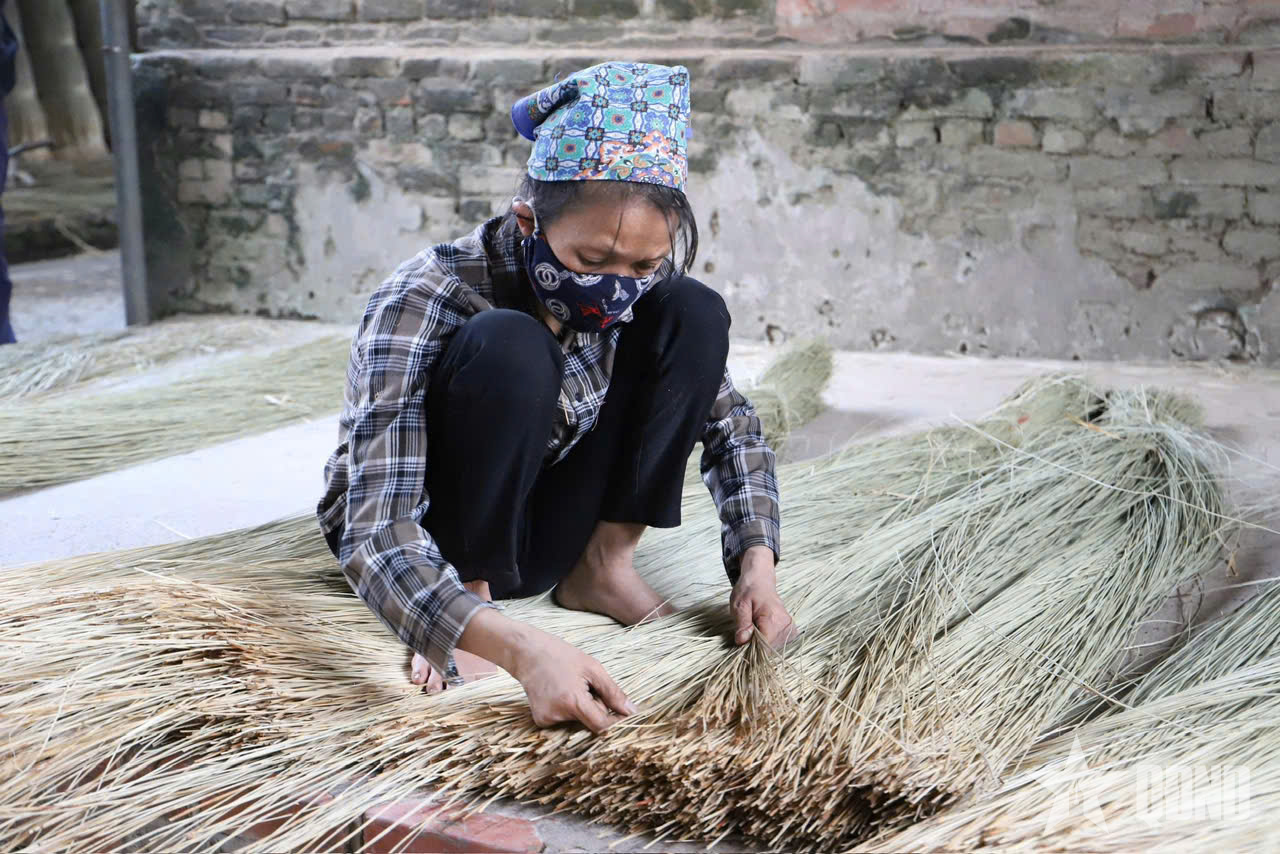 |
The sedge fibers, after being dried in the sun, are carefully selected before being placed on the loom. |
Over time, the sedge mats from this area gradually became known for their firmness, even fibers, durability, and coolness. These simple mats traveled with traders to markets throughout the Northern Delta region. At one time, Vu Ha mats became a familiar household item in many Northern families, found in everything from small houses in villages to tiled-roof houses in the towns.
For the people of Vu Ha, sedge mats are intertwined with every stage of their lives. Family meals are shared on mats spread in the courtyard. On summer nights, children lie listening to adults tell stories of the village. There were years when the whole village was bustling with activity. Some people prepared the sedge, others dried the fibers, some wove, and others printed patterns. The sound of the shuttle echoed from early morning until late at night. Each finished mat is the culmination of the sunshine and wind of the countryside, the sweat of the craftsmen, and the pride in a craft passed down through generations. From mat weaving, many families have improved their lives, built houses, raised their children, and remained in their village through difficult times.
Sunlight and dew leave their mark on the homeland.
Walking around Vu Ha village, it's easy to spot newly woven mats drying in the sun, lined up along the lanes, simple yet warm and inviting. Following directions from the villagers, we found the small house of Mrs. Nguyen Thi Ly, one of the few people still quietly clinging to the traditional hand-weaving mat loom in Vu Ha. On the porch, her hands, calloused by years, still nimbly guide each sedge fiber into the loom, rhythmically and skillfully.
 |
In the entire commune, only Mrs. Ly's family and a few other households still persevere in the traditional craft of weaving mats by hand. |
Mrs. Ly slowly shared that mat weaving is the ancestral craft of her hometown, having followed her since childhood, ingrained in her habits, and remaining a steadfast part of her life until now. Completing a pair of thick, evenly woven, and durable mats is a laborious process requiring patience and skills honed over the years. The mat weaving profession doesn't allow for haste. Each step requires meticulous attention, because even a small mistake can ruin the hard work of an entire day.
In the past, Vu Ha sedge mats were woven entirely by hand on simple wooden looms. Each sedge fiber was hand-spun, naturally sun-dried, dyed, and then placed on the loom. The weavers sat beside the loom, threading the shuttle, pedaling, and adjusting each strand with their sense of touch and experience accumulated over many years of dedication to the craft. Some days, from dawn until dusk, a weaver could only complete one mat. Each product therefore bore the mark of diligent labor and generations of traditional craftsmanship.
To produce a high-quality mat, the selection of sedge is considered a crucial step. The sedge used for weaving must be mature enough, with straight stems and a firm core. When split, the fibers should not be fibrous; when dried, they should not break brittlely. From the beginning, the sedge undergoes multiple selection processes to remove any bent, damaged, spotted, or unevenly colored fibers. Just one poor-quality sedge fiber can affect the durability and appearance of the entire mat.
The sedge is carefully separated into thin strips and then placed on the loom. The weaver uses jute as the weft thread, which is both flexible and strong, to keep the weave tight. Throughout the weaving process, the hands and eyes must work together in perfect harmony to ensure the mat is not misaligned or the weave is loose. The firmness, flatness, and sturdiness of the mat depend entirely on the skill and experience of the weaver.
After the weaving process is complete, the mats are sorted, the surface is cleaned, and then they are dried in the sun. Typically, each mat needs to be dried in five to six strong sun exposures to ensure even drying. On days with weaker sunlight, the mats must be dried longer, and the weavers always monitor them closely to prevent mold or warping. The long stretches of mat drying areas in the village were once a familiar sight, where the sun and wind contributed to the natural color and durability of the product.
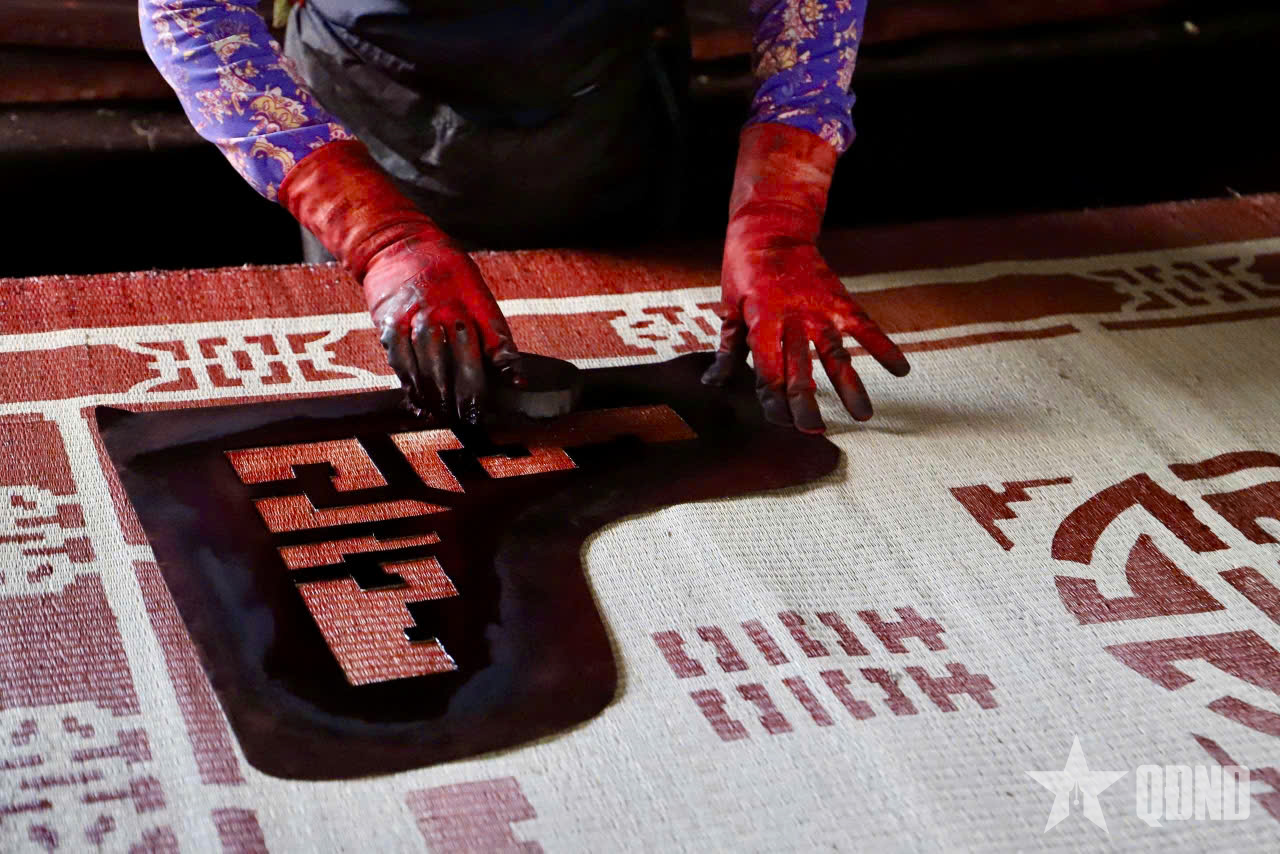 |
| Traditional patterns are hand-printed, adding an aesthetic touch to the rush mat. |
The dried mats are collected in the afternoon and ironed to flatten them, helping the sedge fibers to cling together and form a neat shape. Afterward, the mats are either printed with patterns or sewn directly for finishing, especially for plain white mats.
For floral mats, after printing, they must be steamed to preserve the colors and ensure the patterns remain beautiful over time. The final step is sewing the edges, creating a sturdy frame, increasing durability, and completing the appearance. Mats used in weddings, festivals, or as gifts are always made with more care, requiring higher standards of both quality and aesthetics.
Each finished mat is the culmination of hard work, experience, and the memories of the craft village. In every strand of sedge, the craftsman imbues it with pride in the craft passed down from their ancestors, along with the aspiration to preserve an enduring cultural tradition of the riverside countryside.
The film village in the whirlwind of change
There was a time, when the sky was still misty, the entire village of Vu Ha would awaken to the rhythmic clicking of looms. That sound echoed from one end of the village to the other, regular and persistent like the rhythm of a riverside countryside. At that time, weaving sedge mats was not just a means of livelihood, but a way of life deeply ingrained in every household and every generation.
 |
| Each step in the mat-making process requires meticulous attention to detail and patience from the craftsman. |
Currently, in the commune, the number of households still practicing the traditional craft of weaving mats can be counted on the fingers of one hand. Most of those who remain dedicated to the loom are over 50 or 60 years old. For them, sitting at the loom each day isn't just about making a living, because the income from a few pairs of mats they make isn't enough to cover the effort, but rather about "preserving the craft," preserving a part of the village's memory. Some families only manage to weave one or two pairs of mats a day, and even after selling them, they barely cover the cost of raw materials.
Sharing her thoughts with us, Mrs. Ly said thoughtfully, "I'm old now, but I still want to do this. If I give it up, my children and grandchildren won't know what the traditional craft of our homeland is like anymore." As she spoke, her hands moved swiftly, weaving rhythmically as if clinging to the last remaining strands of sedge from a craft village that is gradually fading away with time.
Faced with the challenges of the times, a new approach has emerged for Vu Ha mat-making village. No longer dependent on traders, many households have begun experimenting with selling sedge mats through social media and e-commerce platforms.
Nguyen Van Tuan (32 years old) is one of the first people in the village to boldly experiment with selling sedge mats on online platforms. According to him, directly reaching customers not only expands the market for the product but also helps those in the craft better understand consumer needs and preferences.
Feedback and suggestions from buyers become a valuable source of information for craftsmen to adjust everything from the design and size to the durability of each mat. According to Mr. Tuan, this two-way interaction has helped traditional products gradually find a new place and adapt to the pace of modern life.
Amidst the whirlwind of change, the sedge mat weaving craft of Vu Ha is finding a way to tell its story in a different way, slowly but persistently. It's a story about the village's adaptation, about the efforts of those who still cherish the loom and each sedge strand that has been a part of their lives.
Source: https://www.qdnd.vn/van-hoa/doi-song/theo-nhip-det-chieu-lang-vu-ha-1018282

![[Photo] General Secretary and President To Lam presides over a meeting with the Central Organizing Committee.](https://vphoto.vietnam.vn/thumb/1200x675/vietnam/resource/IMAGE/2026/06/03/1780482764658_a1-bnd-4741-3342-jpg.webp)

![[Photo] First session of the 14th Congress of the Vietnam Trade Union](https://vphoto.vietnam.vn/thumb/1200x675/vietnam/resource/IMAGE/2026/06/03/1780465947883_ndo_br_img-3852-jpg.webp)

![[Photo] Secretary of the National Assembly Party Committee, Chairman of the National Assembly presides over the meeting of the Standing Committee and Executive Committee of the National Assembly Party Committee.](https://vphoto.vietnam.vn/thumb/1200x675/vietnam/resource/IMAGE/2026/06/03/1780480353201_ndo_br_bnd-2585-jpg.webp)

















































![[Video] Sunset at Lap An Lagoon – Where the sun sets over the fishing nets](https://vphoto.vietnam.vn/thumb/1200x675/vietnam/resource/IMAGE/2026/05/31/1780192137701_beach-landscape-sea-water-nature-grass-745871-pxhere-com.jpeg)





































Comment (0)