

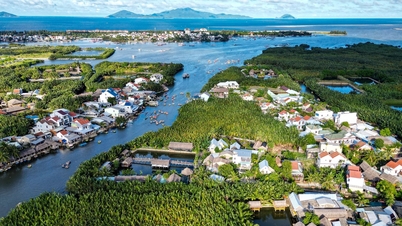
Located beside the picturesque O Loan lagoon, Phu Tan sedge mat weaving village ( Dak Lak ) is one of the oldest traditional craft villages in the South Central coastal region.
Over a century of formation and development, the sedge mat weaving profession has not only created a livelihood for hundreds of households but also become a cultural symbol, crystallizing the lifestyle, soul and identity of the community here.
Despite the vicissitudes of history and the changes of modern life, the craft village has maintained its enduring rhythm of labor.
The sound of looms echoing through the village every early morning has become a familiar sound, linked to the memories of many generations of people in Phu Tan.
From rustic rush grass to exquisite mats
The main material used to make Phu Tan mats is sedge (also known as rush), a plant that grows abundantly in wetlands and brackish water around lagoons.
The sedge is harvested seasonally, then sun-dried for several days to achieve natural dryness, after which it is split, cleaned, and sorted according to fiber size.
One of the most important steps is dyeing. In the past, people used natural dyes extracted from tree bark and forest leaves. The shades of red, yellow, and green were simple yet durable and deeply rooted in folk traditions.
Today, to meet market demands, manufacturers use industrial dyes, which help create brighter, more uniform colors while still preserving the spirit of traditional color blending.

After dyeing, the sedge is further air-dried until it reaches the desired flexibility, sheen, and is not brittle or prone to breakage.
From those seemingly simple sedge fibers, under the skillful hands of the craftsman, durable and beautiful mats are gradually formed.
The rhythm of the loom - the harmony of the craft village
Traditional mat weaving looms are made entirely of wood and bamboo, with a simple yet sturdy structure. The craft of weaving mats in Phu Tan requires two weavers working together in harmony: one person threads the sedge fibers, while the other uses a stick to press each fiber tightly.
The rhythmic "clack-clack" of the wooden blocks, interspersed with the conversations and laughter of the workers, creates a distinctive working atmosphere that is both lively and familiar. It's not just the sound of their profession, but also the rhythm of life, the "breath" of the entire village.

Each finished mat must meet stringent criteria: a flat surface, tightly woven fibers, balanced patterns, and harmonious colors. Therefore, a good mat is not just a consumer product but also has the appearance of a work of art.
Currently, Phu Tan sedge weaving village has 219 households directly involved in production, with more than 550 regular workers. The special thing is that the mat weaving profession is not picky about age: the elderly can participate in light stages such as splitting sedge, dyeing, children can help dry sedge, and wind yarn after school.
The participation of many generations in the same production process has helped the mat weaving profession become a natural “school” for passing on the profession. Skills, experience and love for the profession are quietly passed down from father to son, forming the unique identity of the Phu Tan community.
For the people here, the loom is not just a tool for work, but also a part of their childhood memories, a witness to the changes in rural life over the decades.
Preserving heritage from community to museum
Faced with the competitive pressure of cheap industrial products, the Phu Tan sedge mat weaving craft has been seeking a sustainable development direction. One of the important solutions is to link the craft village with experiential tourism and cultural tourism activities.
The establishment of the An Cu Sedge Mat Production, Service and Tourism Cooperative has marked a turning point for the craft village. Through the cooperative, people are supported to connect with travel agencies and build tours to visit the craft village. When coming to Phu Tan, visitors can not only see the process of weaving mats, but also directly experience some stages such as splitting sedge, testing weaving, and hand-dyeing.
Along with tourism development, the preservation of traditional crafts is also of concern.

The Dak Lak Museum has collected and displayed a set of traditional sedge mat weaving tools donated by Mr. Nguyen Hoang Quan, Director of An Cu Cooperative, including a loom, a loom, and many related items.
Bringing these artifacts of the craft into the museum space not only helps preserve the memory of the profession, but also helps the younger generation and the public gain a deeper understanding of the cultural value of mat weaving.
Despite numerous difficulties and challenges, the Phu Tan sedge mat weaving craft has been preserved thanks to the dedication of the artisans and the support of the local government.
The establishment of cooperatives, the development of craft village tourism, and the connection of businesses are gradually opening up a new path of development, harmonizing the preservation and exploitation of cultural values.
From simple sedge fibers, through the skillful hands of the craftsmen, mats are created every day, carrying the essence of O Loan Lagoon, the sunshine and wind of Central Vietnam, and the enduring love for their homeland.
The rhythmic sound of looms still resonates in the small houses of Phu Tan, like the heartbeat of time, reminding us that amidst modern life, a "spirit of the craft" is still being quietly preserved, continued, and spread.
Source: https://www.vietnamplus.vn/lang-det-chieu-coi-phu-tan-hon-nghe-tram-nam-ben-dam-o-loan-post1074576.vnp

![[Photo] The captivating scenery of the fragrant maple forest in Quang Tri](/_next/image?url=https%3A%2F%2Fvphoto.vietnam.vn%2Fthumb%2F1200x675%2Fvietnam%2Fresource%2FIMAGE%2F2025%2F12%2F10%2F1765353233198_lan09046-jpg.webp&w=3840&q=75)
![[Photo] Explore the US Navy's USS Robert Smalls warship](/_next/image?url=https%3A%2F%2Fvphoto.vietnam.vn%2Fthumb%2F1200x675%2Fvietnam%2Fresource%2FIMAGE%2F2025%2F12%2F10%2F1765341533272_11212121-8303-jpg.webp&w=3840&q=75)




























![[Video] The craft of making Dong Ho folk paintings has been inscribed by UNESCO on the List of Crafts in Need of Urgent Safeguarding.](https://vphoto.vietnam.vn/thumb/402x226/vietnam/resource/IMAGE/2025/12/10/1765350246533_tranh-dong-ho-734-jpg.webp)





















































Comment (0)