

In practical terms, this means that when a user asks ChatGPT a question, the result can be presented in light of previous articles from News Corp's news outlets, including major newspapers worldwide such as the Wall Street Journal, The Sun, The Times, The Australian, and The Daily Telegraph.
OpenAI needs to reach a content licensing agreement with News Corp because generative AI (GenAI) is a "voracious beast": it needs data to learn and, in return, to produce outputs. The power of this "beast" depends on the scale and quality of the training data, in addition to its algorithms.
Could the press and media once again shoot themselves in the foot by sharing their most valuable asset with a rival? Or will we all benefit from a wider availability of reliable information?

The partnership with OpenAI is expected to bring News Corp around 250 million euros over five years. Photo: OpenAI
Working with AI or fighting against it?
In fact, the "beast" ChatGPT has long been freely consuming books, articles, and content from the internet, becoming increasingly "superhuman," thereby generating profit and fame for its "owner," OpenAI. This includes online news articles, whether free, copyrighted, or proprietary content.
But now, this "free and unrestricted consumption" of chatbot models is starting to run into problems, as many news outlets and media organizations are beginning to question its legality.
It's true that ChatGPT or some other AI model is bringing shared value to humanity. But you can't just go to a bookstore or newsstand and arbitrarily buy items there and say that you need to make all those products free because they benefit humanity. Similarly, you can't demand that AI companies make all their products free.
That's why the New York Times and several other news organizations recently sued OpenAI for alleged copyright infringement. And by directly signing agreements with media companies, often very large ones, AI-generated services like ChatGPT are looking to ensure they avoid legal trouble on this issue.
Furthermore, the quality and origin of the training data are also important and can lead to inaccuracies in what the AI produces, which is why AI companies are forced to collaborate with mainstream news outlets.
This also explains why, while some news organizations are trying to prevent the use of their content, others, including the Associated Press (AP), are signing agreements with AI companies.
Be cautious and vigilant.
It remains to be seen how agreements like these will affect news organizations in general, and journalists in particular. But one thing is certain: not all news organizations around the world can independently negotiate content licensing agreements with AI companies or gain their attention like News Corp.
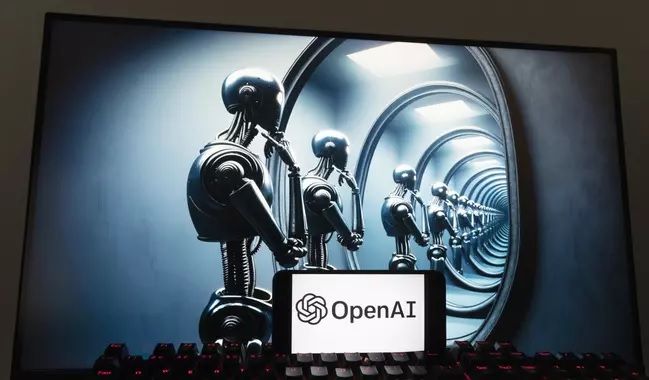
Chatbots like OpenAI's ChatGPT are likened to "voracious beasts." (Illustration: GI)
This means that once again, small and medium-sized media organizations will be pushed aside as the media giants compete for lucrative content contracts, leaving smaller organizations with only scraps of the pie or completely starved.
Technology companies like OpenAI understand that creating quality news costs money and they need licenses to use content from news organizations. Therefore, they will continue to make agreements with several major news outlets to obtain content for AI training and news for users.
This approach by AI companies will be significantly cheaper than them creating content themselves. At least buying products below production cost is already a success; how they then market these products is another matter (but surely no one can be better than them at this).
From the perspective of news organizations that receive payment from AI giants for their content, they will immediately feel they benefit, as they "suddenly" receive a large sum of money without incurring any additional costs (as we know, a digital article, whether sold to 1 or 1 million people, still costs almost the same amount).
But let's pause and think! Whether intentionally or unintentionally, this could very well be another trap set by tech giants for journalism in general. Having obtained content cheaply, these tech companies will "resell" it at very low prices, or even for free (in exchange for advertising), but on a massive scale, from local to global, thereby reaping enormous profits.
And then no readers would pay to access paid or free news sites like News Corp's anymore. Almost all of those news organizations' revenue would come from the money AI companies pay them.
Obviously, a giant like News Corp, owned by the family of media mogul Rupert Murdoch, is shrewd enough to understand that. But it's possible that, for short-term gain or because they may have other binding clauses, they believe that the aforementioned worst-case scenario will not happen.
Nevertheless, this will still be another danger for journalism. It's similar to how all the world's newspapers once handed over their content to technology platforms like Google and Facebook for free in exchange for advertising. The result was that only a few newspapers benefited, while the majority were squeezed and increasingly became tools for others to make money.
Therefore, caution is necessary for news organizations when agreeing to sell content to technology companies to use as "food" for their "hunger-filled AI beasts." Could this be yet another case of journalism shooting itself in the foot?
Hoang Hai
Source: https://www.congluan.vn/thoa-thuan-cua-news-corp-voi-openai-lai-la-hanh-dong-tu-ban-vao-chan-cua-bao-chi-post296836.html

![[Photo] General Secretary To Lam visits the exhibition space showcasing books, photo exhibitions, and achievements of digital transformation in journalism.](/_next/image?url=https%3A%2F%2Fvphoto.vietnam.vn%2Fthumb%2F1200x675%2Fvietnam%2Fresource%2FIMAGE%2F2025%2F12%2F19%2F1766110879215_1766110240024-jpg.webp&w=3840&q=75)

![[Photo] Enchanting ancient rose garden on the mountainside in Nghe An](/_next/image?url=https%3A%2F%2Fvphoto.vietnam.vn%2Fthumb%2F1200x675%2Fvietnam%2Fresource%2FIMAGE%2F2025%2F12%2F19%2F1766109900916_vuon-hong-chin-do-thu-hut-du-khach-toi-check-in-o-ha-noi-3-20162778-1671624890024-1671624890104198100259.jpeg&w=3840&q=75)





































































Comment (0)