

STO - Currently, in Phuoc Truong A hamlet, My Phuoc commune, My Tu district ( Soc Trang province), many households are involved in straw mushroom cultivation, bringing them a comfortable and prosperous life, forming a "straw mushroom farming village" for decades.
Mr. Le Van Day, from Phuoc Truong A hamlet, My Phuoc commune, shared: “I have been growing straw mushrooms for over 20 years. In 2003, my family's straw mushroom cultivation mainly followed the rice harvest season. Because there was no year-round straw, and the amount was small, the mushroom yield after harvest was not much. Since the introduction of combine harvesters, the supply of straw after rice harvest has become abundant. With 6.5 hectares of rice land, the amount of straw harvested is 800 bales/crop (1 year with 2 rice crops, yielding 1,600 bales of straw). In addition to the straw from my family's rice harvest, I buy more straw from traders who deliver it to my house for mushroom cultivation. Each mushroom cultivation cycle requires 2,000 bales of straw. With thousands of bales of straw used annually, the straw mushroom yield is over 10 tons/year, with selling prices ranging from 40,000 to 50,000 VND/kg. After deducting expenses, I pocket over 200 million VND.” VND/year.
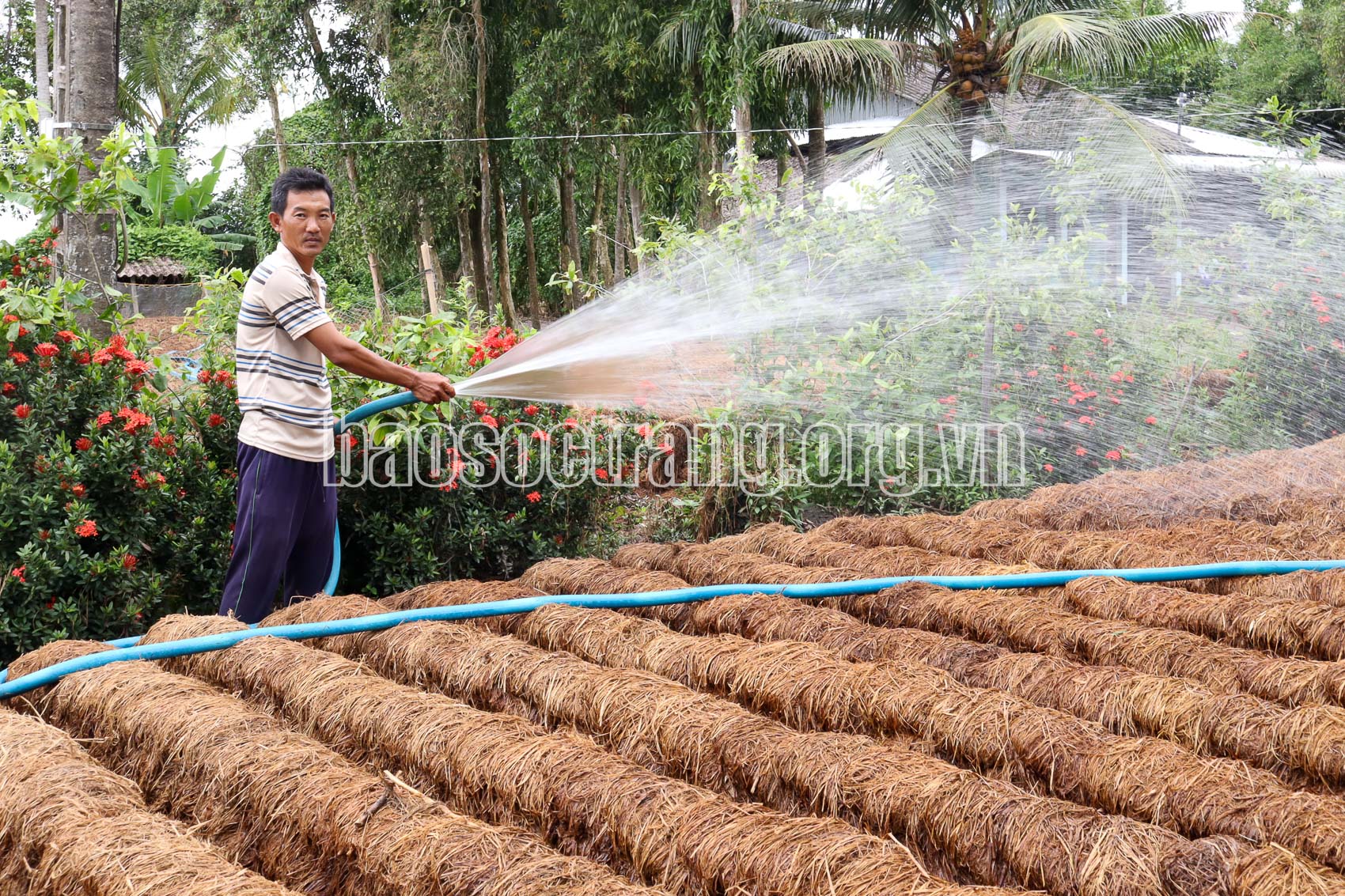
Mr. Le Van Day, residing in Phuoc Truong A hamlet, My Phuoc commune, My Tu district (Soc Trang province), is watering straw mushrooms grown right in front of his house. Photo: THUY LIEU
“The main season for straw mushrooms is from June to October (lunar calendar), but the selling price is not as good as the off-season crop from November to April of the following year. The cultivation time for straw mushrooms is short, from composting the straw to harvesting the mushrooms is 15 days, and mushrooms are harvested daily, lasting for 10-15 days until the end of the growing season (25-30 days). Mushrooms grown in the main season do not need watering; while those grown in the off-season need watering once a day. To achieve high yields, it is necessary to choose mushroom spawn with a clear origin, and the straw bales must be safe and free from pesticide contamination,” Mr. Le Van Day further shared.
Having cultivated straw mushrooms for many years, Mr. Le Minh Hung, from Phuoc Truong A hamlet, My Phuoc commune (My Tu district), shared the reason why he is dedicated to this work: “Utilizing the straw after harvesting 10 hectares of rice from my family's farm, with two rice crops per year, I have been growing straw mushrooms for nearly 20 years. Usually, after the end of the winter-spring and summer-autumn rice crops, I use all the straw to grow mushrooms, 1,000 rolls per crop. Through growing two crops of straw mushrooms per year, I earn over 100 million VND in profit.”
“Straw mushroom cultivation offers a double benefit: firstly, it generates income for farmers, and secondly, it utilizes agricultural by-products. Furthermore, after harvesting the mushrooms, the decomposed straw can be used as fertilizer for crops and ornamental plants. In addition, straw mushroom cultivation creates jobs, reduces the burning of straw, minimizes environmental pollution, and decreases greenhouse gas emissions. Going forward, the Provincial Agricultural Extension Center will strengthen the organization of training courses to transfer scientific and technical knowledge on straw mushroom cultivation processes throughout the province, so that farmers can learn and develop mushroom cultivation models at home, thereby increasing their family income,” informed Mr. Vo Van Be, Director of the Soc Trang Provincial Agricultural Extension Center.
THUY LIEU
Source


![[Image] Central Party Office summarizes work in 2025](/_next/image?url=https%3A%2F%2Fvphoto.vietnam.vn%2Fthumb%2F1200x675%2Fvietnam%2Fresource%2FIMAGE%2F2025%2F12%2F18%2F1766065572073_vptw-hoi-nghi-tong-ket-89-1204-jpg.webp&w=3840&q=75)



























































Comment (0)