

Spreading these models
Thanks to a breeding cow donated by the Border Guard Command and the Women's Union of Dak Lak province, after 5 years, the family of Ms. Nguyen Thi Thoa (47 years old, residing in An village, Ia Lop commune) has escaped poverty sustainably. Recounting her journey of overcoming hardship, Ms. Thoa shared: “Previously, due to a lack of capital and barren land, only one crop could be grown per year, so my family always struggled financially. Knowing our situation, the Women's Association of Ia Lốp commune connected us with the Border Guard Command and the Women's Union of Dak Lak province, who provided my family with a cow. With the dedicated guidance of the officers and soldiers of the Ea H'leo Border Guard Post on breeding techniques and support in terms of funding, materials, and labor for building a barn and planting grass, my husband and I boldly borrowed money to buy another cow. Now, our herd has eight cows. By selling calves and cow manure to local people for growing vegetables and rice, my family earns a surplus each year, enough to cover the children's education.”
Having lost her husband prematurely, Ms. Luong Thi Ninh (47 years old, residing in Dai Thon village, Ia Lop commune) struggled to raise her two children who were of school age. Thanks to the "Accompanying Women in Border Areas" program, which donated 20 pairs of egg-laying chickens, Ms. Ninh's flock now numbers in the hundreds. Although still classified as a poor household, the lives of Ms. Ninh and her children are now much better than before.
 |
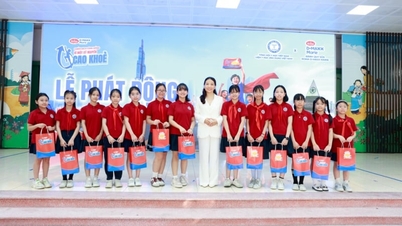
Border guards from Dak Lak province and their affiliated units presented gifts to children in Song Cau ward. |
In Song Cau and Xuan Dai wards, and the communes of O Loan, Buon Don, Ia Rve, Ia Lop, Ea Bung, etc., thanks to the attention and assistance of local Party committees and authorities, and the practical effectiveness of the program, dozens of female cadres, members, and women with congenital disabilities, serious illnesses, and difficult circumstances have gradually escaped poverty. Models such as the "Godmother" program; the Women's Club for preventing illegal border crossings; the Women's Family Club for not violating border regulations; women reporting crimes; and women fighting plastic waste, initiated and launched by the Border Guard Command and the Dak Lak Provincial Women's Union, have also attracted the participation and support of thousands of women.
Ms. Vo Thi Ngoc, Vice President of the Dak Lak Provincial Women's Union, stated: “Based on the signed cooperation program, the two units have extensively implemented the "Accompanying Women in Border Areas" program with many practical contents such as: supporting livelihoods, building economic development models, caring for women and children in difficult circumstances, disseminating legal information, and mobilizing people to participate in protecting border sovereignty and security. After Dak Lak and Phu Yen merged and implemented a two-tiered local government system, Dak Lak province now has both a maritime and a land border, with a wider operational area. We have promptly reviewed and adjusted the content and methods of coordination to ensure clarity of tasks and responsibilities, focusing on grassroots activities and strongly oriented towards specific areas and beneficiaries. Through this, we have gradually improved the effectiveness of coordination, contributing to strengthening people's trust and promoting the role of women in socio-economic development, building and protecting territorial sovereignty.”
Many creative approaches
During the recent April regular meeting of the Women's Club for Preventing and Combating Border Crossing in Ia Lốp commune, officers and soldiers of the Ea H'leo Border Guard Post dedicated most of their time to disseminating information and helping women understand the basic principles of the National Border Law and the Vietnamese Border Guard Law; actively promoting and encouraging relatives and family members not to secretly cross the border illegally to hunt wild animals, exploit forest products, or engage in freelance labor; and promptly informing the authorities, specifically the Border Guard, if they spot strangers crossing the border area, so that timely intervention and handling can be carried out.
Along the coast, to gradually raise awareness and promote compliance with the law among fishermen, the Border Guard goes door-to-door, knocking on every boat and meeting with every household head to disseminate information and encourage participation. Through persistent effort, many women have now not only benefited from the program but also actively participated in protecting sovereignty, maintaining security and order, and providing valuable information to help the troops improve the effectiveness of combating illegal, unreported, and unregulated (IUU) fishing, preventing illegal border crossings and smuggling... contributing to strengthening national defense and security, and building a solid "people's defense" in the border areas of the Fatherland.
Since its implementation, dozens of women have received livelihood support, access to loans, and technology transfer; many public works projects have been completed; and effective models for economic development, environmental sanitation, and building civilized families have been implemented. With increasingly large resources mobilized, the support methods have gradually shifted from individual to systemic, and from short-term to sustainable. More importantly, the program has contributed to changing mindsets, inspiring a spirit of self-reliance and self-improvement among women in border areas.
Through hands-on guidance, the Women's Union and border guards actively coordinated and guided women in developing effective models for raising cattle, hybrid pigs, goats, and egg-laying chickens, creating a foundation for expansion and contributing to women's escape from poverty and legitimate wealth creation. Thanks to the program's effectiveness, many families now have stable lives, many villages have gained additional resources, and many orphaned children have been able to attend school.
Major Nguyen Bao Lan, Deputy Head of Political Affairs of the Dak Lak Provincial Border Guard Command, said: "The models of 'Godmothers,' 'Children adopted by border guard posts,' 'Helping children go to school,' and 'Border guard spring brings warmth to the people'... are highlights in the coordination work of the two units in the past time. Currently, the Provincial Border Guard Command is sponsoring and supporting 64 students with particularly difficult circumstances. In addition, the unit also supports 325 ethnic minority students with difficult circumstances under the 'Army officers and soldiers helping children go to school' project with a support level of 7.4 million VND/year/child. For the three children who are 'children adopted by border guard posts,' the soldiers directly welcome them to the post to care for, guide, and support their studies, helping them strive to become good children and excellent students."
In the coming period, the two units will continue to strengthen coordination to improve the quality of legal education and awareness for officials, members, and women in border areas; promote livelihood support and sustainable poverty reduction associated with digital transformation; replicate self-governance models and protect border sovereignty; strengthen social welfare activities and care for women and children; and further promote the role of women, so that each woman truly becomes a "living landmark," contributing to affirming and firmly protecting the territorial sovereignty of the Fatherland.
Source: https://www.qdnd.vn/xa-hoi/chinh-sach/tich-cuc-dong-hanh-ho-tro-phu-nu-bien-cuong-1041442

![[Photo] Standing Committee member of the Party Central Committee Tran Cam Tu working with the Central Inspection Committee](https://vphoto.vietnam.vn/thumb/1200x675/vietnam/resource/IMAGE/2026/05/28/1779969579668_ndo_br_bnd-2495-jpg.webp)





































































Comment (0)