

Doraemon novels can be considered a rather unique phenomenon in Asian popular culture over the past two decades. Initially, Doraemon was just a simple children's comic book created by Fujiko F. Fujio, telling the story of a robotic cat from the future and the clumsy boy Nobita. However, over time, the series' vitality has transcended the boundaries of ordinary manga to become a fictional world capable of expanding into many different storytelling forms, including Doraemon novels.

The Doraemon novel "Nobita and the Castle Under the Sea" has been released in Vietnam. Photo: KĐ.
It's noteworthy that the Doraemon novels not only co-starred with the movies, but also flourished among fans in many countries. The number of people watching the Doraemon movies and the number of people reading the Doraemon novels are almost equal.
The emergence of Doraemon novels first and foremost shows that a generation of readers has grown up with this series. As children, people loved Doraemon for its magical gadgets and exciting adventures. As they grew older, many saw deeper meanings in the story, such as Nobita's loneliness, family pressure, fear of the future, or the desire to change their fate. Therefore, the Doraemon novel format has the significance of delving into the characters' inner lives, expanding on areas that the comic book version doesn't have the opportunity to explore. In prose, Doraemon is no longer just a fun story for children, but sometimes carries a nostalgic, philosophical, and even slightly melancholic tone of adulthood.
Furthermore, the phenomenon of Doraemon novels also reflects the widespread influence of entertainment products in the digital age. Many people write new stories based on the world of Doraemon, creating unique versions such as an adult Nobita, Doraemon disappearing, or touching endings about friendship and time. Some works demonstrate positive creativity, while others are pushed in a tragic or overly gloomy direction to attract attention. This shows that Doraemon has transcended the status of a mere comic book to become a "collective memory" for many generations of Asian readers.
It can be said that the phenomenon of the Doraemon novels proves that a children's work can still endure in the hearts of adults. This lasting appeal doesn't lie in the magical gadgets, but in the very human feeling the series evokes, because everyone has been vulnerable like Nobita, longed for a constant friend like Doraemon, and wished to return to their childhood to rectify unfinished business.
Every year, the Doraemon brand releases a new movie, a familiar tradition for fans. This year, the movie "Doraemon: Nobita and the Castle Under the Sea" is a remake of the classic 1983 film of the same name. This time, the story takes Nobita and his friends on a journey to explore the mysterious underwater world, inspired by the legend of Atlantis and Jules Verne's famous novel "Twenty Thousand Leagues Under the Sea".
When the movie "Doraemon: Nobita and the Castle Under the Sea" was released, a new version of the Doraemon novel "Nobita and the Castle Under the Sea" was also launched in Vietnam. The novel's story begins with Doraemon and his friends Nobita, Shizuka, Jaian, and Suneo's plan to camp underwater. Thanks to their magical gadgets, the group descends to the ocean depths, encountering the world of deep-sea creatures, driving a buggy underwater, exploring the Mariana Trench, and confronting the mysteries of the missing three-masted ship, the MU Federation, Atlantis, and the threat of Poseidon. The captivating and dramatic story builds to a climax through each chapter, from "It's summer, let's go camping!", "Adventures in the depths of the sea!", "The deepest point on Earth!" to "Heading to the demon castle!" and "Rescuing Shizuka!".

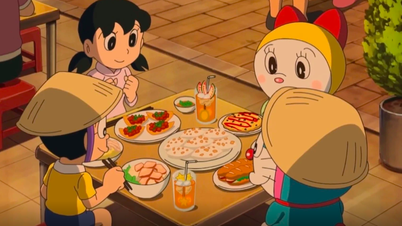
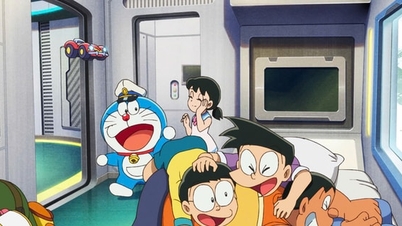
The movie "Doraemon: Nobita and the Castle Under the Sea" (2026 version). Photo: XN
The deep ocean, with its countless mysteries, becomes a captivating summer school, transforming children's curiosity into a driving force for learning. Novel concepts such as the continental shelf, continental slope, trenches, deep-sea creatures, and the Mariana Trench appear naturally during the adventure. These are "eyewitness" experiences, explained in an easy-to-understand way, interwoven into a compelling story. The author skillfully encourages children to ask more questions, observe the world, and nurture their imagination and thirst for knowledge.
Besides its adventurous themes, the new version of the Doraemon novel "Nobita and the Castle Under the Sea" is a hymn to friendship. In dangerous situations, the children don't seek safety for themselves but bravely face the challenges together. Doraemon worries when Jaian and Suneo are in danger, Shizuka stands up to protect Buggy, and Nobita tries to overcome his fear to go with his friends.
Friendship is expressed through acts of caring, willingness to admit mistakes, protecting friends, and taking responsibility. Trouble arises when the characters act impulsively, chasing treasure while forgetting the dangers. But it is from these mistakes that the children learn to admit their errors, cooperate, and grow. In the final chapter, when Shizuka is in danger and Poseidon threatens the world, the group journeys together to the demon castle, fighting together, trusting and protecting each other.
Another profound humanistic aspect of the book comes from the character of Buggy, the underwater gadget. Initially, it was simply a machine operating according to data and commands, but through its journey with Nobita and his friends, Buggy gradually came into contact with very "human" things, from memories, emotions, anxieties, to gratitude, sacrifice, and friendship.
The Doraemon novel "Nobita and the Castle Under the Sea" therefore tells not only the story of humans exploring the ocean, but also the journey of a machine learning to understand the heart. Buggy becomes the main character of the story, a true friend of the group. The victory over Poseidon is called the "victory of the heart," associated with unity, the spirit of not abandoning each other in times of difficulty, and the desire to live together peacefully.
Source: https://nongnghiepmoitruong.vn/tieu-thuyet-doraemon-phat-hanh-cung-luc-voi-phim-dien-anh-d812614.html

![[Photo] Standing Committee member of the Party Central Committee Tran Cam Tu working with the Central Inspection Committee](https://vphoto.vietnam.vn/thumb/1200x675/vietnam/resource/IMAGE/2026/05/28/1779969579668_ndo_br_bnd-2495-jpg.webp)



































































































Comment (0)