

Vinmec Central Park saves the life of a patient with a large ovarian tumor.
However, thanks to a well-structured treatment strategy and advanced surgical techniques, doctors at Vinmec Central Park (Ho Chi Minh City) successfully performed a major surgery, completely removing a malignant ovarian cancer tumor complicated by a colonic fistula.
This is a very dangerous medical condition, once considered "incurable".
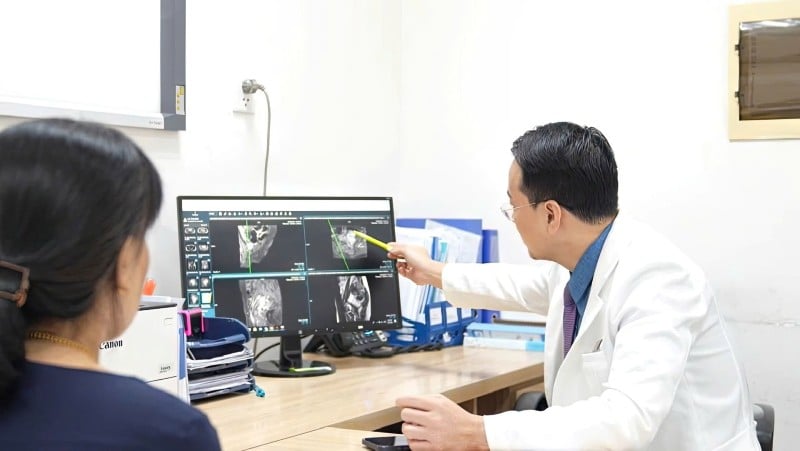 |
| The doctor is advising the patient. |
Recently, Ms. LTĐ was admitted to Vinmec Central Park International General Hospital with persistent abdominal pain, fatigue, and a weight loss of 7 kg in just 3 months.
Upon examination, the doctor discovered a 10-12 cm mass in the abdominal region, located in the left ovary, and classified as high-risk malignancy (ORADS 5). Ultrasound images and clinical examination also revealed the mass adhering tightly to the colon, containing gas inside, an extremely rare sign in ovarian tumors, raising suspicion of a fistula.
Dr. Nguyen Chi Quang, Head of the Obstetrics and Gynecology Department (Vinmec Central Park), explains in detail the tumor images and the treatment process for the patient.
Instead of immediate intervention, the doctors performed an MRI and colonoscopy to accurately determine the condition. The results confirmed the initial concerns: there was a fistula between the colon and the ovarian tumor. Immediate surgery would carry a high risk of fecal leakage, peritonitis, and the need for a colostomy.
Given the patient's weakened condition, anemia, and malnutrition, the multidisciplinary board decided to postpone surgery to focus on improving their pre-operative health.
In the 7 days prior to surgery, the patient received comprehensive care including blood transfusions, iron supplementation, and nutritional support, under the close coordination of the Hematology, Nutrition, ICU, Anesthesia, Gynecology, and Gastrointestinal Surgery departments.
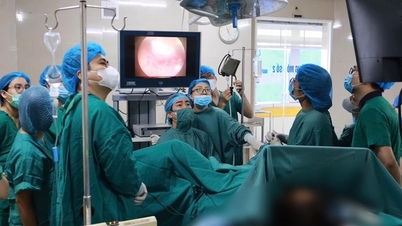
Once the patient's condition stabilized, the Vinmec medical team proceeded with a 6-hour major surgery, a collaborative effort involving Dr. Nguyen Chi Quang (Head of Obstetrics and Gynecology), Dr. Nguyen Van Nghia (Gastrointestinal Surgery), specialist William A. Casteleins, and the Anesthesia and Resuscitation team.
The tumor was firmly attached to the rectum, pelvic wall, and the entire sigmoid colon (part of the large intestine). During dissection, a perforation in the colon was discovered, confirming the diagnosis.
The surgical team performed two major surgeries simultaneously: hysterectomy, bilateral salpingo-oophorectomy, left colectomy, omentalectomy, and pelvic and aortic lymph node dissection. Notably, the surgeons used an automated bowel stapler to restore digestive continuity during the operation, avoiding the need for a temporary colostomy and shortening the recovery time.
"If we split it into two surgeries, the risks are very high. The best solution is to combine all the necessary procedures into a single operation," shared Dr. Nguyen Chi Quang, Head of the Obstetrics and Gynecology Department.
After surgery, the patient was cared for in the Intensive Care Unit, with close monitoring of her nutritional status and rehabilitation. Thanks to effective coordination among multiple specialties, Ms. D. recovered well, her spirits were stable, and she had regular follow-up appointments after discharge.
“I am very grateful to the doctors and nurses at Vinmec. Not only are they highly skilled, but they are also very dedicated and caring. My health has almost returned to normal,” Mrs. D. said emotionally.
With state-of-the-art equipment such as MRI, hybrid operating rooms, and a team of experienced specialists, Vinmec is one of the few medical facilities in Vietnam capable of performing complex major surgeries with high precision.
I suffered from allergic rhinitis and sinusitis for 2 years because of a familiar "culprit" in my house.
A 9-year-old boy in Ho Chi Minh City has just been diagnosed with allergic rhinitis and sinusitis that has lasted for two years, the cause of which stems from a very common but often overlooked factor: house dust mites.
This case was detected and treated at MEDLATEC Go Vap Polyclinic, and it serves as a warning about complacency in preventing respiratory illnesses in children.
The patient is NQH (9 years old), who for two consecutive years experienced symptoms of itchy nose, sneezing, and runny nose, which worsened particularly with changes in weather, exposure to dust, or cigarette smoke.
Recently, the nasal congestion worsened, causing the child to breathe through their mouth while sleeping, accompanied by a cough with phlegm, fatigue, frontal headache, and poor sleep. The family took the child to MEDLATEC Go Vap Multi-Specialty Clinic for examination and treatment.
Through clinical examination and imaging techniques, the doctor discovered pale, uneven nasal mucosa and fluid accumulation at the floor of the nasal cavity. A CT scan of the sinuses revealed the child had maxillofacial sinusitis, bilateral inferior turbinate mucosal thickening, and polyps in the left sphenoid sinus and left middle turbinate.
Endoscopic images showed inflamed and edematous mucous membranes. Notably, the results of the 53-allergen panel test showed elevated specific IgE levels, strongly positive for house dust mite allergens. The doctor diagnosed the child with year-round allergic rhinosinusitis due to house dust mite allergy.
After identifying the cause, H. was treated with anti-inflammatory and anti-allergic medications and advised on environmental changes to reduce exposure to allergens. She also underwent weekly follow-up examinations.
After nearly a month of treatment, symptoms such as nasal congestion, runny nose, and nighttime cough have significantly improved. The child is eating and sleeping better, no longer experiencing discomfort in the nasal and sinus area, and their health and quality of life have improved noticeably.
According to Dr. Tran Minh Dung, a specialist in Ear, Nose, and Throat at MEDLATEC Go Vap Multi-Specialty Clinic, allergic rhinitis and sinusitis is a very common disease, affecting 10-30% of the population in developed countries.
The illness can begin as early as age 2, worsens with age, and is often mistaken for a common cold due to similar symptoms. While not life-threatening, the prolonged illness seriously affects children's sleep, learning, and daily lives, and increases medical costs for families.
Among allergens, house dust mites are a common but often overlooked culprit. Dust mites are tiny arachnids, invisible to the naked eye, that commonly hide in blankets, pillows, mattresses, carpets, curtains, stuffed animals, and more.
Their food consists of shed skin cells from humans and animals. For children with allergies, even contact with a very small amount of dust mites is enough to trigger an inflammatory response, causing prolonged respiratory symptoms if not detected and treated promptly.
To prevent allergic rhinitis and sinusitis, Dr. Dung advises parents to proactively improve their children's living environment with measures such as: using dust mite-proof covers for blankets and pillows with fabric fibers ≤6 microns; washing bed sheets and pillowcases with hot water ≥55°C weekly; vacuuming with a vacuum cleaner equipped with a HEPA filter;
Keep indoor humidity below 50%; avoid using humidifiers and minimize stuffed animals and curtains in the bedroom. Additionally, you can try methods to kill dust mites using heat, hair dryers, or specialized chemicals currently under research, such as 0.1% emamectin.
Finally, parents need to be equipped with the knowledge to recognize early signs of allergies such as persistent sneezing, nasal congestion, nighttime coughing, runny nose, etc., and take their children to an ENT or Allergy-Immunology specialist for timely diagnosis and treatment.
Choosing a reputable healthcare facility plays a crucial role in accurately identifying the cause and developing an effective treatment plan, helping children recover quickly and develop healthily.
Bone grafting saves severely damaged knee joint.
Years of untreated osteoarthritis in the knee caused severe joint deformity, forcing the 55-year-old woman to use a wheelchair for an extended period. Thanks to bone grafting and knee replacement surgery at the hospital, she was able to walk normally just a few days after the operation.
Ms. Hong, 55 years old, residing in Ho Chi Minh City, suffered from osteoarthritis of the knee for many years but did not receive proper treatment, only using temporary painkillers. When she finally went to the hospital for examination, her condition was severe, requiring her to use a wheelchair. Her left knee was so severely degenerated that she could not bend or straighten it, her leg was bent inward, her gait was significantly off-center, and it affected her spine, causing back pain.
According to Dr. Dang Khoa Hoc , Head of the General Orthopedics Department at Tam Anh General Hospital in Ho Chi Minh City, the most serious aspect of this case is the large area of the medial tibial plateau being compressed, leading to structural instability of the joint. "This is a consequence of neglecting prolonged joint pain, a common mistake among older adults that allows the disease to progress silently to the point where recovery is difficult," the doctor stated.
After a specialist consultation, the doctors decided to replace the patient's knee joint with an artificial one to restore mobility. However, due to the large defect in the tibial plateau, the initial option was to use a special type of joint that requires less bone grafting but is expensive and difficult to replace a second time if needed.
To balance treatment effectiveness and cost, doctors choose the conventional artificial knee replacement method combined with autogenous bone grafting, which means taking bone from the patient's own body to fill the bone deficiency.
To minimize pain and blood loss, and to avoid removing too much bone (which would affect the donor site), Ms. Hong had an artificial wedge grafted for reinforcement.
During the surgery, the doctors used a subvastus incision technique, lifting the quadriceps femoris muscle instead of cutting it, which helps reduce pain and bleeding, allowing the patient to start exercising and recover function quickly. At the same time, the patient's leg alignment is corrected, resulting in equal legs and restoring a natural gait.
On the very first day after surgery, Mrs. Hong was able to stand up and walk without a wheelchair. She shared that she clearly felt the change: her legs were no longer aching, and she could walk with better balance and flexibility. After a follow-up visit two weeks later, both her knee and spine were stable, her back pain had disappeared, and her quality of life had improved significantly.
However, according to Dr. Dang Khoa Hoc, surgery is only one part of a comprehensive treatment process. Patients need to follow rehabilitation guidelines, avoid heavy lifting, take precautions against falls, and have regular health checkups to monitor degeneration in other joints.
Doctors recommend that older adults, especially women, should undergo regular annual osteoporosis screenings and seek specialist consultation immediately if they experience persistent joint pain.
Early detection allows for conservative treatment with medication, physical therapy, weight management, and lifestyle adjustments. If these methods are ineffective, surgery will be a necessary option. When intervention is done at the right time, the recovery rate is very high, the treatment cost is reasonable, and the risk of needing a joint replacement in the future is minimized.
Source: https://baodautu.vn/tin-moi-y-te-ngay-157-hy-vong-song-cho-benh-nhan-ung-thu-giai-doan-muon-d331225.html


![[Image] Close-up of the newly discovered "sacred road" at My Son Sanctuary](/_next/image?url=https%3A%2F%2Fvphoto.vietnam.vn%2Fthumb%2F1200x675%2Fvietnam%2Fresource%2FIMAGE%2F2025%2F12%2F13%2F1765587881240_ndo_br_ms5-jpg.webp&w=3840&q=75)




















































































Comment (0)