


The center of Ho Chi Minh City as seen from the Thu Thiem area - Photo: VAN TRUNG
In his concluding remarks at the conference, Ho Chi Minh City Party Secretary Tran Luu Quang affirmed that after a year of operation, very positive results had been achieved, most difficulties had been overcome, and localities had basically stabilized their operations, with only a few things remaining to be finalized.
Encourage competitive examinations and prioritize selecting talented individuals for the system.

Mr. Tran Luu Quang
According to Mr. Tran Luu Quang, Ho Chi Minh City has the advantage of receiving close guidance from the Central Government and the Politburo , and has many special mechanisms, including Resolution 09 and the upcoming Law on Special Urban Areas.
Therefore, in the coming period, all sectors, levels, localities, and units must be decisive and thorough in leading and organizing the implementation with concrete results and products. The core spirit is to improve "efficiency, effectiveness, and efficiency," while ensuring that the apparatus is close to the people and promptly addresses the needs of the people at the grassroots level.
Regarding personnel matters, Mr. Quang stated that the city will continue to review and adjust leadership personnel and staff at all levels to ensure they meet the requirements of actual operations. This review will be conducted for both city-level and grassroots leaders. According to him, the city has also approved a policy of exchanging personnel between areas with surpluses and those with shortages; however, this requires genuine consensus.
Notably, according to Resolution 09 of the Politburo, Ho Chi Minh City will be allowed to increase its total staff by approximately 20% in the near future. However, Mr. Quang emphasized that there will be no "one-size-fits-all" approach, but rather an encouragement of open competitive examinations and assessments, prioritizing talented individuals, outstanding students, and personnel with in-depth expertise in technology and management to join the system.
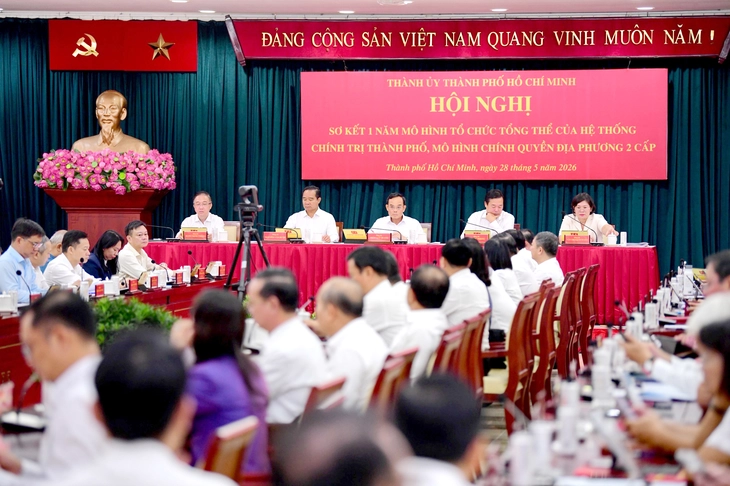
Overview of the conference - Photo: QUANG DINH
More efficient, more effective
Reporting at the conference, Deputy Secretary of the Ho Chi Minh City Party Committee, Van Thi Bach Tuyet, stated that the initial implementation of the two-tiered local government model presented certain difficulties, such as pressure to reorganize the staff and streamline the administrative apparatus; a large workload; and limited capacity for governance, management, and practical work handling at the grassroots level in some areas.
However, to date, the city's political and organizational system operates synchronously, stabilizing and achieving many results. Notably, the administrative apparatus is organized scientifically , streamlined, and operates more efficiently and effectively. The model of government is closer to the people, provides better service, and has received public support and high praise.
Ho Chi Minh City has completed the reorganization of 168 grassroots-level administrative units, and the new organizational structure has been operating stably since its implementation. The reorganization was carried out in conjunction with the Party organization system, the Fatherland Front, and other political and social organizations, ensuring the comprehensive leadership role of the Party and not disrupting the operation of the political system.
In personnel management, staff were assigned to positions in 168 communes, wards, and special zones. Simultaneously, policies were promptly implemented for 6,332 cases of resignation with a budget of over 6,094 billion VND, contributing to stabilizing morale and creating consensus within the workforce.
In addition, the city strengthened training and professional development by organizing training courses for more than 10,000 officials, civil servants, and public employees; completing 100% of the training plan, meeting the requirements for operating the new model.
Continue implementing digital transformation.

Deputy Secretary of the Ho Chi Minh City Party Committee, Van Thi Bach Tuyet, reports at the conference - Photo: QUANG DINH
However, according to Ms. Van Thi Bach Tuyet, some communes are still slow in consolidating and assigning leadership positions at the departmental level and job positions; and there is still a shortage of experienced officials and civil servants in key areas.
Many offices do not meet the required area, requiring them to be scattered across multiple locations, affecting coordination, management, and transactions for citizens. The "one-stop" software system is still under development; some administrative procedures, especially in the land sector, have not yet been fully configured.
According to Ms. Tuyet, digital transformation is identified as the operational foundation of the new model, but the technical infrastructure and data interoperability are not yet fully synchronized and unified. Data is still scattered across many industries and units, and is not yet seamlessly connected.
In addition, some legal regulations on land, housing, real estate business, public investment, public asset management, and guiding decrees need to be further reviewed and proposed for adjustment to suit the reality.
"This task requires a lot of time and manpower, while the legal staff at the grassroots level are still small and lack experience in handling emerging issues, especially those related to policy transitions," Ms. Tuyet said.

Graphics: TUAN ANH
Clearly define each milestone for achieving each objective of Resolution 09.
Also at the conference, delegates listened to and commented on presentations regarding the draft Law on Special Urban Areas, the presentation from the Standing Committee of the City Party Committee on the draft action program to implement Resolution 09 of the Politburo on building and developing Ho Chi Minh City in the new era, and the presentation from the Standing Committee of the City Party Committee on the draft plan and decision to establish the Ho Chi Minh City Press and Broadcasting Agency.
In his subsequent remarks, Party Secretary Tran Luu Quang stated that the drafting of the Law on Special Urban Areas is urgently needed to meet current practical requirements. He requested that all opinions from the conference be promptly incorporated; that the draft law be further reviewed and refined to ensure consistency, uniformity, and feasibility; and that it adhere closely to the central government's policies and directions, as well as the city's development requirements in the new phase.
Regarding the implementation of Resolution 09 of the Politburo, Mr. Quang stated that the action program clearly defines each objective and task, with completion timelines, assigned responsibilities, and especially a specific control mechanism to ensure centralized, unified, and consistent direction, and to ensure synchronization in implementation.
He also stated that the project and decision to establish the Ho Chi Minh City Press and Broadcasting Agency is a major and consistent policy of the Party and the State. The city is implementing it in the spirit of closely following the directives of the Central Government, aiming to create conditions for the professional and modern development of the press, meeting the increasingly high demands of information and propaganda work.
To concretize the special and superior mechanisms to the maximum extent in the Law on Special Cities.
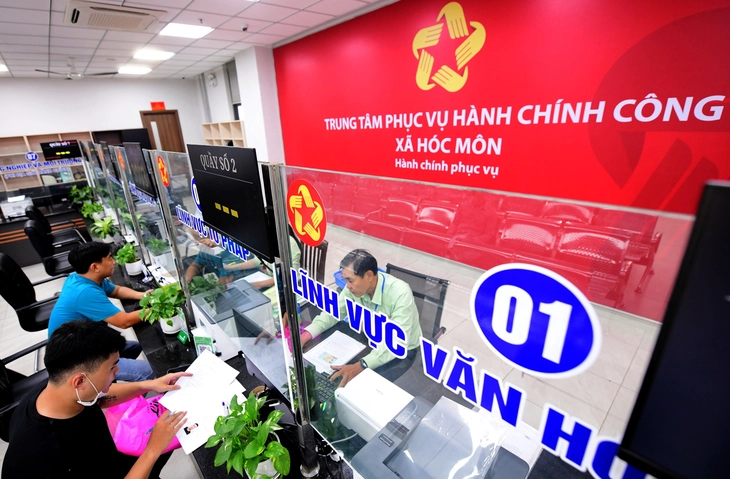
Citizens carrying out administrative procedures at the Hoc Mon Commune Public Administrative Service Center, Ho Chi Minh City - Photo: QUANG DINH
On the afternoon of May 28th, Chairman of the People's Committee Nguyen Van Duoc and Vice Chairman of the People's Committee of Ho Chi Minh City Nguyen Manh Cuong chaired a workshop to gather feedback from former central and city leaders on the draft Law on Special Urban Areas. The draft Law on Special Urban Areas currently comprises 9 chapters and 45 articles, proposing to grant Ho Chi Minh City approximately 300 powers.
Most of the feedback at the workshop focused on suggesting additions and clarifications to the scope and name of the Law on Special Urban Areas associated with Ho Chi Minh City, specifically for Ho Chi Minh City. Many also suggested that the draft law should more clearly define the decentralization and delegation of power to the city; ensuring autonomy, self-determination, and accountability for Ho Chi Minh City in developing policies and legal regulations that meet the practical requirements of Ho Chi Minh City's development in each stage, and shortening the time for applying and enforcing the law.
In addition, some opinions also emphasized the need for autonomy in organizational structure and staffing; mechanisms to protect officials who dare to think and act; and the management and use of public assets.
In his concluding remarks at the workshop, Mr. Nguyen Van Duoc acknowledged the contributions and suggestions for the City People's Committee to finalize the draft Law on Special Urban Areas.
Mr. Được emphasized that the perspective in building the Law on Special Urban Areas of Ho Chi Minh City is to concretize as much as possible the regulations on special and superior policy mechanisms so that Ho Chi Minh City can create a superior legal framework and apply and implement it immediately to ensure the development requirements of Ho Chi Minh City in the new situation. In particular, it focuses on mechanisms to remove bottlenecks in the city's development as well as regulations that create new development drivers for Ho Chi Minh City.
Source: https://tuoitre.vn/tp-hcm-bo-may-tinh-gon-gan-dan-hon-20260529084200078.htm
![[Photo] Admire the coral "masterpiece" amidst the million-year-old heritage of Dak Lak province.](https://vphoto.vietnam.vn/thumb/1200x675/vietnam/resource/IMAGE/2026/05/30/1780107638639_y25-jpg.webp)


































































Comment (0)