

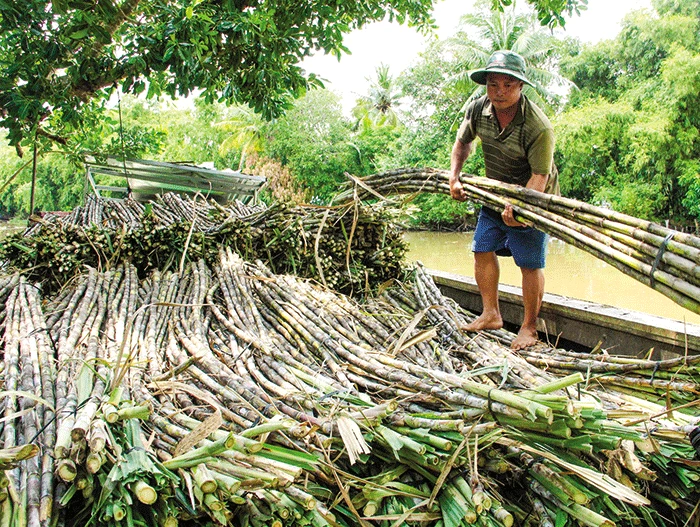
Due to slow sugarcane sales, workers in this industry are also facing difficulties.
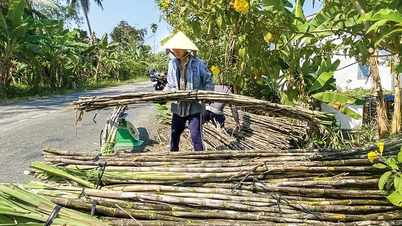
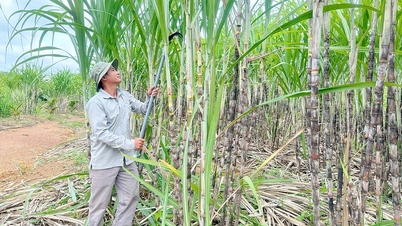
Similar to last year, this year, Mr. Nguyen Van Lip's family in Say Neu hamlet, Phung Hiep commune, Can Tho city, continues to sell their sugarcane in bundles to traders. Mr. Lip said: "With 2 acres of sugarcane, last year I earned 47 million VND from selling it to traders, but this year it has decreased to 43 million VND. For households selling sugarcane by weight, the price is 1,200-1,300 VND/kg, a decrease of about 200-300 VND/kg compared to the same period last year. With the current sugarcane prices, farmers only break even or make very little profit because investment costs have increased by about 5-10% compared to the same period last year."
According to farmers, in the past, when they sold sugarcane to sugar factories, the harvesting time for ROC 16 variety was over 10 months, and for Suphan Buri 7 (Su 7) variety it was over 11 months. However, for many years now, since the sugar factories in the former Hau Giang province (now Can Tho City) ceased operations, farmers have switched to growing sugarcane for sale in bundles to traders who then distribute it to other provinces and cities for use in beverages. The time from planting to harvesting sugarcane bundles usually only takes 8 months for ROC 16 variety, and 9-10 months for Su 7 variety. Although the harvesting time for sugarcane bundles is shorter than for raw sugarcane, due to higher investment costs, especially for fertilizer and labor, the production cost per hectare of sugarcane bundles this year is estimated by farmers at 15-16 million VND.
After selling 5 acres of sugarcane (ROC 16 variety) from her family's farm, Ms. Pham Thi Mau, residing in Say Neu hamlet, Phung Hiep commune, confided: "With the current sharp drop in sugarcane prices, the total income per acre is only about 20-22 million VND. After deducting investment costs, sugarcane farmers only earn a profit of about 5-6 million VND per acre. This amount is only enough to reinvest in the new sugarcane crop, leaving no surplus, so the lives of sugarcane farmers continue to be difficult. With the current unstable income from sugarcane, many households are considering switching from sugarcane to other crops after many years of dedication."
Currently, in addition to sugarcane farmers facing difficulties, the workforce engaged in sugarcane harvesting is also in a similar situation. This is because many sugar factories are no longer operating, and farmers can only sell sugarcane in bundles, but the demand from traders for sugarcane bundles is low. As a result, there is relatively little work for hired laborers, and some days there is no work at all.
Mr. Nguyen Van Hung, a sugarcane cutter and carrier in Hiep Hung commune, said: "We have a team of 10 people specializing in cutting, transporting, and carrying sugarcane for the locals. When the sugar factories were still operating, during the sugarcane harvest season, my team had to work all day and for more than a month. Now, when traders ask us to cut sugarcane bundles, they only require us to cut 200-300 bundles per day. The payment for cutting and transporting the sugarcane from the field to the boat is only 5,500 VND per bundle. Therefore, each person only earns between 150,000 and 165,000 VND per day."
During the period from 2010 to 2017, the area planted with sugarcane in Hau Giang province (formerly) typically exceeded 10,000 hectares annually, with some years reaching over 14,000 hectares. This was also a time when sugarcane provided an attractive source of income for farmers, as many sugar factories in the Mekong Delta region contracted to purchase and buy raw sugarcane from farmers at high prices. Sugarcane cultivation at this time helped many households escape poverty and become relatively wealthy. However, from 2018 to the present, due to difficulties in the production and consumption of the domestic sugarcane industry, the lives of sugarcane farmers have been significantly affected. Because of reduced income and difficulties in sales, people have switched from sugarcane to other crops to generate higher economic value.
According to a review by the Department of Agriculture and Environment of Can Tho City, the current sugarcane cultivation area in key regions of the city is approximately 7,700 hectares, concentrated mainly in Tan Phuoc Hung commune, Hiep Hung commune, Phung Hiep commune, Nga Bay ward, My Tu commune, and Cu Lao Dung commune. At this time, farmers have harvested more than 500 hectares to sell sugarcane in bundles, with an average yield of about 100 tons/ha.
Ms. Nguyen Thi Giang, Deputy Director of the Department of Agriculture and Environment of Can Tho City, said: Based on the two sugarcane growing areas of the former Hau Giang province and the former Soc Trang province, the Department of Agriculture and Environment will review the specific sugarcane area. From there, it will develop a plan and investment orientation for the development of sugarcane raw material areas linked to sugar factories, ensuring farmers can confidently continue cultivating sugarcane. Initially, the Department of Agriculture and Environment of Can Tho City will request professional staff in localities with sugarcane growing areas to continue promoting the transfer of scientific and technical knowledge to help farmers cultivate sugarcane with high yields and quality, thus generating substantial profits from sugarcane.
Text and photos: Huu Phuoc
Source: https://baocantho.com.vn/tran-tro-cua-nong-dan-vung-trong-mia-a188724.html























































































Comment (0)