

Israel sets new goals.
Israel's latest decisions have led observers to speculate that the country will become more resolute in its clashes with Hezbollah forces in Lebanon. On September 17, the Israeli Prime Minister's office announced that the security cabinet had officially set a fourth objective in the Gaza conflict: ensuring the safe return of residents in northern Israel. Tens of thousands of Israelis in the north have been displaced amidst bombing and shelling during the fighting between Hezbollah and Israel.
During a telephone conversation with his American counterpart Lloyd Austin on September 16, Israeli Defense Minister Yoav Gallant said that the door to diplomacy for resolving the stalemate with Hezbollah was closing. Gallant also told US envoy Amos Hochstein, who was in Tel Aviv on September 16, that as long as Hezbollah remains bound to Hamas and refuses to end the conflict, the only solution for the safe return of Israeli citizens to the north is through military action.
After being called "less effective" by Israel, Hamas claims to have gained experience and new members.
For his part, Hochstein warned that a large-scale campaign against Hezbollah would not ensure the safety of the population, but rather risked triggering a protracted war in the region. Experts assess Hezbollah's military potential as considerable, adding that a large-scale conflict with Israel would inflict significant losses on both sides, in addition to increasing humanitarian pressure.
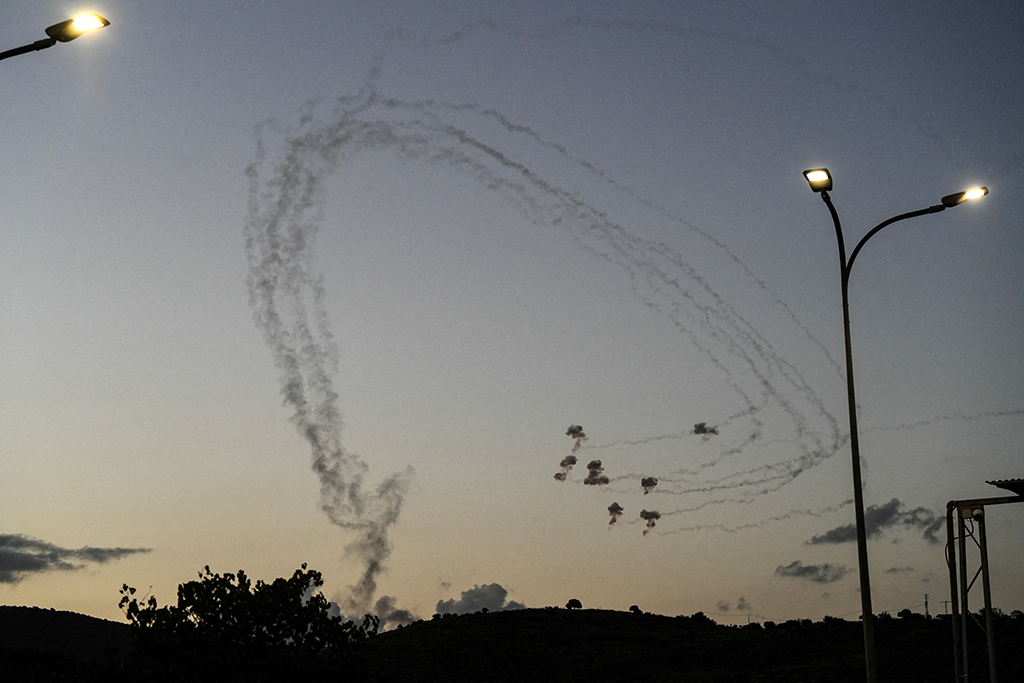
Rockets launched from Lebanon toward Israel were intercepted in the air on September 16.
In an article published in Foreign Affairs on September 12th, Assaf Orion, a former Israeli army major general and now a researcher at the Washington Institute for Near East Policy (based in the US), noted that Hezbollah has launched more than 7,600 rockets at Israel in the past year, and Tel Aviv has attacked more than 7,700 Hezbollah targets in Lebanon. "In a full-scale war, that kind of conflict could last for days," Orion stated, adding that if supported by Iranian missiles and drones, Hezbollah's arsenal would pose a significant challenge to Israel's air defenses.
Houthi escalate tensions.
In the event of a full-scale conflict, Israel would likely face not only Hezbollah, but also armed groups in Syria, Iraq, and Yemen, which have clashed with Tel Aviv to varying degrees in recent months. The Houthi forces in Yemen recently issued a warning by firing missiles into central Israel on September 15th. This was the first time Houthi missiles had penetrated so deeply into Israeli territory, according to Reuters. Following the attack, Houthi spokesperson Yahya Saree warned of more attacks against Israel in the future. Conversely, Israeli Prime Minister Benjamin Netanyahu emphasized that the Houthis would "pay a heavy price."
Houthi supersonic missiles defeat Israeli air defenses.
Foreign Policy, in an analysis published on September 11th, cited Steven A. Cook, a researcher at the Council on Foreign Relations (based in the US), who argued that the Houthi rebels have their own objectives and are likely to continue attacking Israel and obstructing cargo ships in the Red Sea even if Israel and Hamas reach a ceasefire agreement. According to Cook, the Houthi rebels are clashing with various factions in Yemen. Continuing attacks on Israel and cargo ships in the Red Sea could help the Houthi achieve political gains and build their position in Yemen.
According to The Wall Street Journal , Israel has launched numerous attacks on Houthi-controlled infrastructure in Yemen in recent months, with the aim of deterring them. However, the latest Houthi attack somewhat indicates that Israel's actions have not yet been able to deter this armed group.
Hezbollah's pagers explode in a series of explosions.
Lebanon's Ministry of Health reported on September 17 that at least eight people were killed and 2,750 injured in a series of pager explosions across the country, according to Reuters. Earlier that day, a security source said more than 1,000 Hezbollah members were injured when their pagers exploded unexpectedly. A Hezbollah official said it was the "biggest security incident" in nearly a year of escalating tensions with Israel. Al Jazeera reported that Lebanese hospitals were appealing for blood donations, regardless of type. Mehr News Agency reported that Iran's ambassador to Lebanon, Mojtaba Amani, was also injured by the pager explosions. The exploding pagers were the latest models purchased by Hezbollah in recent months, according to security sources.
Khanh An
Source: https://thanhnien.vn/trung-dong-ngoi-tren-dong-lua-185240917223312638.htm



![[Photo] General Secretary and President To Lam presides over a working session with the Central Policy and Strategy Committee on the development of the materials industry.](https://vphoto.vietnam.vn/thumb/1200x675/vietnam/resource/IMAGE/2026/05/21/1779359935432_a3-bnd-3129-1412-jpg.webp)




























































































Comment (0)