

The forward-thinking vision of a modern medical university.
On June 12, 2025, the Government issued Decision No. 1131/QD-TTg, establishing 11 national strategic technology groups and 32 priority product groups for development. Among these, artificial intelligence (AI) and biotechnology, especially stem cells and gene technology, are considered two important pillars in the future development of healthcare .
With a forward-thinking vision, Phan Chau Trinh University (PCTU) has early on shaped its medical university model based on two strategic pillars: AI & Big Data, and modern Biotechnology.
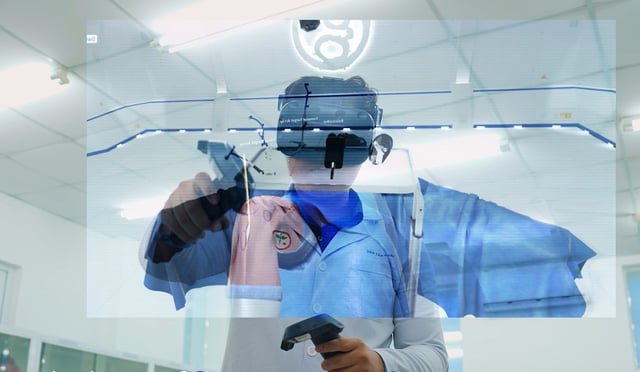
Students learn anatomy using virtual reality models.
AI and Big Data in Education , Research, and Clinical Practice
AI and Big Data create a "second brain" in training, research, and diagnosis. Applying AI to medical education helps students access global knowledge while personalizing their learning through specific "medical prompts," thereby developing systems thinking and data-driven clinical decision-making.
In research, AI assists in analyzing large volumes of medical records and paraclinical results, thereby modeling pathologies, predicting treatment outcomes, and building diagnostic support algorithms—the foundation of data-driven medicine.
In the clinical field, PCTU implements a Treatment Decision Support System (CDSS), AI in medical image analysis (MRI, CT, endoscopy), and patient management, helping to improve accuracy, reduce medical errors, and increase the effectiveness of early treatment.
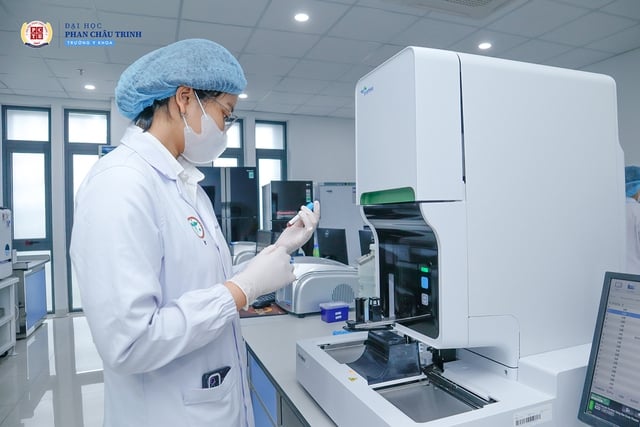
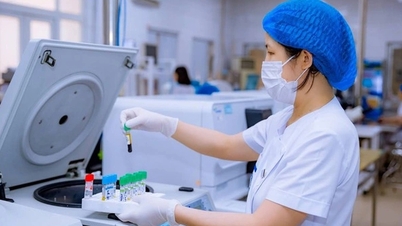
PCTU's laboratory science students are doing their internship at the Pathology Department of the hospital.
Biotechnology: From Stem Cells to Gene Editing
Along with AI, biotechnology is the second pillar that has received substantial investment at PCTU. The Biomedical Research and Application Center (BMAC) focuses on stem cell research, tissue culture, and regenerative therapies – with the potential to revolutionize the treatment of chronic diseases, musculoskeletal disorders, neurological disorders, post-surgical injuries, and more.
The university's Genomic - PCR - CRISPR laboratory serves genetic research, gene mutation screening, and personalized treatment. The application of CRISPR gene editing technology opens up possibilities for early intervention in genetic diseases, cancer, and metabolic disorders.
PCTU also internationalizes its research through collaborations with centers in Japan, South Korea, Germany, the United States, and other countries, aiming to bring advanced technologies into clinical practice domestically.
Training the doctors of the future.
PCTU aims to cultivate a model of a doctor who is also a data analyst and practitioner of precision medicine. The training program follows the CBME (Competency-Based Medical Education) model, with personalized and practical competency-based assessment.
Students learn through over 2,000 common clinical scenarios, supported by AI assistants for research, analysis, and management. A personalized e-portfolio system allows students to track their learning progress and receive continuous feedback.
A breakthrough in training is the Smart Hospital, featuring an OR1 simulated operating room, AI-integrated ICU, and virtual anatomy models, facilitating safe and accurate practice of preclinical skills.
As a result, graduates are not only strong in theory but also proficient in technology, possess analytical thinking skills, and have an innovative spirit – key elements in modern medicine.
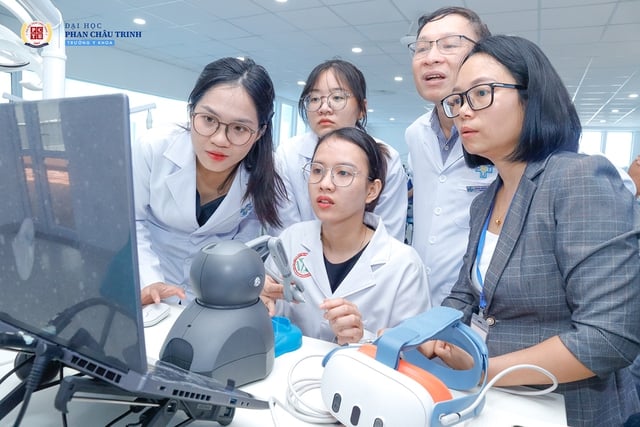
Practice dental skills on an AI-powered simulation system.
Comprehensive digital transformation ecosystem
Beyond the classroom, PCTU is building a comprehensive digital ecosystem encompassing training, research, treatment, and academia.
The Phan Chau Trinh University Medical Center Hospital, with 300 beds and fully equipped specialized departments, operates according to a digital hospital model: integrating HIS, PACS, LIS, RIS systems and electronic medical records (EMR). It also provides a practical clinical environment for students.
The Deep Medical Unit connects data between research, treatment, and training. AI is used to personalize learning, analyze disease causes, and predict disease progression—the foundation for predictive medicine and proactive prevention.
In addition, the smart medical library, with its connection to international knowledge sources such as PubMed, Cochrane, Uptodate, and Amboss, along with AI technology for retrieving personalized learning content, contributes to improving the quality of self-study and research.
In line with national strategy
PCTU's AI and biotechnology strategy is not isolated but harmonizes with the national direction in developing precision medicine, personalized medicine, and preventive medicine – the three pillars of future healthcare.
In the coming period, PCTU will focus on:
- Establishing a regional AI healthcare center for Central Vietnam, elevating Vietnamese healthcare to a regional level.
- Training doctors, technicians, and biomedical researchers to use technology as a foundational competency;
- Developing a medical ecosystem based on genomics, approaching the standards of advanced countries in personalized healthcare.
In the context of AI and biotechnology becoming national strategies, Phan Chau Trinh University demonstrates a pioneering role in medical education innovation, digital transformation, and applied research for public health.
PCTU doesn't follow trends - PCTU creates trends.
PCTU doesn't just train doctors - PCTU trains healers for the digital age.
Source: https://thanhnien.vn/truong-dh-phan-chau-trinh-tien-phong-ung-dung-ai-va-cong-nghe-sinh-hoc-y-khoa-185250616165644928.htm

![[Photo] Prime Minister Pham Minh Chinh attends the Conference on the Implementation of Tasks for 2026 of the Industry and Trade Sector](/_next/image?url=https%3A%2F%2Fvphoto.vietnam.vn%2Fthumb%2F1200x675%2Fvietnam%2Fresource%2FIMAGE%2F2025%2F12%2F19%2F1766159500458_ndo_br_shared31-jpg.webp&w=3840&q=75)
























































































Comment (0)