

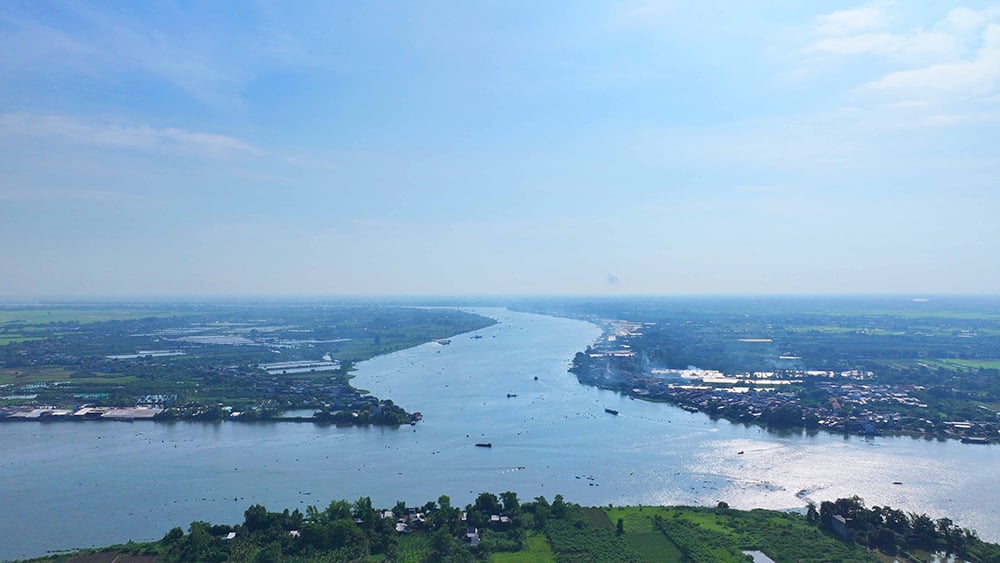
At the end point of the Vam Nao River, where it meets the Hau River.
The golden age of the spotted catfish is over.
At dawn, from Binh Thuy islet (Chau Phu district), we asked for directions to the end point of the Vam Nao River, where it connects to the Hau River. Following the dirt road to the riverbank, after a short distance, we saw the end of the Vam Nao River. In the morning, the river flowed slowly, and boats carrying goods were quite busy. At the end of the river, glimpses of fishing boats bobbed on the waves. Wandering around the islet village, we met Mr. Nguyen Van Hanh (Bay Hanh, 64 years old), a second-generation fisherman who makes his living fishing on this Vam Nao River.
When asked if the supply of spotted catfish is still abundant, Mr. Bay Hanh sighed regretfully, saying that spotted catfish have been scarce for many years, and the golden age of this specialty fish is over. More than 10 years ago, at this time of year, the Vam Nao River was bustling with the sounds of oars and paddles as fishermen cast their nets for spotted catfish. Now, the riverbanks in Binh Thuy islet no longer have any boats or canoes engaged in the profession of netting this famous fish. "Before, fishermen lined up to wait their turn to net spotted catfish. Every evening, I would catch 3-4 fish, weighing 7-10 kg. Now it's not like that anymore," Mr. Bay Hanh said with a somber tone.
Pointing down to the clear blue water, Mr. Bay Hanh confidently stated that this is the time when the spotted catfish return to the Vam Nao River. From there, they feed on anchovies, then swim upstream to breed. Understanding this natural cycle, the locals take advantage of the opportunity to bring their nets to the river to catch the fish. As dusk falls, the entire stretch of river is illuminated by red lights, creating a lively atmosphere. Large spotted catfish come ashore, gasping for air and thrashing their tails noisily. The locals cast their nets for a few dozen minutes before heading out to the river to retrieve the fish. “During the monsoon season, when the water ripples gently, the spotted catfish swim up from the sea in schools. Their main food source is ripe mangrove fruit that falls in the saltwater and freshwater anchovies. Before, thanks to this fish, I earned 2-3 million dong per night,” Mr. Bay Hanh recalled.
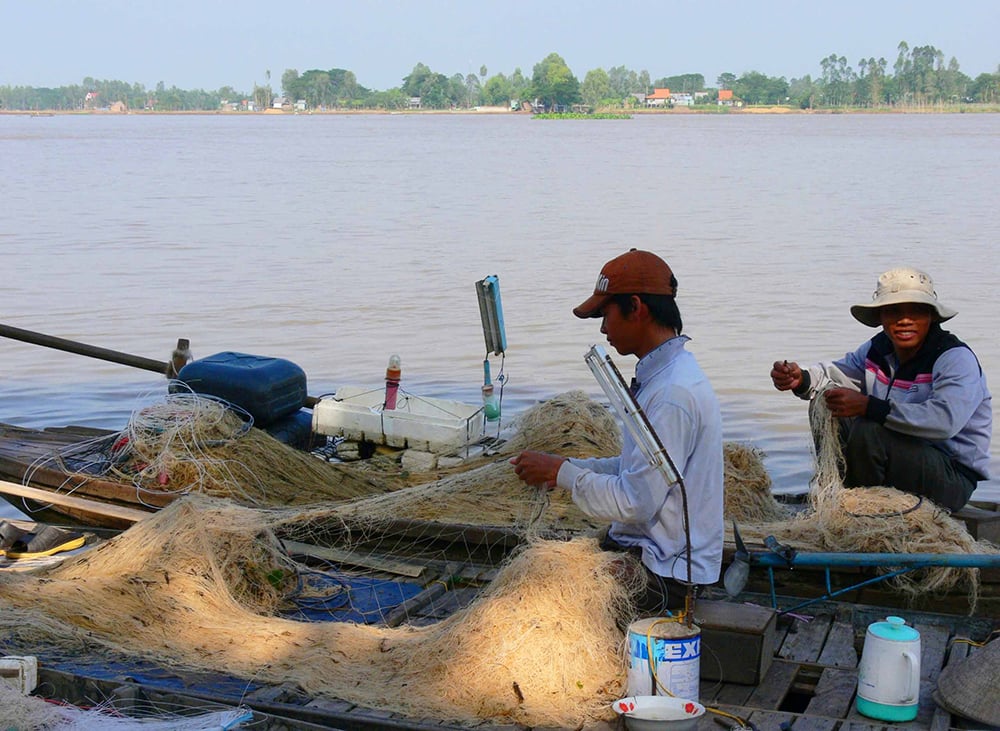
A few fishermen still cling to the trade of casting nets to catch grouper.
Many fishermen are quitting the profession.
Nowadays, the supply of spotted catfish in the Vam Nao River is very scarce, and many fishermen have pulled their boats ashore, abandoning the profession to find other jobs to make a living. Mr. Bay Hanh said that many people in this village have given up fishing for spotted catfish. Young people have gone to Binh Duong to find work. Only Mr. Bay Hanh and a few others remain, clinging to this river. Currently, Mr. Bay Hanh has switched to fishing for anchovies on the river to sell and earn a living. Perhaps, having been involved in this "fishing" profession year-round, Mr. Bay Hanh has become familiar with the river's nature.
Recalling the golden age when fish and shrimp were abundant, Mr. Bay Hanh said: “In the past, this river was just a small stream. If you wanted to cross the river, you only needed to shout a few words and someone on the other side would come over in a boat to pick you up. Over time, the water flowed strongly, the river eroded and widened, and many huge fish species came to take refuge here. Mr. Bay Hanh recalled that in the past, his father came from Bien Ho to settle in this sandbank village, where the population was sparse. At night, he would go out to the river to cast his nets and catch countless catfish. Sometimes he would even catch large grouper and freshwater stingrays. He even saw dolphins playing in the river, but now these species are rare.”
Mr. Bay Hanh asserted that at the end of the Vam Nao River, bordering the Hau River, there is still a very deep spot, about 50 meters deep, where giant catfish weighing around 10 kg still take refuge. In the past, Mr. Bay Hanh used to cast his nets in this section of the river. At night, large giant catfish would still come up to gasp for air. Because it is so deep, it is difficult to catch large fish. Seeing the deep section of the river where giant catfish were gasping for air, some fishermen came here to cast their nets hoping to catch large fish, but without success.
Leaving the end of the Vam Nao River, we crossed the Chua ferry and followed the rural road through the two communes of My Hoi Dong and Kien An (Cho Moi district) to reach the beginning of the Vam Nao River, connecting the Tien River. For a long time, nature has created the masterpiece of the Vam Nao River, linking the Tien and Hau rivers. When the tide is high, water from the Hau River flows upstream into the Tien River. When the tide is low, the water flows in the opposite direction. The harmonious blend of these two rivers creates the mysterious Vam Nao River.
The Vam Nao River is very wide at its source, bordered on one side by Cho Moi District and on the other by Phu Tan District, while the opposite bank connects to the Tien River in Dong Thap Province. Currently, at this point in the river, there are still more than 10 boats operating on the Vam Nao River, fishing for fish and shrimp. We met Mr. Nguyen Van Thuan at midday while he was casting his net on the Vam Nao River. As his net drifted to the river junction, Mr. Thuan quickly pulled it up, revealing a large spotted carp (a type of small fish) caught in the net. After removing the fish, he was overjoyed. He estimated the fish to weigh over 4 kg. Mr. Thuan explained that the river is over 6.5 km long, and at the point where it intersects with the Tien River, the water flows strongly, providing shelter for many large fish. Therefore, local fishermen come here to fish and earn extra income.
As midday shadows lengthened, we continued along the rural road beside the Vam Nao River. The gentle northeast wind blew softly, creating a tranquil and pleasant atmosphere on the Vam Nao. Nowadays, the Vam Nao River is no longer as fierce as it once was, but has become much calmer.
Source: https://baoangiang.com.vn/ve-dong-vam-nao-a421709.html

























































































Comment (0)