

My foreign friend messaged me asking all sorts of questions, including about Kinh Bac. My limited English required me to rely on Google to explain a few things in detail. She still longs to hear Quan Ho folk singing in a village square, to climb the mountain range and see what it was like that led an emperor to abandon his throne and luxurious palace to become a monk. Well, come visit this spring! The Kinh Bac region, with its rolling hills, villages, and bustling towns, is filled with thousands of spring festivals, sure to delight you. The scenery—sometimes ancient and moss-covered, sometimes wild and pristine, sometimes modern—along with delicious food and the warm hospitality of its people, will tell you fascinating stories about life today. Bac Ninh is perhaps the most special place, boasting eight UNESCO World Heritage sites.
 |
Illustration: Ha Huy Chuong. |
That day, I took some friends to take pictures of daisies at the Da Mai film studio (in Da Mai ward). Standing under the moon-shaped pavilion (a wooden pavilion built for visitors to take photos), looking at the vast expanse of flowers, I suddenly remembered these verses by Nguyen Gia Thieu: "The path we walked in last year's flower garden / The peach blossoms we picked while they were still green / On the phoenix pavilion, below the nightingale pavilion / The immortals' pillows are clearly side by side…" (Lament of the Royal Concubine) . Reading those verses, I pictured a "renowned and prestigious" family in Lieu Ngan village, Ngu Thai commune, Thuan Thanh district (formerly) - the birthplace of On Nhu Hau Nguyen Gia Thieu. Looking at the birds flying quickly over the pavilion, I saw a scene of the royal palace with its hundred red and thousand purple gardens, and graceful palace maidens. I shared my thoughts, and Ms. Huong - my literature teacher whose house is near the ancient citadel of Luy Lau - invited me to visit her next week. It's certainly true; historical records state that Nguyen Gia Thieu had a profound understanding of literature, history, and philosophy. He was also proficient in many art forms such as music , painting, architecture, and decoration. I wanted to return to immerse myself in the ancient charm of the land, to absorb some of the energy of a cultural region that gave birth to and nurtured our ancestors. “Now, in the morning, we go to Son Dong to admire the mountains, and at night we sleep in Luy Lau, strolling comfortably under the shade of the old citadel. The landmarks feel closer than before,” Ms. Huong happily expressed. I felt the same way. Before the province was merged, going to Dong Ho village or Phu Lang pottery village required a whole week of planning, because going to another province felt far away and I hesitated. But now it feels different; we're still within the province, and we can go quickly and come back in no time. Sometimes, after lunch in Bac Giang ward (part of the old Bac Giang city), we'd go back to Phu Lang to play, visit Tam Pottery to choose some items we liked, and then return. On the way back, we absolutely had to stop in the old Bac Ninh city to eat fish porridge and then stand admiring the brightly lit intersection near Vincom.
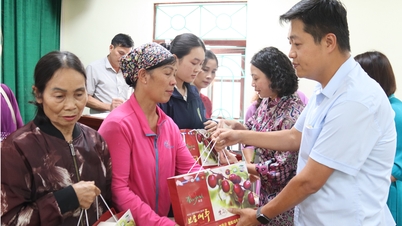
Outside of my office hours, I play the role of a street vendor, making brown rice tea and handmade sticky rice cakes in the evenings to sell to those who appreciate nostalgia. I have a customer from the village near the Do Temple. She said that the temple gate sells hundreds of kinds of sweets and sticky rice cakes for people to buy for offerings, but she prefers the "rustic" taste of my sticky rice cakes. "Eating them makes me feel like I'm meeting my mother; when she was alive, she also cooked them with this exact same flavor." A customer, a businessman from Saigon, also said the same thing, eating them reminds him of his mother. So, it's just that simple, rustic country food that blurs the boundaries of distance; the location doesn't matter anymore, if you need something, you can still find it. People from Bac Ninh now, whether in An Chau or Khe Ro, can easily find what they need at Cho Yen Phong market or Lim Tu Son street. Cars run day and night. This year's fruit festival is proof of this integration of hearts. The crowd waiting for the free shuttle bus at the gate of Bac Ninh Library 2 (formerly Bac Ninh city) to go to Chu ward for the festival was always large. Some people, seeing the beautifully displayed fruits at the festival for the first time, and taking photos in the orchards of ripe yellow pomelos and oranges, exclaimed, "It's so beautiful! I never imagined that right here in my province there could be so beautiful. Why would I need to dream of going to the orchards elsewhere?" "I was hesitant to leave home and go all the way to Chu, but since the province was merged, thanks to cultural events like this, people are cared for and given transportation, so we find it wonderful. It's truly a vast expanse of pomelos, ma'am. Luc Ngan is so prosperous and rich. You only know it when you're there; you can't imagine it from home," shared Mrs. Tu, 75, a resident of Suoi Hoa street.
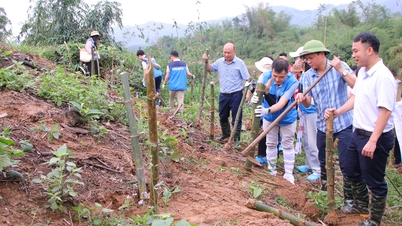
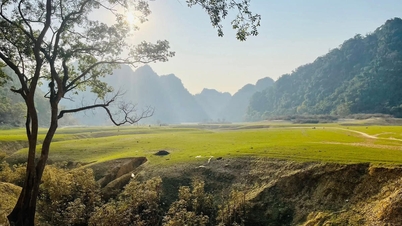
Try standing in the ginseng garden of my hometown at the foot of Mount Danh on a morning. It's best to visit during the flowering season, in late autumn, late spring, or early summer. The entire area is covered in a vast expanse of creamy white flowers. The fragrance is subtle and pure, like the fresh morning sun, not overpowering or pungent. The ginseng leaves are dark green, making the flowers even more striking. Ginseng flowers, harvested, dried, and roasted to make tea, are excellent. They treat insomnia, soothe the mind, nourish the eyes, and beautify the skin... Nowadays, people even eat the fresh flowers and young buds by stir-frying them or adding them to hot pot. My sister-in-law, Ms. Nguyen Dung, Director of the Lien Chung Ginseng Cooperative, even raises chickens on a farm, feeding them ginseng leaves and giving them ginseng root water to produce surprisingly delicious and nutritious chicken meat. Every year, she and other ginseng garden owners attend numerous seminars, conferences, and trade fairs to promote their products. She shared that many families in her hometown (formerly Lien Chung commune, now part of Phuc Hoa commune) have become wealthy thanks to ginseng cultivation, earning from one to two billion to even tens of billions of dong annually. Besides selling seedlings, ginseng flower tea, and fresh and dried ginseng roots, the cooperative and a few other businesses also offer additional products such as ginseng tea bags, ginseng shampoo, ginseng vermicelli (containing ginseng in the flour used to make the vermicelli), and ginseng wine...
From farmers, many have become business owners and producers of goods. Rural life has changed. Looking at the ginseng fields and Mount Danh, I only hope that the government and ginseng growers will not encroach on the mountains to plant ginseng, but only plant ginseng at the foot of the mountains and in the hills far from the mountains. The mountains themselves must have green trees and forests to protect the soil and prevent erosion and landslides. A mountain is only truly a mountain when it is surrounded by perennial trees, and the large hills around the mountain should also have trees. Only then will Mount Danh become a sustainable ecological zone. Ginseng is very precious, but ginseng plants struggle to hold the soil during storms and erosion. Wealth combined with a peaceful life is the ultimate goal. Looking at the ginseng flowers, I think of a precious lotus species in Gia Binh. It's the two-colored lotus. The lotus blooms simultaneously in two colors, purplish-pink and white, which is very beautiful. Perhaps we need to propagate and preserve this lotus species. Looking at the plants reminds me of the land; how far are Phuc Hoa and Gia Binh? Only a mile a day's journey is needed.
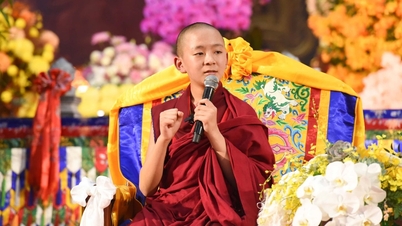
These places, once considered "different provinces," now share a single, familiar, and beloved homeland. While chatting with the abbess of Tieu Pagoda (Tam Son Ward), I was reminded of the simple Cong Phuong Pagoda in my hometown. The abbess of Tieu Pagoda cultivated vegetables and rice for many years to support herself, and later, Buddhist followers would offer her vegetables and rice as donations. She said that monks shouldn't have money, because it breeds greed, making it difficult to maintain oneself and the pagoda. Therefore, there is no donation box in Tieu Pagoda, and no money on the altars. Cong Phuong Pagoda in my hometown is also called the "Buddhaless Pagoda" because it has no Buddha statue. The people built the pagoda, constructed seven steps, painted them white, and placed incense burners on them. Those who come to the pagoda are consciously aware of the presence of Buddha in their hearts, so even without a concrete image of Buddha, the Buddha sits on those thrones and platforms, aware of all worldly affairs.
Strangely enough, leaning against the earthen wall in Bac Hoa village (Tan Son commune), listening to the rain flowing over the time-worn yin-yang tiled roof, I longed to wash my face, remembering the water scooped with a bucket from the well of Diem Quan Ho village. The subtle flow of my homeland guides me back to my memories, to live in the present, and to act for tomorrow. Watching the traditional ball-throwing game in the high-altitude villages of Son Dong in spring, I would surely dream of sitting on a boat, drifting through the Quan Ho villages along the Cau River...
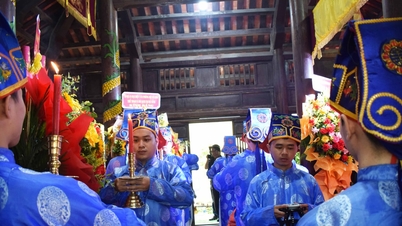
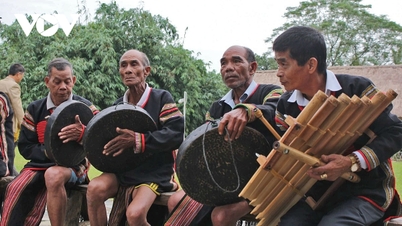
Perhaps the names of places, people, and the simple yet immortal beauties of life have blended together, supporting, complementing, and enhancing each other. Each village and neighborhood has its own unique customs and products, creating the rich and distinctive culture of Kinh Bac - Bac Ninh. Quan Ho, Ca Tru, Hat Ong - Hat Vi, Sang Co, Soong Co, Sloong Hao... all resonate throughout the villages, where many ethnic groups live. I stayed up all night experiencing Hat Ong at the village communal house with the artisans of Hau hamlet (formerly Lien Chung commune) to understand why young men and women in feudal times had to sing into bamboo tubes to express their love, while in Quan Ho, the singing continues all night, the love between people is so deep, poignant, and inseparable, yet it is not easy for them to form a couple...
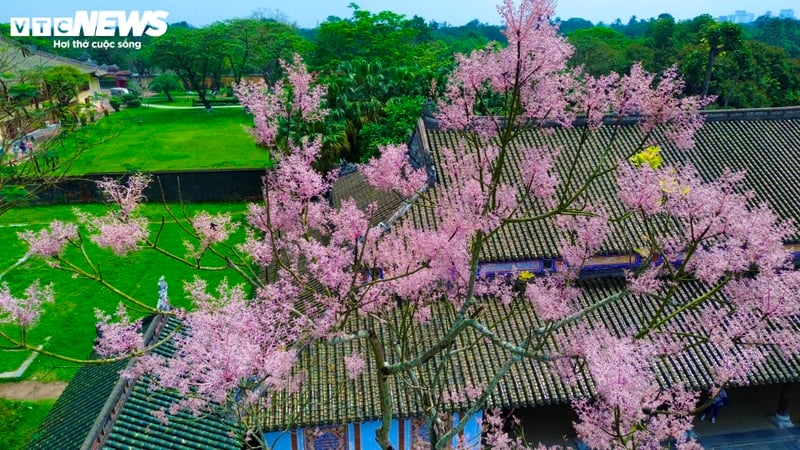
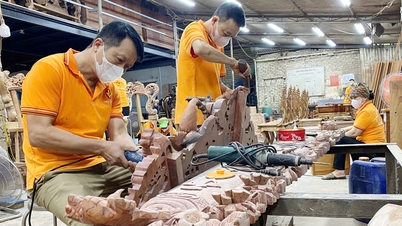
Those seemingly intangible things are the very soul of the Kinh Bac region. Spring here is always longer, more beautiful, and more profound. Visiting temples, attending festivals, listening to folk songs, admiring the mountains, exploring orchards, experiencing life as a factory worker... wherever you go, the land, sky, and people of this region radiate vibrant energy.
Source: https://baobacninhtv.vn/ve-mien-kinh-bac-postid436337.bbg














































Comment (0)