

Looking back at history, the merging and splitting of provincial-level administrative units has taken place in many stages, reflecting changes in the State's management strategy. From the French colonial period with 61 provinces, to the period of national reunification with 72 provincial-level administrative units, and then many adjustments and splits to suit the actual situation. Currently, Vietnam has 63 provincial-level administrative units, including 57 provinces and 6 centrally-administered cities.
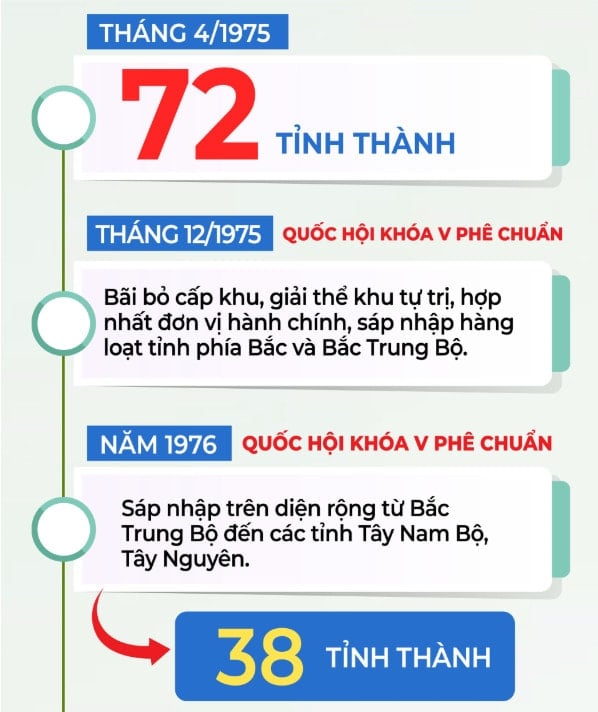
History of mergers and splits
Vietnam has undergone numerous phases of reorganization, division, and merger of provincial-level administrative units throughout its history.
Before 1945 (during the French colonial period): Under the Nguyen Dynasty (before complete French colonial rule), the country had 31 provinces and 1 Thua Thien prefecture (equivalent to a province). After the French established their administrative apparatus, Vietnam was divided into three regions: Tonkin, Annam, and Cochinchina. The total number of provinces varied throughout different periods.
Period 1945 - 1954 (Resistance War against France) : In 1945, after gaining independence, the Government of the Democratic Republic of Vietnam maintained the old provincial system but with adjustments. By 1954, the whole country had 70 provinces and cities (including provinces in the North, Central and some provinces in the South).
Period 1954-1975 (division of North and South Vietnam) : North Vietnam: The Government of the Democratic Republic of Vietnam made several adjustments. During this period, there were approximately 30-32 provinces/cities. South Vietnam: The Government of the Republic of Vietnam also implemented administrative changes. By 1975, South Vietnam had 44 provinces and one capital city (Saigon).
Period 1975 to present: After the reunification of the country (April 1975), Vietnam had 72 provincial-level administrative units, including 25 in the North and 47 in the South. Through several adjustments, from 2008 to the present, Vietnam maintains 63 provincial-level administrative units, comprising 57 provinces and 6 centrally-administered cities: Hanoi , Ho Chi Minh City, Da Nang, Can Tho, Hai Phong, and Hue (which was transformed from Thua Thien Hue province into a centrally-administered city in 2024).
History of mergers and splits
Vietnam has undergone numerous phases of reorganization, division, and merger of provincial-level administrative units throughout its history.
- Before 1945 (during the French colonial period): Under the Nguyen Dynasty (before complete French colonial rule), the country had 31 provinces and 1 Thua Thien prefecture (equivalent to a province). After the French established their administrative apparatus, Vietnam was divided into three regions: Tonkin, Annam, and Cochinchina. The total number of provinces varied throughout different periods.
- Period 1945 - 1954 (Resistance War against France) : In 1945, after gaining independence, the Government of the Democratic Republic of Vietnam maintained the old provincial system but with adjustments. By 1954, the whole country had 70 provinces and cities (including provinces in the North, Central and some provinces in the South).
- Period 1954-1975 (division of North and South Vietnam) : North Vietnam: The Government of the Democratic Republic of Vietnam made several adjustments. During this period, there were approximately 30-32 provinces/cities. South Vietnam: The Government of the Republic of Vietnam also implemented administrative changes. By 1975, South Vietnam had 44 provinces and one capital city (Saigon).
- Period 1975 to present: After the reunification of the country (April 1975), Vietnam had 72 provincial-level administrative units, including 25 in the North and 47 in the South. Through several adjustments, from 2008 to the present, Vietnam maintains 63 provincial-level administrative units, comprising 57 provinces and 6 centrally-administered cities: Hanoi, Ho Chi Minh City, Da Nang, Can Tho, Hai Phong, and Hue (which was upgraded from Thua Thien Hue province to a centrally-administered city in 2024).
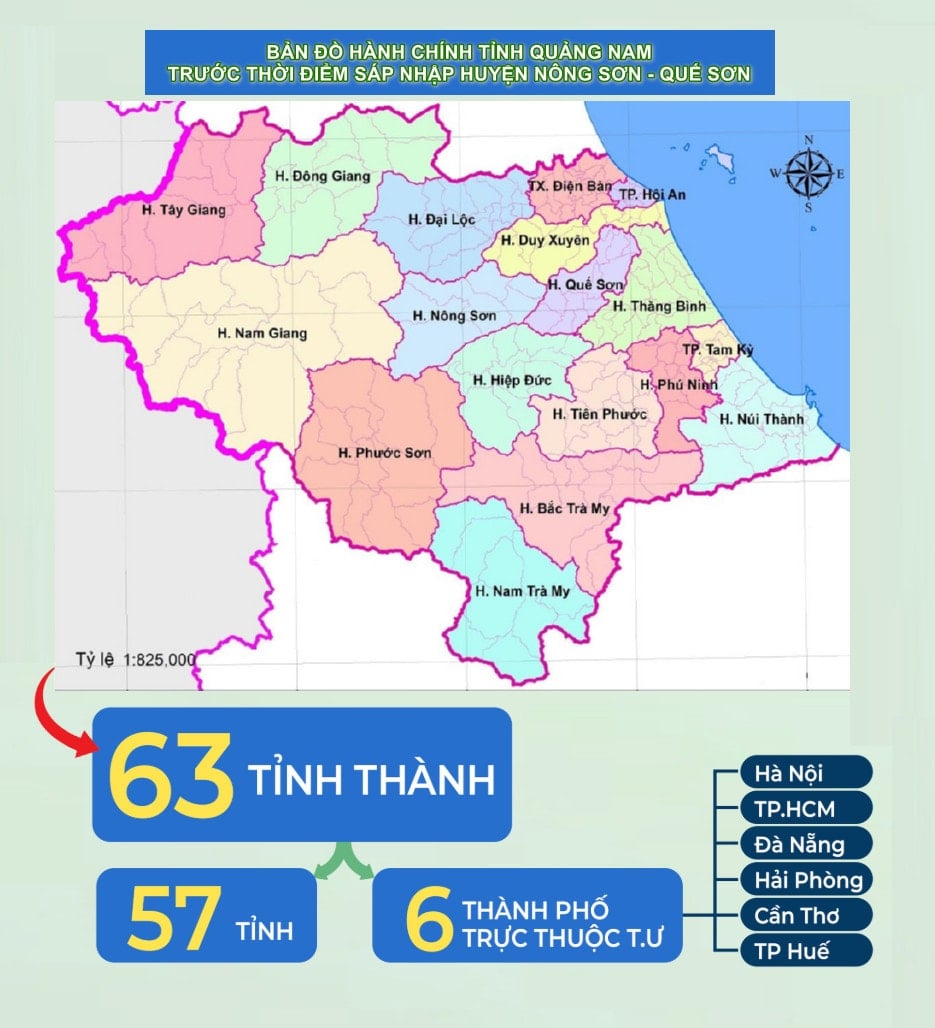
However, according to assessments by the central government and the opinions of many scientists and researchers, the number of districts and provinces in Vietnam is excessive compared to its area and population size. The administrative apparatus is cumbersome, multi-layered, and inefficient.
Therefore, the need to reorganize and merge provinces, and abolish intermediate administrative levels (districts), is inevitable and urgent. However, merging provinces and abolishing districts is not just a simple addition and subtraction on an administrative map. This is a revolution whose ultimate goal is to unleash potential, unlock resources, and create a more flexible and efficient operating system.
This is a challenging journey, requiring strategic vision, unwavering determination, and above all, the consensus of the entire society; along with a rational roadmap in accordance with the central government's directives.
Quang Nam - Da Nang and the history of its establishment and separation:
1889: After conquering all of Vietnam, the French colonialists separated Da Nang from Quang Nam, renamed it Tourane, and placed it under the direct administration of the Governor-General of Indochina.
Early 20th century: France developed Tourane into a Western-style city, becoming an important commercial center.
1950: France handed Da Nang back to the Bảo Đại government.
1965: US Marines landed, turning Da Nang into a military base.
In 1967: Da Nang was designated as a centrally governed city of the Republic of Vietnam.
November 6, 1996: At its 10th session, the 9th National Assembly of the Socialist Republic of Vietnam passed a resolution allowing the separation of Quang Nam - Da Nang province into Quang Nam province and Da Nang city, both directly under the central government.
Objectives of administrative restructuring:
- Streamline the organizational structure, reduce costs, and increase operational efficiency.
- To create momentum for socio-economic development in key economic regions.
- Enhancing state management capacity to meet development requirements...
Source: https://baoquangnam.vn/viet-nam-qua-cac-lan-thanh-lap-sap-nhap-tinh-3149426.html

![[Image] Central Party Office summarizes work in 2025](/_next/image?url=https%3A%2F%2Fvphoto.vietnam.vn%2Fthumb%2F1200x675%2Fvietnam%2Fresource%2FIMAGE%2F2025%2F12%2F18%2F1766065572073_vptw-hoi-nghi-tong-ket-89-1204-jpg.webp&w=3840&q=75)
























































































Comment (0)