

- Early warning signs of autism in children
- Autism in children - A concern for families and society.
Lesson 1: The heartfelt concern of a dedicated female doctor
After five years of examining, treating, and caring for many children with developmental disorders, Dr. Ninh Thi Minh Hai and her colleagues have opened up a bright future for many young children and brought smiles to many families in Ca Mau .
The challenging journey of a "new recruit"
In a small corner of the Ca Mau Obstetrics and Pediatrics Hospital, there's a place where life moves slowly, seemingly forgotten, yet filled with so much hope: the Speech Therapy Room. For Dr. Ninh Thi Minh Hai, this is where she and her colleagues confront the most fragile aspects of human existence every day: the beginning of speech, connection, and the journey to becoming a "complete human being."
The clinic was established in 2021, when concepts like "early intervention" and " speech therapy " were still unfamiliar to many families. In the early days, Dr. Hai and his colleagues entered this field as "new recruits." They had studied Pediatrics and were familiar with cases of fever and cough in children, but developmental disorders were a different " world "—there were no clear symptoms, no quick prescriptions, and it required a great deal of patience.
"We were learning as we went along, facing many challenges and constantly wondering if we could help the children achieve the best possible development," Dr. Hai shared.
The continuous training sessions, the late-night study sessions, the pressure of an increasing number of children while manpower is limited... all of these things made them understand that this profession requires not only knowledge but also perseverance to never give up.
Currently, the clinic is supporting around 30 children and receives an additional 20-30 new cases each month. For many, this is a welcome sign of changing parental awareness. But for Doctor Hai, it is also a source of concern: "If only the children had come sooner..."
Each intervention session lasts only 45 minutes, but it's a process filled with immense effort. The doctors don't "examine" in the usual way, but rather "play" with the children – playing to understand, to assess, and to open doors that the children don't yet know how to navigate. Some children may take weeks just to look into someone's eyes. Some may take months to produce meaningful sounds. Some may take a whole year to be able to say "mom"...
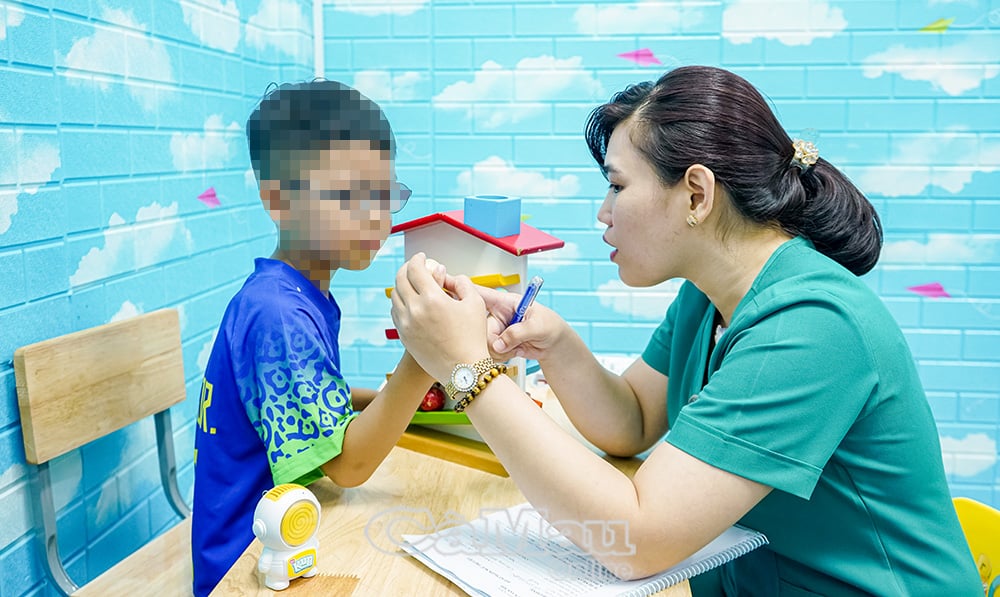 Speech Therapy sessions at the Speech Therapy Department differ from other places: children are engaged in conversations and games to assess the severity of their disorder... While seemingly gentle on the surface, these sessions actually require keen observation, empathy, and in-depth diagnostic methods.
But what troubled Dr. Hai wasn't the children's slow progress, but the story behind each one. She remembers a nearly six-year-old boy who, when he came to the clinic, couldn't speak a word. His eyes were beautiful—clear as water, yet they lacked focus. His gaze swept over everything, as if the world had never touched him. His mother realized her son was "different" early on but lacked information, so she went to many places before finally finding her here.
"Some opportunities have already passed, and we can only try our best in the time that remains," Dr. Hai said regretfully.
Another story is about an engineer father who discovered his child had developmental delays at the age of two, but didn't receive his family's approval. He quietly took his child for treatment alone. Every day after work, he spent time playing with his child and recorded videos to send to the doctor for further advice. In those videos, there was nothing extraordinary, just the father patiently repeating very small actions: calling his child's name, waiting for a response, and then trying again...
"In his eyes as he watched his child, there was hope, but also a deep sense of worry," Dr. Hai recalled.
Those very eyes made the doctor tell himself that he couldn't afford to be careless or give up.
Patiently support fragile progress.
In reality, not every family has the resources, information, or luck to choose the right early intervention for their children. Some children come to the clinic when they are already 5-6 years old, almost past the "golden period." Some families spend a lot of money and time, but choose the wrong method or the wrong place for treatment.
"Sometimes, looking into the parents' eyes, you can see both pain and helplessness," Dr. Hai said in a somber tone. After each examination, what remains is not just the medical record, but also a feeling of regret for missed opportunities, for those "early" things that no longer held any meaning.
According to Dr. Hai, the problem is not just within individual families but also within the entire system. Local interventions are fragmented and lack coordination among specialties such as healthcare, speech therapy, psychology, and special education. This leads to a lack of continuity in the intervention process, sometimes requiring children to "start over" multiple times.
Furthermore, the lack of quality control mechanisms makes it difficult for parents to choose a treatment center. In the "jungle" of information, especially on social media, not everyone is discerning enough to distinguish right from wrong. Some parents have tried many methods, some of which have even slowed down their child's progress.
Another challenge is human resources. Speech therapy is a relatively new field in Vietnam, especially at the provincial level. A shortage of highly trained personnel puts significant pressure on the existing staff. Furthermore, bureaucratic hurdles and inconsistent procedures force parents to travel to multiple locations, wasting time, when what they need is timely support.
Despite these difficulties, there are still some encouraging signs for Dr. Hai. “Parents today are much more proactive and open. Thanks to the media, they access information early, take their children for check-ups early, and are ready to support their children,” Dr. Hai said enthusiastically.
At the clinic, each child has a personalized intervention plan. Parents receive detailed guidance, direct monitoring, and even video recordings of their child's sessions if they cannot be present. Every small step is recorded, and every small progress is cherished.
 In addition to examining children, Dr. Ninh Thi Minh Hai also spends time talking with parents, making them an important link in the treatment support process.
In the future, Dr. Hai hopes to build a sustainable intervention model right in the local area, where children can receive support from their early years and parents become "co-therapists." According to her, no one understands children better than their parents, and intervention is only effective when it is continued in daily life. Parents should not only be the ones to take their children for checkups, but should also be empowered to help their children develop every day.
Amidst these concerns, Dr. Hai still maintains a simple belief: each child is a unique "green sprout," perhaps slower to grow, weaker, but with proper care, it can still thrive. Her job, and that of her colleagues, is to patiently support these fragile steps, to listen to every small change in the children.
In the southernmost corner of the country, in a small room at the Obstetrics and Pediatrics Hospital, everything unfolds quietly each day. But it is these simple, small things that sometimes work miracles: helping a gaze pause, a hand grasp, and pretty lips utter their first words.
Lam Khanh
Lesson 2: The Silent Love of a Second Mother
Source: https://baocamau.vn/vo-ve-nhung-giac-mo-xanh-a128451.html
![[Photo] Capturing the moment the tide recedes at Yen Binh Son rapids - a million-year-old scenic spot in Quang Ngai.](https://vphoto.vietnam.vn/thumb/1200x675/vietnam/resource/IMAGE/2026/05/19/1779175463885_yen9-1199-jpg.webp)
![[Photo] National Assembly Chairman Tran Thanh Man attends the groundbreaking ceremony for the National Highway 1A spatial axis project.](https://vphoto.vietnam.vn/thumb/1200x675/vietnam/resource/IMAGE/2026/05/19/1779161360398_ndo_br_bnd-1412-jpg.webp)
![[Photo] General Secretary and President To Lam presides over a meeting on the implementation of Directive No. 34-CT/TW of the Party Central Committee.](https://vphoto.vietnam.vn/thumb/1200x675/vietnam/resource/IMAGE/2026/05/19/1779187768672_a1-bnd-2350-631-jpg.webp)

























































![[Photo] General Secretary and President To Lam receives Indian Defense Minister Rajnath Singh](https://vphoto.vietnam.vn/thumb/402x226/vietnam/resource/IMAGE/2026/05/19/1779184046302_anh-man-hinh-2026-05-19-luc-16-46-58.png)























Comment (0)