

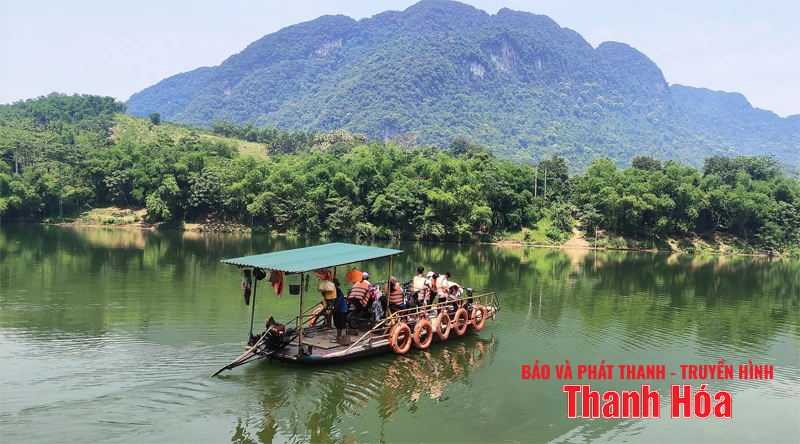
Students from Thiet Giang village cross the Ma River.
Nestled at the foot of majestic limestone mountains, Thiet Giang is as beautiful as a traditional ink painting, but its location between a deep river and high mountains makes it quite isolated. To reach the commune center, residents have only two options: crossing the Ma River by ferry or taking a detour of about 20km along a mountain road to reach La Han Bridge. For students, especially those in junior and senior high school, the journey to school is far from easy.
A new school year is beginning, and Thiet Giang village currently has over a hundred students attending various levels of education, including 19 preschoolers, 42 primary school students, 43 secondary school students, and 6 high school students. Every day, most secondary and high school students have to wake up very early, prepare their belongings, and wait for the ferry at the dock.
Pham Thi Tuyet, Party Secretary of Thiet Giang village, could not hide her worries, saying: “We are very concerned to see such young children having to cross the river to go to school every day. It's difficult in the sun, and even more dangerous during the rainy season. We only hope for a bridge so that people are less isolated and the children can go to school more safely.”
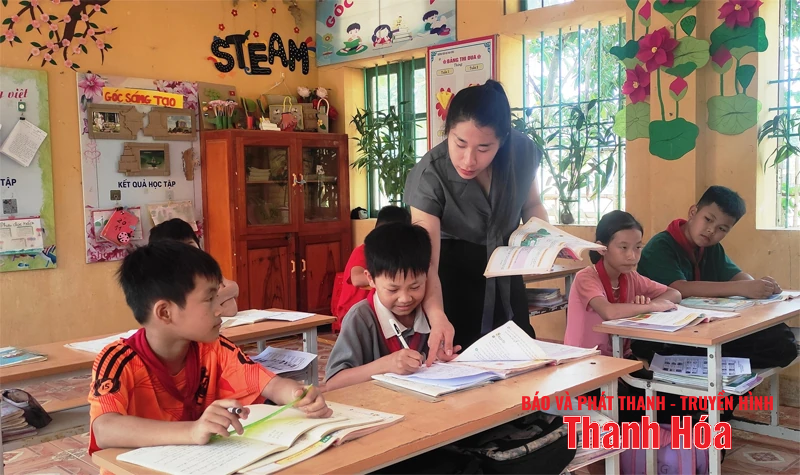
Elementary school students in the Thiet Giang area - Thiet Ong Elementary School during class time.
On numerous occasions, parents have had to take time off work to bring their children to school. Teachers from other regions have also had to get used to the daily commute, often arriving early in the morning and late in the afternoon. Yet, what earns them the most admiration is the 100% attendance rate in Thiet Giang. In recent years, there have been no dropouts, despite all the difficulties and obstacles.
Ms. Pham Thi Nguyen, a teacher at the Thiet Giang branch of Thiet Ong Kindergarten, has been regularly crossing the river every day for the past six years to get to class. She single-handedly cares for 19 children, many of whom have special circumstances, such as parents working far away, living with grandparents, or even children from broken families.
Despite receiving investment in electricity grids, roads, and cultural centers from the National Target Program for New Rural Development, Thiet Giang village remains classified as an extremely disadvantaged area. This village has 161 households, mostly Muong people, who rely on agriculture and forestry for their livelihoods, largely remaining self-sufficient. |
The classrooms are rudimentary, supplies are scarce, water has to be obtained from nearby houses, there is no school health staff, and no first-aid kit... "There are days when the children have high fevers and cough a lot, all I know is to apply compresses, wipe their bodies, and then call their parents to pick them up. Without medical expertise, I don't dare give the children medicine on my own; I only wish I had a small first-aid kit and some basic first-aid skills," Ms. Nguyen shared.
Ms. Nguyen further explained that because the school doesn't have a boarding facility, she often brings her own lunch, eats in the classroom, and rests there during lunchtime. All her activities revolve around a small, rather cramped room. Her greatest wish is to have a well to ensure a reliable supply of clean water for the children's hygiene needs.
Currently, Thiet Ong Kindergarten is developing a plan to organize a half-day meal program at its Thiet Giang branch. According to Ms. Trinh Thi Tan, the school principal, "the implementation will face many difficulties due to a lack of kitchen facilities, beds, blankets, etc. We will propose that the commune support us in drilling a well and renovating the school site, gradually creating better conditions for teachers and students."
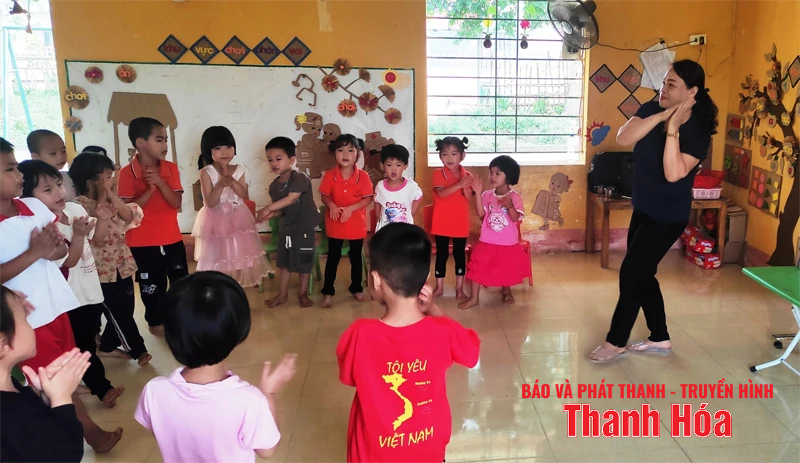
She and the children at the Thiet Giang branch of Thiet Ong Kindergarten during a dance and singing lesson.
At the remote branch of Thiet Ong Primary School in Thiet Giang village, teacher Le Thu Ha, who is in charge of the area, said that there are currently 42 students studying in combined classes from grades 1 to 5. Although teaching combined classes is challenging, the teachers are doing their best to help the children keep up with the curriculum. However, transportation remains a major obstacle for the teachers. “We travel by small boat provided by local people. Every day, the teachers pool their money for fuel and wages to ask the locals to ferry us across the Ma River,” Ms. Ha shared.
Upon reaching the secondary and high school levels, students in Thiet Giang village have to travel to the commune center to attend school. Despite the difficulties and hardships, their motivation to learn remains very high. Mr. Le Ba Mo, Principal of Thiet Ong Secondary School, shared: "Even though the students have to travel by boat, they rarely arrive late for school. The learning spirit of the students in Thiet Giang is truly admirable."
Pham Thi Hinh, a sixth-grade student, innocently said, "I want to be a teacher when I grow up, to teach the children in my village how to read and write." This simple dream is like a ray of light in the journey of overcoming hardship for the children here.
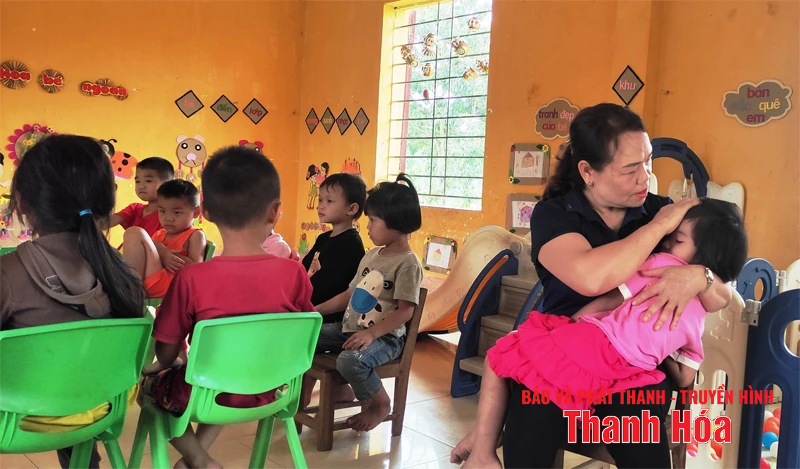
Teacher Pham Thi Nguyen takes care of children at the Thiet Giang branch of Thiet Ong Kindergarten.
The dream of having a bridge connecting Thiet Giang to the commune center has always burned brightly in the hearts of the local people. Although a team has come to survey and measure the area, all hope still seems to remain elusive.
Mr. Pham Van Thanh (62 years old), a long-time ferryman here, still vividly remembers the days when villagers had to cross the river in dugout canoes, risking their lives against the strong currents. "Now we have motorboats, it's a little safer. But every time there's heavy rain, or the hydroelectric dam releases water, the river rises and flows fiercely, everyone is worried," Mr. Thanh said.
Having worked as a ferryman for many years, Mr. Thanh no longer remembers how many classes of students have crossed his river, and he has even had to transport seriously ill patients to the emergency room many times in the middle of the night. He can't bring himself to refuse calls at 1 or 2 in the morning, because even a few minutes' delay could endanger the lives of his fellow villagers. "I can't ignore people when they need me, but it's really dangerous. Once, I and the patient were almost swept away by the current," he recounted with a sigh.
“On normal days, the children's journey to school is already difficult, but during the rainy season, it becomes even more dangerous. Every time the hydroelectric dam releases water, the raging currents make the villagers anxious as the boats carrying the children sway precariously on the Ma River.” Pham Thi Tuyet, Secretary of the Party Branch of Thiet Giang village |
Sharing a late afternoon ferry ride with his sixth-grade daughter, Pham Van Hiep (41 years old) confided: "Many days, seeing my little girl get on the ferry to go to school when the Ma River is high, we are very worried. But what can we do? We can only tell her to study hard so that she can have a better future."
In Thiet Giang village, the biggest challenge for students is the transportation infrastructure. But it is precisely this situation that has fostered a strong spirit of overcoming difficulties. It is known that the local Party committee and government are continuing to work alongside and support schools in remote areas like Thiet Giang.
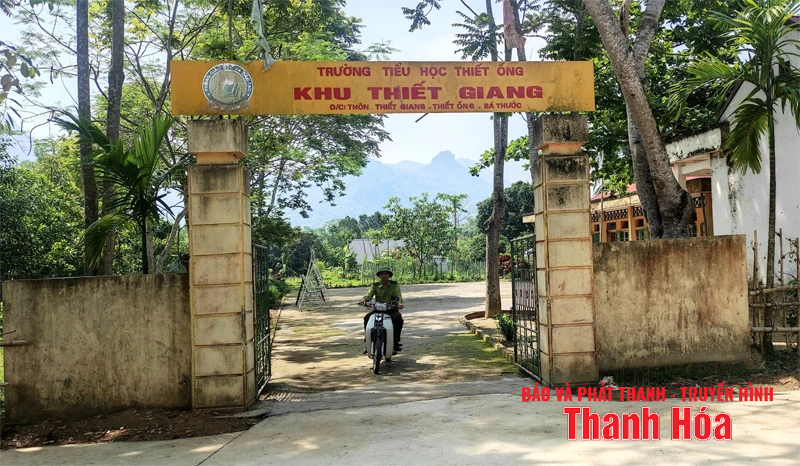
Thiet Giang area - Thiet Ong Primary School.
On the last ferry ride of the day leaving Thiet Giang, we could clearly feel the children's eyes still following us towards the distant shore. No matter how wide and dangerous the Ma Giang River may be, it cannot stop the children's yearning to go to school. I secretly hoped that one day the dream bridge would become a reality, when the silent calls of the children by the river would be heard and understood.
Ha Giang – Hoang Trang
Source: https://baothanhhoa.vn/vuot-ma-giang-di-tim-chu-258460.htm


























![[Infographics] Objectives, target groups, and implementation principles of Resolution 29/2026/QH16 of the National Assembly](https://vphoto.vietnam.vn/thumb/402x226/vietnam/resource/IMAGE/2026/05/22/1779439731704_infographics-mu-w1200t0-di2620d199d5113259t11358l1-nq29-1-029.webp)



























































Comment (0)