

From the "pioneer" of the Hmong people
In the summer month of June, when we arrived in Toa Tinh amidst the scorching sun, the coffee plants were still lush and green, stretching across the hillsides. The coffee plantations were in their fruiting season, clusters of white blossoms still clinging to the foliage. From a high hilltop overlooking the entire Tuan Giao district, Mr. Vu A Minh – the Party Secretary of Che A village – was quietly tending to his newly sprouted melon seedlings. Right next to him, the coffee hills, interspersed with pear and macadamia trees, created an endless expanse of green.
Vu A Minh was one of the first people to participate in the coffee farming model in Toa Tinh commune since 2011. At that time, coffee was still an unfamiliar name in the Mong region. “After graduating from university, I decided to return to my village to develop the economy . My family abandoned rice farming three years ago; now the entire area is used to grow coffee, pears, macadamia nuts, plums, and wild melons,” Minh shared.
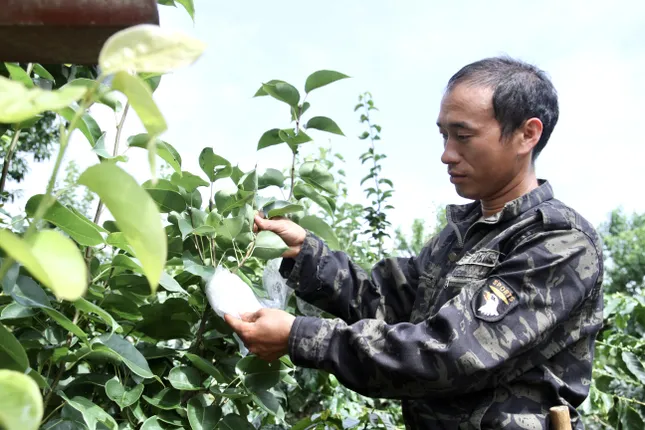 |
Besides coffee, Vu A Minh's family is also growing pears, plums, macadamia nuts, and honeydew melons. |
After more than a decade of perseverance, his family now owns nearly 7 hectares of farmland, with coffee as the main crop. On the hillsides, the coffee plants are intercropped with 375 macadamia trees, along with pears, plums, and melons, diversifying the produce while protecting the soil and retaining moisture.
"Coffee helps me make a living on this hilly land. But to make a good living, you have to plan carefully. You have to choose good varieties, use organic fertilizers, and practice intercropping to preserve the soil. Farming these days also requires foresight," he added.
There are no more empty hills in Toa Tinh.
According to Mr. Tran Manh Thang, Secretary of the Party Committee of Toa Tinh commune, the commune currently has 729 hectares of coffee, of which 430 hectares are currently producing crops. The area planted with coffee in the commune accounts for 50% of the total coffee growing area of Tuan Giao district, making Toa Tinh the largest coffee growing area in the entire district.
In 2024 alone, the villagers harvested 2,406 tons of fresh coffee cherries, a 60% increase compared to 2023. In the first six months of 2025, although it's not yet the main harvest season, the coffee plants are growing well, and production is projected to remain stable and promising.
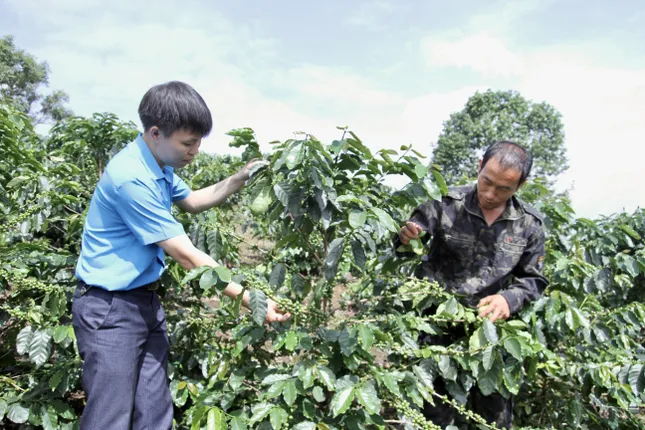 |
| Thanks to coffee cultivation, the poverty rate in Toa Tinh commune has decreased by more than 30% in the last three years. |
“Coffee prices in 2024 reached record highs, fluctuating between 9,000 and 10,000 VND/kg, and at times exceeding 12,000 VND. Many households earned between 200 and 300 million VND, with some reaching up to 800 million VND. The lives of the people have changed significantly,” Mr. Thang said.
Thanks to coffee cultivation, the poverty rate in Toa Tinh has dropped sharply from 46% last year to 33% currently, a reduction of over 30% in just the past three years. This is one of the fastest-growing Mong ethnic minority communes in the district in terms of poverty reduction. "Now, walking around the commune, you can see that there are no more empty hills or plots of land. Every household grows coffee, the whole village and commune are turning green. The barren hills of the past have now become economically productive hills," Mr. Thang shared.
In Hua Sa A village, Mr. Ly Khai Lin led us through a coffee garden laden with young fruit. The soil was meticulously tilled, each planting hole mounded high, and organic fertilizer already developing. “Growing coffee isn’t just about tilling the soil and planting. You have to learn the right techniques, apply compost, shape the trees, and protect against pests and diseases… only then will you have beautiful fruit and a good price,” Mr. Lin explained.
Besides coffee, intercropping models involving macadamia nuts, pears, and honeydew melons are also being adopted by people in many villages. Farmers receive technical training, seeds, and agricultural supplies, gradually changing their mindset and practices.
 |
The people are making the most of the land available throughout the commune to grow coffee. |
Output problem: Still a major concern.
However, product output remains a major concern. Currently, farmers mainly sell fresh fruit to traders, lacking a stable distribution chain or a model of production, processing, and consumption linkages along the value chain.
Mr. Thang said: "In fact, many businesses have approached the commune to discuss purchasing all of the products, and even proposed building a core area for organic production for export. They want to create model farms and open processing plants in the locality." It is known that Tuan Giao district is planning to build a coffee processing plant in Quai Cang commune, hoping it will become a sustainable output center for the entire Toa Tinh raw material area.
“Currently, farmers are growing Arabica coffee. The cold climate and high altitude prolong the flowering and fruiting period, resulting in superior quality coffee beans. However, because the flowers bloom sporadically, people have to pick each ripe berry individually instead of stripping the entire branch. It's more laborious, but it also preserves the quality,” Mr. Thang further explained.
Coffee cultivation has not only transformed the landscape of Toa Tinh, but more importantly, it has changed the economic mindset of the Hmong people. Now, they not only know how to grow coffee but also how to select the right varieties, cultivate it using proper techniques, calculate output, and move towards commercial agriculture.
Source: https://tienphong.vn/xa-nguoi-mong-lam-kinh-te-tu-hat-nau-dat-do-post1749242.tpo
![[Photo] Da Nang: Over 38,000 people "painted the streets red" during the Olympic Run for National Security.](https://vphoto.vietnam.vn/thumb/1200x675/vietnam/resource/IMAGE/2026/03/22/1774148860624_ndo_br_chay-15-jpg.webp)
![[Image] 126 communes and wards of Hanoi participate in the 2026 Olympic Run Day.](https://vphoto.vietnam.vn/thumb/1200x675/vietnam/resource/IMAGE/2026/03/22/1774155767210_ndo_br_4013885316804510786-copy-jpg.webp)


![[Photo] Hanoi residents enthusiastically participate in the 2026 Olympic Run Day.](https://vphoto.vietnam.vn/thumb/1200x675/vietnam/resource/IMAGE/2026/03/22/1774154260360_ndo_bl_91e6430c9ea310fd49b232-8788-jpg.webp)


























































Comment (0)