

According to the Vietnam Association of Seafood Processing and Export (VASEP), Vietnam's shrimp exports in 2023 are expected to reach approximately $3.4 billion, 21% lower than in 2022.
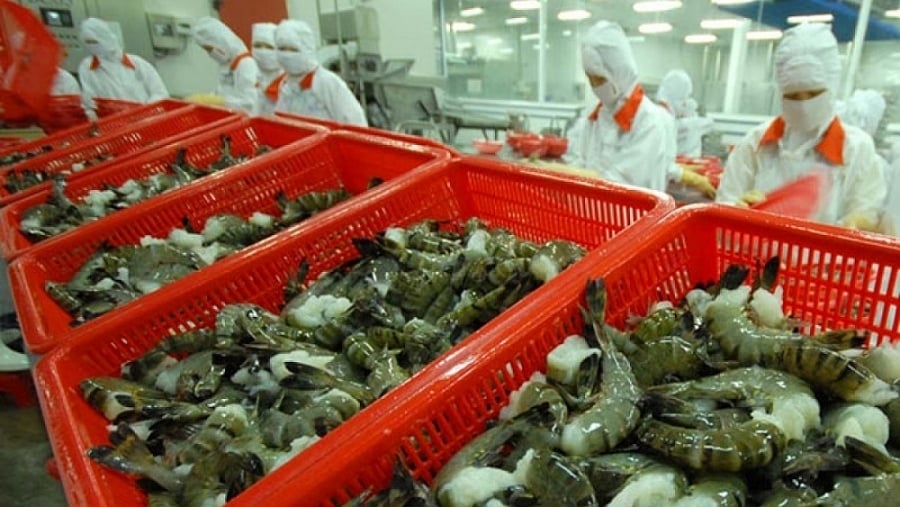 |
| In 2023, shrimp exports decreased by 21% compared to 2022. |
Regarding import markets, the United States is the single largest market, continuing to increase imports of Vietnamese shrimp in November. In November 2023, shrimp exports to this market increased by 24% to reach $51 million, marking the fifth consecutive month of positive growth. For the first 11 months of the year, shrimp exports to this market reached $640 million, a decrease of 17% compared to the same period last year.
For the EU market, the decline in exports to this market was less severe due to increased demand at the end of the year, and inflation there has also cooled down somewhat. In November, shrimp exports to this market decreased by 3% to $36 million.
Exports to China and Hong Kong continued to decline in November. Demand in this market is unstable, showing positive growth for three months from June to August, then reversing to a downward trend in September, October, and November. However, the decline was not as sharp as in the early months of the year. China and Hong Kong experienced the lowest decline among the major import markets.
The demand for Vietnamese shrimp in the Chinese and Hong Kong markets depends not only on economic growth and inventory levels in those countries but also heavily on the availability of cheap shrimp from Ecuador.
China's demand for shrimp imports remains strong, but the influx of supply into this market at low prices makes it difficult for Vietnamese shrimp to compete on price. In the last month of this year, Vietnamese shrimp exports to this market still decreased compared to the same period last year. A slight recovery is possible in the first months of 2024.
Economists predict that China will become increasingly dependent on imported seafood, similar to the model of Western countries. China's shrimp consumption is substantial, even exceeding that of the United States and Europe. In 2023, it was estimated that the country imported a massive 1 million tons of shrimp, primarily for processing and domestic consumption, with exports being almost negligible.
China is a target market for many shrimp exporting countries such as Ecuador and India, providing a supply of cheap raw shrimp, thus putting Vietnamese shrimp under competitive pressure on price. In addition, businesses also face competition from shrimp processors within the Chinese domestic market.
To capitalize on opportunities from China, VASEP recommends that B2B trade activities be further strengthened, with greater attention paid to local-level trade. In addition, there needs to be an exchange and sharing of information on market demand and regulations, especially when there are changes in import and export policies.
According to the Center for Digital Transformation and Agricultural Statistics ( Ministry of Agriculture and Rural Development ), in the first 11 months of 2023, shrimp farming output reached 1,100,400 tons, an increase of 5.9%, of which black tiger shrimp reached 252,600 tons, an increase of 1.5%; and whiteleg shrimp reached 779,700 tons, an increase of 7.3%. Raw shrimp prices in the Mekong Delta provinces tended to increase in November 2023, especially for large-sized shrimp, but supply was limited because farmers stocked less shrimp during the period of falling prices.
Mr. Duong Long Tri, Deputy Secretary General of the Vietnam Fisheries Association, stated that, to date, farmed shrimp production is approximately 1.1 million tons, but export value still only fluctuates between 3.5 and 4 billion USD, whereas previously, 700,000 tons achieved a similar value. Therefore, solutions for preliminary processing and further processing are needed to increase product value and boost export revenue.
Regarding this matter, the Vietnam Association of Seafood Processing and Export stated that Vietnam is currently aiming to become one of the leading countries in deep processing and creating high value-added seafood products.
Promoting the production of value-added shrimp products continues to be a direction for authorities and a priority for businesses in the coming period to enhance the competitiveness and sustainable development of the shrimp industry.
Source link



![[Photo] Delegation attending the 14th Congress of the Vietnam Trade Union visits the Mausoleum of President Ho Chi Minh.](https://vphoto.vietnam.vn/thumb/1200x675/vietnam/resource/IMAGE/2026/06/03/1780451842301_ndo_br_img-3824-jpg.webp)




























































































Comment (0)