

His characters do not belong on the blank pages of a book, but emerge from the very void in our minds, representing the mysteries hidden deep within us.
From November, Silk...
The works of Alessandro Baricco translated into Vietnamese over the past 20 years offer readers a glimpse into the creative landscape of contemporary Italian literature. Highly experimental, Baricco's literary creations transcend the confines of the genre they are labeled in, becoming entirely adaptable to music , theater, and even film. In most of Baricco's works, from "Novecento"—The Pianist on the Ocean, "Silk," to his most recent " Abel—A Western Metaphysical Tale ," the author himself also performs the work, and two of them ( "Silk" and "Novecento ") have been successfully adapted into films.
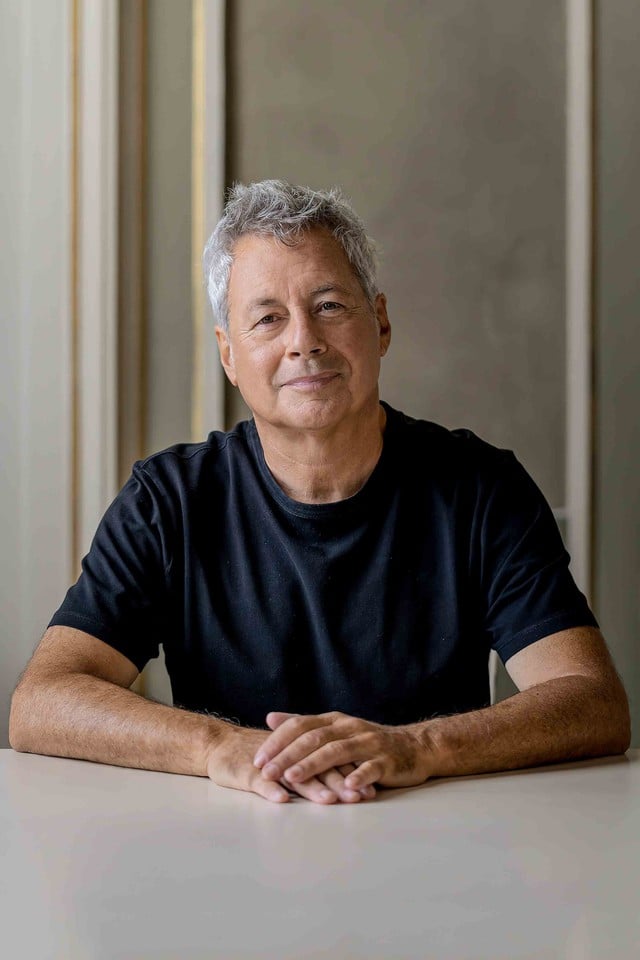
The writer Alessandro Baricco
PHOTO: PROVIDED BY ANNA LA NAIA/PHANBOOK
It seems that Alessandro Baricco was not interested in the concept of a "great work" in the sense of being "massive" as seen in the literary tradition of Europe in particular, and the world in general. He deviated from that notion with his novellas (short novels), with a unique melody that he called "white music" - which is the dominant tone, the source of inspiration for free and spontaneous creativity.
His characters are similar. They belong to a completely private world, outside of common sense or established norms. The life of a pianist at sea like Novecento is surely an unrealistic ideal. Life is no longer found beneath those steps, but here, on this drifting ship. Novecento was born and decided to stay on the ship, beside his piano, with music that "the world" can hardly comprehend, transcending human happiness and suffering.
Baricco's characters often possess extraordinary qualities, suspended on the invisible nail of lost ideals in the world. On the one hand, they share finitude with fate; on the other, they arrive at a noteworthy point of reference: self-realization. In *Silk* , the merchant Hervé Joncour undertakes a thousand-mile journey to Japan with the apparent purpose of finding silkworm eggs to salvage his business when a plague threatens the silkworm farming industry in the French countryside. But it is the distant East, with its map that stirs his mind, that truly captivates the merchant. Like the image of Novecento forever playing the piano on his dilapidated ship, Hervé Joncour pauses in pensive contemplation by the lake of his homeland in his old age.
One of the fascinating aspects of Baricco's novels is its exploration of various settings, even though the setting that creates the superficial sense of wonder is not necessarily everything (whether it's the ocean, distant Japan, or the harsh Wild West...). Geography has achieved universality, reaching the "promised land" of creation and existence: the human spirit.
Abel - The Explorer of Destiny
The character of Abel, amidst the "sand dunes of time" of the Wild West with his two sharpshooters, is both vivid and metaphysical. Each shot Abel fires establishes geometric lines to explore and examine his destiny.
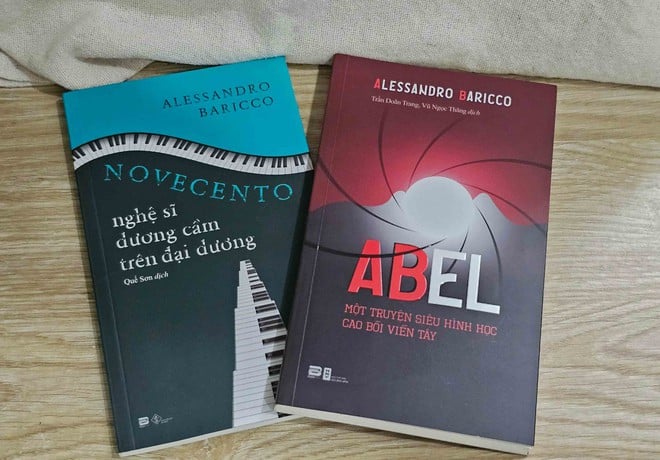
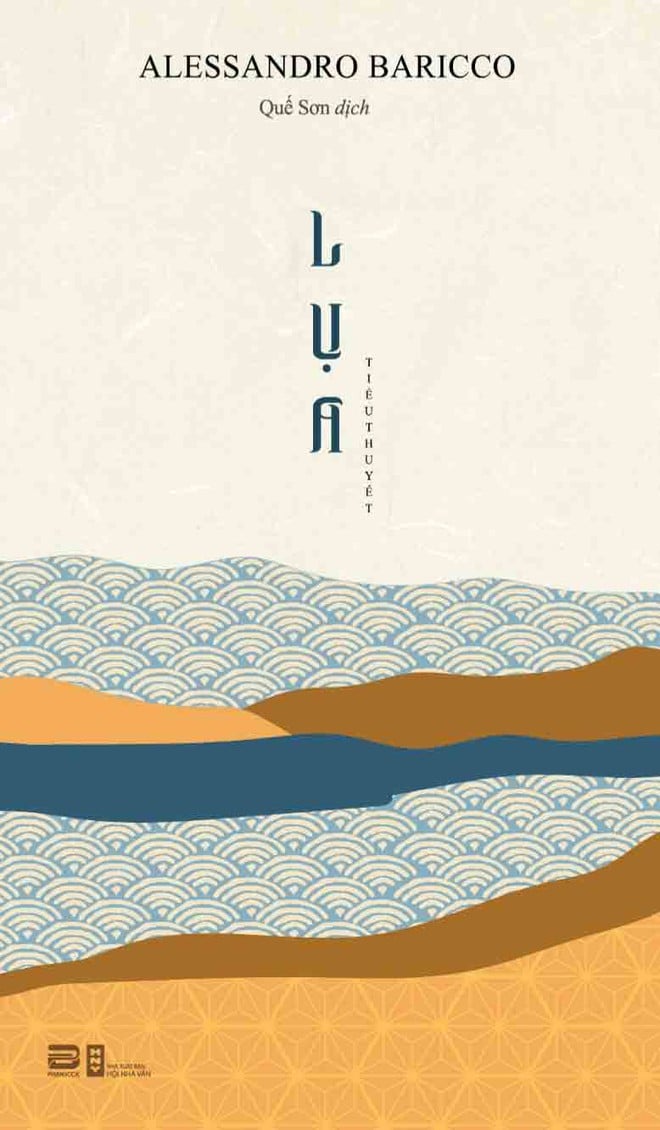
Works by Alessandro Baricco
PHOTO: NGUYEN VINH NGUYEN
Abel learned the art of marksmanship to survive from his cold, unyielding father—who was ultimately beheaded by two Absaroka natives. But marksmanship only became a metaphysical contemplation when Abel received the experience of listening to the mind's influence through his blind teacher: "The soul will perceive when the person you are aiming at is perfectly aligned with the barrel of your weapon, and at that moment, you will perceive as if a breath passes by, or an invisible noose is stretched between your mind and the mind of that person."
From this point, Alessandro Baricco's novel encourages readers to boldly transcend the allure of gunfights and instead focus on the rhythm of a spiritual world still marked by spiritualism.
Readers encounter a literary style that consistently blends poetic and philosophical elements. In *Abel* , Baricco pushes the boundaries of thought, juxtaposing mystical echoes with the modern, wildness with civilization, magic with law, gospel with violence, and the surreal with the unreal... all in a light, concise, and musical style. By dividing the book's "spectacle" into segments, the work is like an assembly of multifocal lenses, capable of seeing a vast desert and yet clearly discerning individual dust particles in the enchanting labyrinth of human destiny, including the intersections of multicolored spectra.
The characters in Abel all bear biblical names, but they are not sanctified in the Wild West; they are archetypes of action in the desolate world. Abel becomes a legend at age 27, finding meaning in life through a lifetime of shooting. But Hallelujah—a girl whose name is a blessing—leads him into another dimension of life even after he lays down his gun.
Alessandro created Abel just as he had woven Novecento on the sea, or Hervé Joncour on his journey to the East. Along these journeys across the vastness of the world's geography lie unfathomable realms of consciousness.
Alessandro Baricco, born in 1958 in Turin, is a contemporary Italian writer whose works have been translated into numerous languages worldwide. His most recent Vietnamese translations include *Silk* (translated by Que Son, Phanbook & Vietnam Writers Association Publishing House, 2021), *Novecento - The Pianist on the Ocean* (translated by Que Son, Phanbook & Da Nang Publishing House, 2024), and *Abel - A Metaphysical Western Cowboy Story* (translated by Vu Ngoc Thang and Tran Doan Trang, Phanbook & Vietnam Writers Association Publishing House, 2025).
Source: https://thanhnien.vn/abel-trong-con-cat-thoi-gian-185250418205006349.htm

![[Image] Leaked images ahead of the 2025 Community Action Awards gala.](/_next/image?url=https%3A%2F%2Fvphoto.vietnam.vn%2Fthumb%2F1200x675%2Fvietnam%2Fresource%2FIMAGE%2F2025%2F12%2F16%2F1765882828720_ndo_br_thiet-ke-chua-co-ten-45-png.webp&w=3840&q=75)
![[Photo] Prime Minister Pham Minh Chinh receives Lao Minister of Education and Sports Thongsalith Mangnormek](/_next/image?url=https%3A%2F%2Fvphoto.vietnam.vn%2Fthumb%2F1200x675%2Fvietnam%2Fresource%2FIMAGE%2F2025%2F12%2F16%2F1765876834721_dsc-7519-jpg.webp&w=3840&q=75)
![[Image] The tenacious fighting spirit of Vietnamese women's football](/_next/image?url=https%3A%2F%2Fvphoto.vietnam.vn%2Fthumb%2F1200x675%2Fvietnam%2Fresource%2FIMAGE%2F2025%2F12%2F17%2F1765990260956_ndo_br_4224760955870434771-copy-jpg.webp&w=3840&q=75)
![[Photo] Prime Minister Pham Minh Chinh receives the Governor of Tochigi Province (Japan)](/_next/image?url=https%3A%2F%2Fvphoto.vietnam.vn%2Fthumb%2F1200x675%2Fvietnam%2Fresource%2FIMAGE%2F2025%2F12%2F16%2F1765892133176_dsc-8082-6425-jpg.webp&w=3840&q=75)
![[Live] 2025 Community Action Awards Gala](/_next/image?url=https%3A%2F%2Fvphoto.vietnam.vn%2Fthumb%2F1200x675%2Fvietnam%2Fresource%2FIMAGE%2F2025%2F12%2F16%2F1765899631650_ndo_tr_z7334013144784-9f9fe10a6d63584c85aff40f2957c250-jpg.webp&w=3840&q=75)



![[Video] Exhibition space "Great Poet Nguyen Du - Remembered for a Thousand Years"](https://vphoto.vietnam.vn/thumb/402x226/vietnam/resource/IMAGE/2025/12/17/1765983645796_khong-gian-trung-bay-dai-thi-hao-nguyen-du-ngan-nam-nho-mai-3610-jpg.webp)













































![[Live] Closing Ceremony and Award Presentation for the "Impressive Vietnam Tourism" Video/Clip Creation Contest 2025](https://vphoto.vietnam.vn/thumb/402x226/vietnam/resource/IMAGE/2025/12/17/1765974650260_z7273498850699-00d2fd6b0972cb39494cfa2559bf85ac-1765959338756946072104-627-0-1338-1138-crop-1765959347256801551121.jpeg)

















Comment (0)