

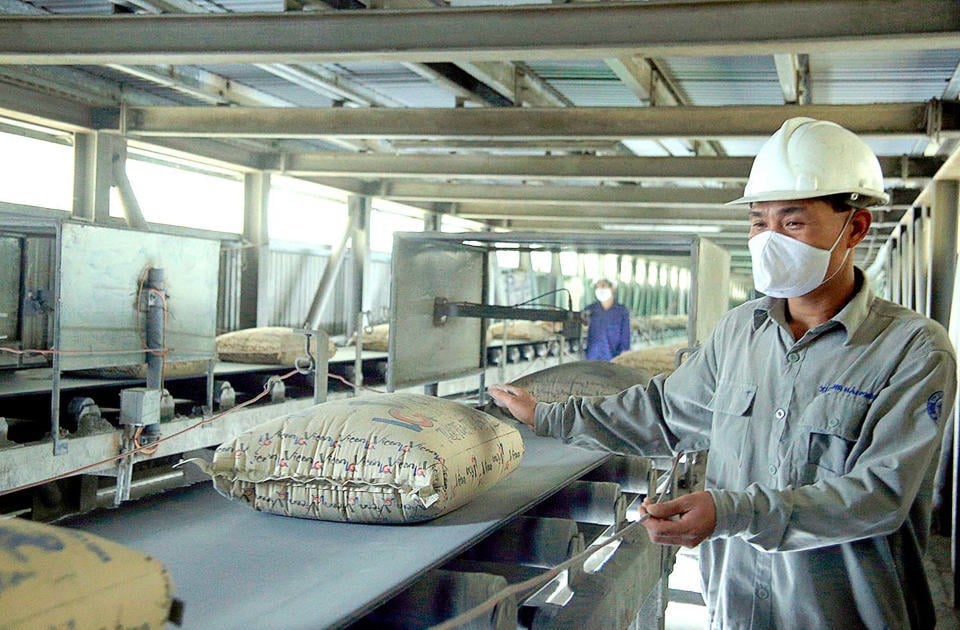
Price adjustment
Currently, the prices of input materials such as coal and electricity are continuously rising and show no signs of stopping in the near future. Cement factories are still operating at a loss and are at risk of having to cease production.
In light of the current situation, the Vietnam Cement Association and cement factories have proposed solutions to alleviate difficulties for domestic cement manufacturers. Accordingly, to stabilize production and business, minimize losses, and ensure product quality, some businesses have announced adjustments to domestic cement prices.
Effective January 1, 2025, Bim Son Cement Joint Stock Company has announced a price increase of VND 50,000 per ton (including VAT) for all types of bagged and bulk cement. Similarly, Vicem Hoang Mai also announced an increase of VND 50,000 per ton (including VAT) in the net price at the factory for all types of bagged cement produced by the company, compared to the current price.
The Vissai Group has also sent notices to its member units (Vissai Ninh Binh Joint Stock Company, Vissai Ha Nam Joint Stock Company, Dong Banh Cement Joint Stock Company, Vissai Song Lam Joint Stock Company and Vissai Song Lam 2 Joint Stock Company) regarding the adjustment of the selling price of bagged cement of all types by an additional 46,300 VND/ton (excluding VAT).
Tan Thang Cement Joint Stock Company has adjusted the selling price of cement, increasing it by 50,000 VND/ton (including VAT) for all types of bagged and bulk Tan Thang cement throughout the entire market until further notice.
Many industry experts believe that the price of input materials such as coal, electricity, and other energy costs has a significant impact on the cement industry. Coal, for example, is one of the main energy sources for producing clinker (the primary material in cement production). When coal prices rise, cement production costs also increase. This is because coal accounts for a large portion of the total production costs of the cement industry, especially in factories using rotary kilns to produce clinker.
Electricity in the cement industry is used not only to operate equipment during the cement grinding process, but also in other stages such as clinker grinding, bagging, and transportation. High electricity prices increase the operating costs of cement plants. When raw material and energy costs rise, the price of cement products will be pushed up. This can reduce the competitiveness of cement businesses, especially those with thin profit margins.
If a business cannot pass on all the increased costs to customers (through price adjustments), it will suffer reduced profits. In a highly competitive environment, companies often have to maintain stable prices to retain market share, but this means that profit margins will shrink as costs rise.
Furthermore, fluctuations in raw material, electricity, and fuel prices can cause instability in the production and business plans of cement companies. Especially in the context of volatile international energy prices, companies need risk management strategies and flexible production adjustments to cope with these fluctuations.
According to data from the Ministry of Construction , in 2024 the total national cement supply will reach approximately 122 million tons, while domestic consumption will only reach about 60 million tons, leading to oversupply, fierce competition, and falling prices...
Rising input costs such as electricity and coal, along with persistently high production material prices, have led to significantly increased production costs. Exports are also facing difficulties due to trade barriers from the Philippines, China, and several other major markets. The sluggish real estate market and slow disbursement of public-private partnership (PPP) construction projects directly impact domestic cement consumption.
Businesses are running out of steam.
Recently, on January 9th, the Government Office issued a document conveying the directives of Deputy Prime Minister Tran Hong Ha regarding reports that the Vietnam Cement Corporation (VICEM) reported additional losses of thousands of billions of dong.
Specifically, the directive requires the Ministry of Construction to take the lead, in coordination with the Ministry of Finance and other relevant agencies, in reviewing the reported incident. It also calls for clarifying the reasons behind Vicem's losses of thousands of billions of dong and proposing solutions for the future.
Previously, at the 2024 business performance review conference held on January 7th, VICEM's clinker production reached 15.94 million tons, achieving 94.3% of the annual plan, a decrease of 3.6% compared to 2023. This was due to a decline in cement and clinker consumption, leading to high inventory levels. As a result, some VICEM Hai Van and VICEM Ha Long plants had to shut down their kilns, reducing productivity and equipment utilization time compared to the plan, in order to minimize clinker dumping.
VICEM's total cement and clinker consumption reached 23.78 million tons, achieving 98.9% of the 2024 plan, a 5.4% increase compared to 2023. Of this, cement consumption was approximately 21.04 million tons, reaching 97.4% of the 2024 plan; domestic cement consumption was approximately 18.18 million tons, reaching 97.8% of the 2024 plan. Cement exports totaled approximately 2.86 million tons, reaching 94.9% of the plan, with FOB export prices ranging from 40 to 40.5 USD/ton. Clinker exports totaled approximately 2.74 million tons, reaching 111.6% of the 2024 plan. Total revenue for VICEM in 2024 reached VND 27,151 billion.
Currently, VICEM is reviewing, collecting, and analyzing information to develop a feasible and positive production, business, and investment plan for 2025. However, given the many difficulties and uncertainties surrounding 2025, VICEM is approaching this plan with considerable caution.
Specifically, clinker production is projected at approximately 17.87 million tons, an increase of 12.1% compared to 2024; cement and clinker consumption is projected at approximately 25.58 million tons, an increase of 7.6% compared to the previous year, of which domestic cement consumption is approximately 19.7 million tons; and revenue is expected to be around VND 29,413 billion, an increase of 8.3% compared to 2024.
To address the difficulties, according to the Ministry of Construction, the Corporation needs to identify the causes, both subjective and objective, in order to rectify them. Accordingly, it is necessary to focus on strengthening cost management; tightly controlling costs from raw materials, fuel, production, processing, consumption, and business management; implementing rational supply chains, reducing transportation costs; and restructuring loss-making member units and companies to avoid the risk of capital loss.
Another important solution is to boost domestic consumption and exports; optimally exploit opportunities from key public investment projects; and seek and develop potential export markets.
Source: https://kinhtedothi.vn/am-dam-nganh-xi-mang.html




![[Photo] General Secretary and President To Lam receives Amazon's Senior Vice President David Zapolsky](https://vphoto.vietnam.vn/thumb/1200x675/vietnam/resource/IMAGE/2026/05/22/1779466547770_a1-bnd-3513-6601-jpg.webp)

























































































Comment (0)