

Sacred tree in the ancient forest
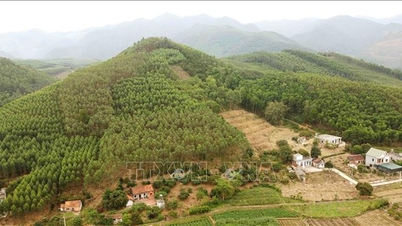
On the summit of Hon Giao, one of the highest areas of Bidoup - Nui Ba National Park, part of the Langbiang World Biosphere Reserve (located in Lac Duong commune and Lang Biang ward - Da Lat, Lam Dong province), legendary stories of the ancient forest are retold, where "green treasures" such as the rare thousand-year-old cypress and two-leaved pine trees stand majestically.
Navigating through the dense forest, village elder Cil Ten (Dung K'Si hamlet, Lac Duong commune, Lam Dong province) paused beside a tall, flat-leaved pine tree, slowly sharing: according to local beliefs, these ancient pine trees are "sacred trees," dwelling places of spirits, so no one dares to cut them down. "Touching sacred trees brings bad luck to the community," the elder said.
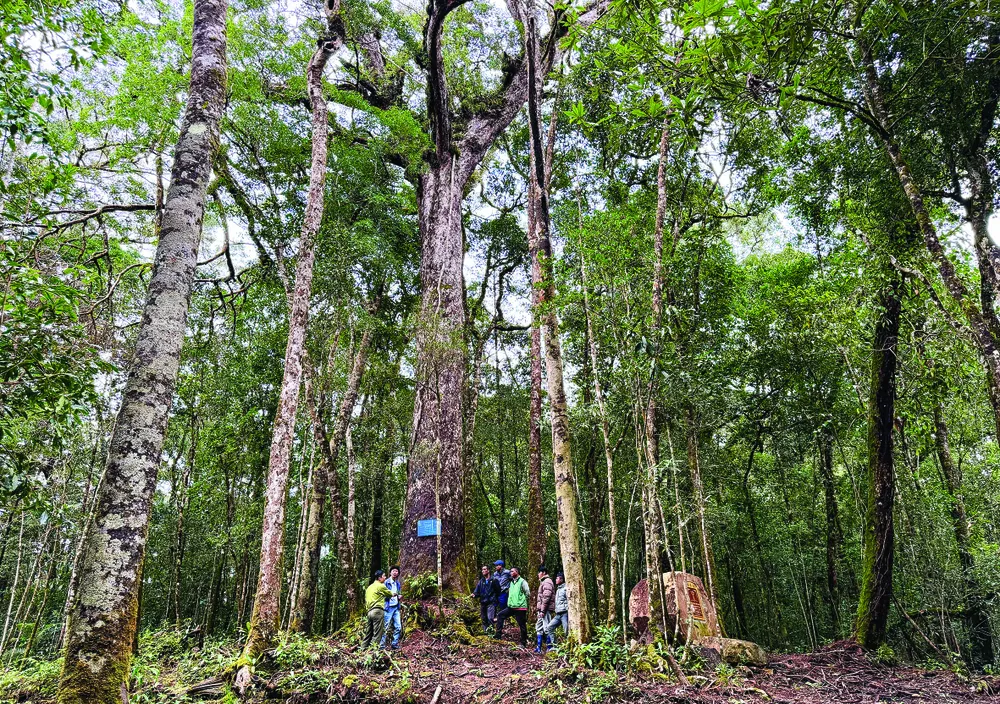
The easily recognizable characteristics of this species are its peeling underside bark, which secretes a milky white sap; the leaves grow in clusters at the end of branches, spirally arranged, consisting of two flattened, sword-shaped leaves, enclosed in a single sheath.
The flat-leaved two-needle pine population in Bidoup - Nuí Bà National Park currently comprises hundreds of trees with trunk diameters ranging from 50-60cm to nearly 2m, thriving in a multi-layered forest ecosystem. This area is being protected under contracts with over 70 local ethnic minority households.
Messenger of Time
The flat-leaved two-needle pine population is concentrated in plots 3, 4, and 5 of sub-area 89 and plots 1, 2, and 3 of sub-area 90, within the forest area managed by Bidoup - Nuoi Ba National Park. This area is not far from National Highway 27C (connecting Da Lat and Nha Trang), making it convenient for scientific research and experiential tourism.
Through surveys, scientists have identified 108 endemic, endangered, and rare flat-leaved pine trees with diameters of 1-1.9m and estimated ages of 430-1,000 years. This population has recently been recognized as a Vietnamese Heritage Tree; each individual tree has been numbered and its GPS coordinates identified for monitoring and conservation purposes.
In addition, a large number of flat-leaved two-needle pine trees with trunk diameters under 1 meter, which have not been fully accounted for, continue to contribute to maintaining the biodiversity of the Langbiang World Biosphere Reserve.
According to Mr. Truong Quang Cuong, Deputy Director of the Tourism and Science Service Center (Bidoup - Nui Ba National Park), the 108 ancient flat-leaved pine trees are a valuable resource for genetic conservation and climate change research. Through analyzing the annual rings of the forest trees, scientists can reconstruct past weather patterns, thereby developing scenarios to predict future climate change.
The type of forest with flat-leaved two-needle pine forms five distinct layers (emergent, sub-canopy, understory, shrub, and herbaceous layer), allowing about 70% of rainwater to infiltrate the soil, regulating runoff into rivers and streams, slowing down the water cycle, and retaining water more effectively than areas of open land with sparse vegetation.
Mr. Ton Thien An, Director of Bidoup - Nui Ba National Park, said that in the coming time, the unit will continue to coordinate with research agencies to strengthen monitoring and protection of the flat-leaved pine population, while developing ecotourism associated with conservation.
The goal is to create sustainable livelihoods for local communities by utilizing (not consuming) ecosystem services, thereby contributing to enriching Vietnam's natural heritage.
Thanks to its diverse forest ecosystems, Bidoup - Nuí Bà National Park (covering over 69,663 hectares) possesses a treasure trove of biodiversity. To date, the area has recorded 2,089 species of vascular plants, out of a total of approximately 13,000 species in Vietnam's flora.
Of these, 74 species are listed in the Vietnam Red Book 2024 and 35 species are on the Red List of the International Union for Conservation of Nature and Natural Resources (IUCN) 2021.
Source: https://www.sggp.org.vn/bau-vat-dinh-hon-giao-post838789.html




























































































Comment (0)