

From the shade of the banyan tree on a distant island, thinking about the roads named after President Ton Duc Thang in my hometown of An Giang today, I suddenly feel that spring has an added layer of meaning. Spring is not just about blooming flowers and brightly lit streets; spring is also a time when people remember and cherish the things that once made up the dignity of a land.

Ton Duc Thang Street, Long Xuyen Ward.
A SYMBOL OF RESILIENCE AMIDST STORMS
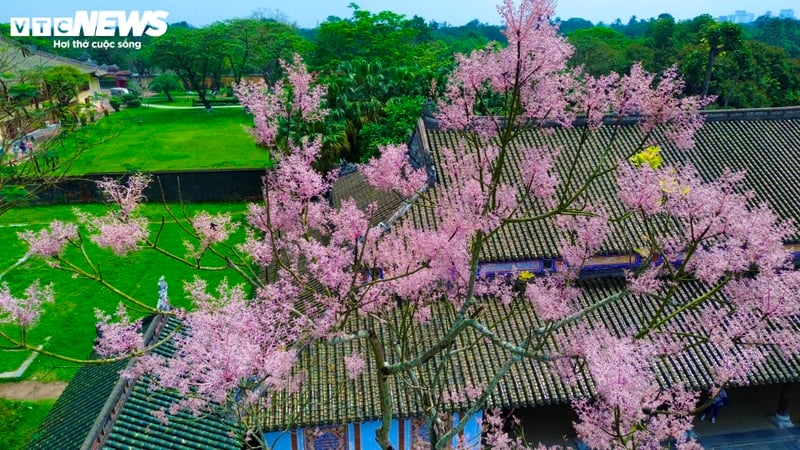
Upon arriving in Con Dao, one immediately notices the presence of Terminalia catappa trees in many places: along the roads, around residential areas, in front of administrative buildings, and near historical sites. Some trees have gnarled trunks and wide, spreading canopies, standing exposed to the sea breeze as if accustomed to storms. The seasons of leaf change here are also unusual; sometimes almost all the Terminalia catappa leaves fall, leaving only the fruit on the branches, the canopy becoming more compact so that the wind rustles through, sounding like the sea breathing.
Long-time residents of the island recount that the Terminalia catappa tree has long been intertwined with the lives of the people of Con Dao. During the notorious atrocities committed in Con Dao prison, young Terminalia catappa leaves and fruits were precious "food to stave off hunger." Whenever imprisoned revolutionary fighters were allowed out to work, they would secretly pick leaves and fruits, hiding them on their person or holding them in their mouths before bringing them back to their cells, sharing them with their comrades to help them survive. In a place where even food and drink could become a life-or-death struggle, a young Terminalia catappa leaf was not just food, but a symbol of protection and support.
Another story, often retold in the memories of the islanders, recounts how Uncle Ton once hid documents under a banyan tree opposite a government office at the time. Time may have passed, place names and signs may have changed, but the way people passed the story added a layer of solemnity to the banyan tree on the island—a layer of ingenuity, patience, and faith.
Mr. Tam, who came from Hai Phong to Con Dao to do business over a decade ago, said something that described the scenery as if describing a person: "In the season when the Terminalia catappa trees shed their leaves, the bare branches welcome the wind, their rough trunks bearing the marks of time, yet they stand there through one gust of wind after another, without complaining, without falling." He said that one day, sitting and looking at the Terminalia catappa tree in front of his shop, the red leaves falling gently onto the sand, the sea breeze whipping up, yet the tree remained silent, and naturally, his heart calmed down. "The Terminalia catappa trees on the island are like the people of Southern Vietnam, resilient, hardworking, and quietly steadfast," Mr. Tam remarked.
The war is long over, Con Dao has changed considerably, but the old banyan trees still silently provide shade. Each stormy season, their canopies shield against the harsh wind, reminding us that some things endure not for the sake of decoration, but to provide a peaceful foundation for life.
SPRINGTIME SCENERY ON STREETS NAMED AFTER HIM
If the banyan trees in Con Dao evoke a time of endurance and indomitable spirit, then the streets named after Ton Duc Thang in my hometown tell the story of a time of expansion and construction.

A corner of Ton Duc Thang street in Rach Gia ward.
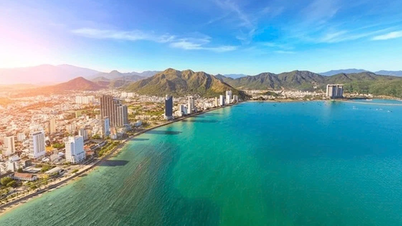
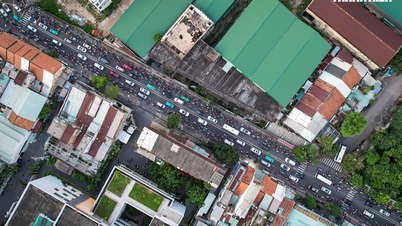
In Rach Gia ward, Ton Duc Thang street is a major artery of the coastal city. The road connects bustling areas, passing many buildings and amenities; the sea breeze makes the air milder, especially in the afternoon. People come there to do business, meet up on weekends, and watch the water change color at sunset. A young city, with a fast pace of life and bustling traffic, yet the street name evokes a slow-paced memory: Remembering the outstanding son of An Giang who endured imprisonment but maintained his integrity.
Mr. Ho Chi Dung, Vice Principal of Nguyen Hung Son High School, said: “Every time I walk along the road named after Uncle Ton, I feel a unique sense of pride. Pride in the transformation of my homeland; pride in the fact that his name is not only displayed on the street sign but is also integrated into the daily lives of the people – in their studies, work, business, recreation, and future aspirations.”
Ms. Tuyet Nhung, a civil servant working in Rach Gia ward, recounts the story of the street from a very ordinary perspective: "After work, my friends and I often sit along the embankment of Ton Duc Thang street, eating, chatting, and recharging our energy." For Ms. Nhung, the "springtime" of the coastal city is those moments of leisurely together in the salty breeze; even in that leisurely moment, the name Ton Duc Thang street silently reminds each person of the value of independence and freedom that our ancestors sacrificed their lives for.
Although it's still Ton Duc Thang Street, the one in Long Xuyen ward has a different appearance. The street isn't long, only about a kilometer, but it's home to many administrative offices and units. At the end of the street is a park named after President Ton Duc Thang, which has recently been renovated and expanded. In the evening, the towering ancient trees stand still, the atmosphere becomes tranquil, and residents come to stroll, exercise, or rest under the shade. It has a solemn, gentle atmosphere, befitting the pace of life in a large city in the Mekong Delta.
Mr. Le Thanh Man (72 years old), who grew up in Long Xuyen, recounts that as a child he used to call the road in front of his house Gia Long. Back then, the road was as peaceful as a small street; people greeted each other with open doors in the morning and closed them in the evening, the pace of life slow and friendly. After the country was reunified, the road was named Ton Duc Thang. The new name brought about change: houses were renovated, shops opened, lights stretched on, and the crowds grew larger. Amidst this bustling atmosphere, Mr. Man still recognizes one thing that remains unchanged: the memories of those who witnessed their homeland's development day by day, and the feeling of cherishing the name given to remind future generations.
Spring sometimes begins with very small things. It could be a cool, breezy afternoon in the park, a meal by the sea, or a leisurely stroll down a familiar path. But if one pauses, one will see a larger shadow within those small things. That shadow is the shadow of history, of character, of the resilience and simplicity that Uncle Ton left behind.
Uncle Ton - a son of Ong Ho islet. President Ton Duc Thang was born on August 20, 1888, on Ong Ho islet, in An Hoa village, Dinh Thanh commune, Long Xuyen district (now My Hoa Hung commune). From the working environment and patriotic spirit of the people of Southern Vietnam, he soon became enlightened about the revolution, left his hometown to participate in activities, working as a laborer at the Ba Son shipyard, and became deeply involved in the workers' movement. His life spanned many stages: from a laborer, a soldier-worker, to an organizer of the struggle; from imprisonment in Con Dao to participation in the resistance war; holding many important responsibilities in the Party, State, and Front, and serving as President of the Republic . In each role, he is remembered as a humble, simple, and exemplary model of revolutionary ethics and the spirit of national unity. |
NGUYEN HUNG
Source: https://baoangiang.com.vn/bong-bang-bong-bac-ton-a476777.html




































































Comment (0)