

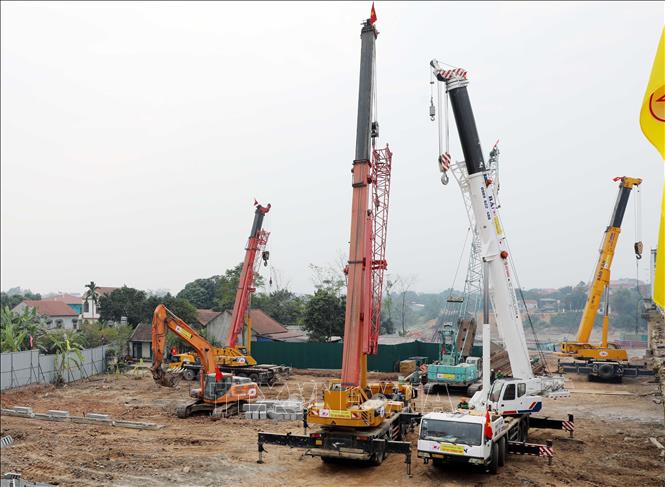
With a series of groundbreaking reforms such as a strong shift from pre-inspection to post-inspection, reduction of administrative procedures, deeper decentralization, and increased accountability for participating entities, the Law is considered one of the most powerful reform laws in the construction industry in recent years, marking a fundamental change in the State's management thinking regarding construction activities.
Shift from pre-audit to post-audit
According to Mr. Bui Van Duong, Deputy Director of the Department of Economic and Investment Management of Construction ( Ministry of Construction ), the most important innovation of the amended Construction Law lies in the change in management thinking. Previously, construction activities were mainly controlled through pre-inspection mechanisms with many layers of administrative procedures. The new law shifts strongly towards post-inspection, management through planning, standards, technical regulations, and the responsibilities of participating entities.
This approach clearly demonstrates the State's proactive management role, focusing on building a clear and transparent legal framework, rather than deeply interfering in each stage through administrative procedures. According to experts, this is a modern management trend, consistent with international practices, helping the State manage more effectively while reducing compliance costs for citizens and businesses.
One of the issues attracting much attention is the expansion of the list of construction projects exempt from building permits to eight categories. However, according to the Ministry of Construction, this is not a "loosening" of regulations, but rather the elimination of redundant procedures. Core aspects such as compliance with planning, technical requirements, construction safety, and fire safety have already been checked in previous stages, especially during project appraisal or feasibility study review.
According to experts, continuing to require construction permits in these cases does not increase management efficiency but instead prolongs investment preparation time, generates costs, and creates pressure on both businesses and management agencies. Therefore, the amended Construction Law establishes the principle of a single, sufficient, and accurate control process, focusing on the most important aspects.
The principle of "each project and construction only undergoes one administrative procedure from preparation to commencement" is considered one of the most important reforms of the Law. In reality, for many years, a construction investment project often had to go through many overlapping procedures such as project appraisal, design appraisal, and then applying for a construction permit. This process not only prolongs the time but also increases social costs and affects project implementation progress.
Under the new regulations, once the basic aspects of planning compliance, adherence to technical standards and regulations, and safety assurance have been verified during the feasibility study review process, further requirements for construction permits are deemed unnecessary. This regulation is expected to have a significant impact on public investment projects, large infrastructure projects, and enterprise projects, helping to remove bottlenecks in construction investment implementation.
In addition, the amended Construction Law also stipulates exemption from construction permits for individual houses under 7 floors with a floor area of less than 500 m2. This is a matter of particular interest to the public. According to the drafting agencies, it is important to understand the spirit of the Law correctly: exemption from construction permits does not mean arbitrary construction or disregard for other legal regulations.
Individual residential buildings must still strictly comply with planning regulations, architectural management regulations, construction safety requirements, fire safety regulations, environmental protection regulations, and technical infrastructure connectivity. The law also clearly stipulates areas where building permits are not exempt, such as functional zones, urban development areas according to the general plan, areas with existing architectural management regulations, or areas with specific management requirements. Therefore, before construction, people still need to carefully research planning information and specific local regulations.
Enhancing accountability and management through digital tools.
The reduction of administrative procedures and the expansion of exemptions from construction permits place higher demands on post-inspection work. The overarching principle of the amended Construction Law is to simplify procedures but not to relax management.
According to Minister of Construction Tran Hong Minh, the Law has designed a more complete and rigorous construction order management cycle, spanning from the announcement of commencement, throughout the construction process, to acceptance, handover, and commissioning of the project.
For large-scale projects, those with complex engineering or significant impacts on safety and public interest, the Law stipulates that inspections of acceptance testing by specialized construction agencies and the State Council for Construction Acceptance Testing must be carried out during construction and upon completion of the project. This approach helps to detect violations early and prevent risks, instead of only addressing them after the project is completed.
"The management of construction order is carried out from the commencement of construction to acceptance and handover, aiming to detect, prevent, and promptly handle violations," Minister Tran Hong Minh emphasized.
Alongside strengthening post-construction inspections, the Law also enhances the responsibility of entities involved in construction activities. Investors, design consultants, supervision consultants, and contractors are identified as entities directly responsible for the quality and safety of construction projects. This responsibility is not only professional but also legal, instead of placing the entire burden on state management agencies as before.
Another notable point is the simplification of procedures for granting land use rights certificates and ownership certificates for properties attached to land for constructions exempt from building permits. According to Minister Tran Hong Minh, these details will be stipulated in the Decree, moving towards implementing online procedures throughout the entire process, simplifying documents and conditions, and shortening the processing time to approximately 7-10 days.
These regulations are expected to reduce the time and costs for citizens and businesses by at least 30%, as required by the Government . Promoting the application of information technology and digital transformation is considered a key solution to ensure convenience and enhance transparency in management.
In the long term, the amended Construction Law aims to build and operate a national information system and database on construction activities, synchronously connected with land, planning, and population data. When these data systems are interconnected and transparent, management efficiency will be improved, while simultaneously limiting negative practices and harassment in the process of law enforcement.
According to experts, the amended Construction Law not only addresses immediate problems but also lays the foundation for a modern management model, in which the State manages through laws, standards, and digital tools; and citizens and businesses are given the opportunity to be proactive, creative, and responsible.
Source: https://baotintuc.vn/kinh-te/buoc-ngoat-tu-duy-quan-lyxay-dung-20251218091830330.htm


![[Image] Central Party Office summarizes work in 2025](/_next/image?url=https%3A%2F%2Fvphoto.vietnam.vn%2Fthumb%2F1200x675%2Fvietnam%2Fresource%2FIMAGE%2F2025%2F12%2F18%2F1766065572073_vptw-hoi-nghi-tong-ket-89-1204-jpg.webp&w=3840&q=75)






































































































Comment (0)