

- Chau Thoi develops production models and enhances the value of agriculture.
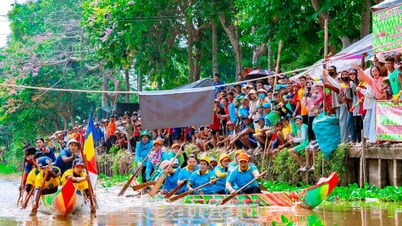
- Chau Thoi Commune Youth Union excellently won first prize in the three-leaf boat race.
- Farmers in Chau Thoi commune are ready for the 2026 Summer-Autumn rice crop.
Sustainable agricultural development
Chau Thoi district has a natural area of over 91 km² and a population of over 41,000 people, with a long tradition of rice cultivation. Despite possessing many advantages in terms of land, water resources, and an abundant agricultural workforce, rice production in Chau Thoi has remained small-scale, with low added value, limited application of science and technology , and restricted production linkages. These are the "bottlenecks" that need to be addressed to elevate the local rice industry.
Stemming from practical needs, the Party Committee of Chau Thoi commune issued a thematic resolution "on high-quality rice production in Chau Thoi commune for the period 2026-2030, with a vision to 2045". This is a strategic step to concretize the Party's guidelines and the State's policies on restructuring the agricultural sector in conjunction with building new rural areas and sustainable development.
The resolution identifies the development of agriculture towards high quality, sustainability, and climate change adaptation, linked to environmental protection, efficient use of land and water resources, science and technology, and digital transformation. In this process, farmers play a central role, cooperatives and businesses are the driving force, and the State plays a facilitating and supporting role. Production is no longer simply about "making products," but must be linked to the value chain from production and processing to consumption, aiming to increase the added value and competitiveness of local agricultural products.
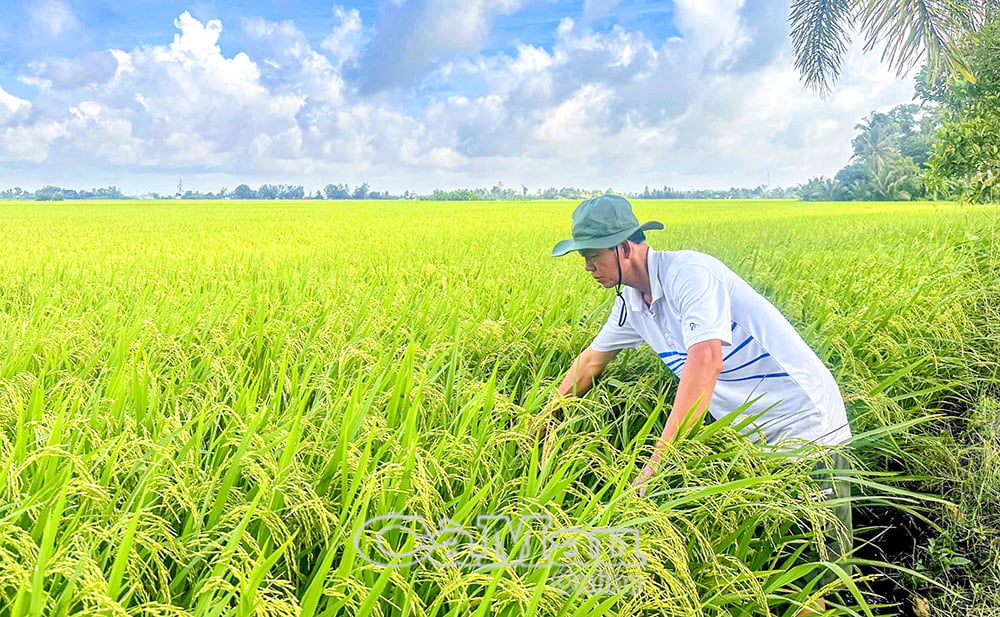 Farmers in Chau Thoi commune prioritize selecting rice varieties that are suitable for their farming conditions, easy to sell, and highly competitive, such as ST24 and ST25.
By 2030, the goal is for over 70% of the commune's rice production area to apply advanced, safe, and standardized technical processes such as VietGAP, organic farming, or SRP; striving for 50% of the rice production area to have established planting area codes and traceability systems; aiming to form 1-2 sustainable chain linkage models with high-quality rice-based OCOP products, increasing farmers' income by 15-20% compared to traditional farming methods.
Reorganize production
To achieve this goal, the commune focuses on reorganizing production towards a concentrated approach, forming large-scale raw material areas, large-scale model fields, and developing cooperatives or farmer groups. Mechanization, the application of digital technology in production management, electronic logs, and quality monitoring are promoted, creating a foundation for smart agriculture.
Establishing value chain linkages between farmers, cooperatives, and businesses through product purchase contracts, benefit sharing, and raw material area management is crucial. Simultaneously, attention should be paid to building brands, trademarks, traceability, and expanding consumer markets to enhance the value and position of local rice products.
 Establishing value chain linkages between farmers, cooperatives, and businesses through product purchase contracts.
Improving the quality of human resources is one of the key solutions, equipping farmers with knowledge about high-quality, safe agricultural production, and moving towards green, circular agriculture. At the same time, communication efforts and the replication of effective models are being intensified, creating a ripple effect within the community.
Environmental factors and climate change adaptation are prioritized. The commune encourages the adoption of water-saving measures, the treatment of agricultural by-products, emission reduction, and proactive responses to drought, salinity intrusion, flooding, and diseases, aiming for long-term sustainable production.
Mr. Nguyen Tan Trang, Deputy Head of the Economic Department of Chau Thoi commune, said: “To improve production efficiency and move towards sustainable, high-quality agriculture, the commune guides farmers to sow seeds at the correct density, use balanced fertilizers and pesticides according to the "4 correct principles"; at the same time, apply advanced IPM techniques, "3 reductions, 3 increases", "1 must, 5 reductions", and reduce emissions.”
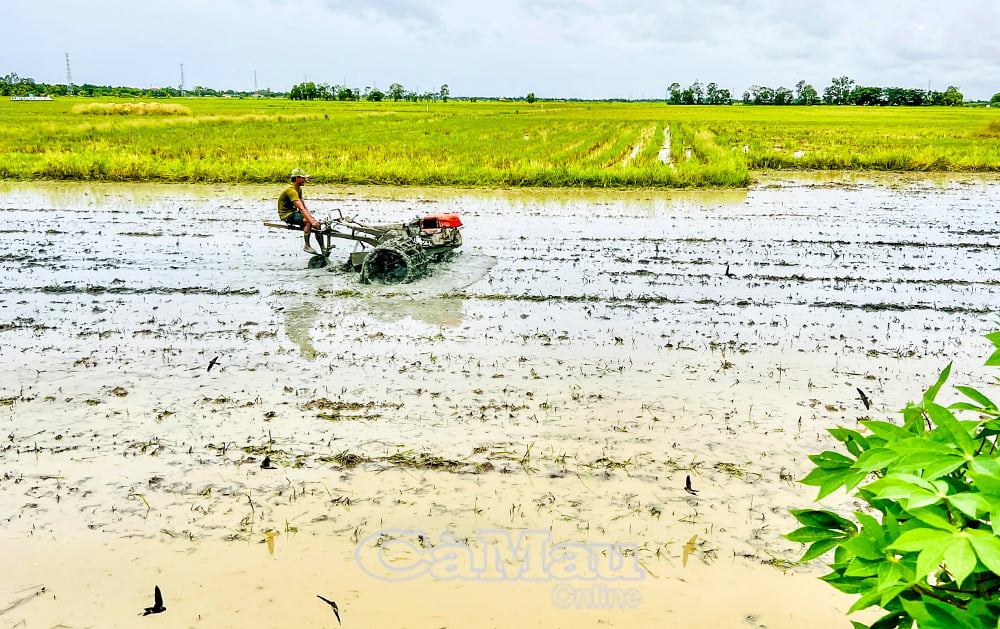 Many households are applying mechanization to production, saving time and labor.
With a vision extending to 2045, Chau Thoi strives to build a modern, smart, low-emission, large-scale, and professional agricultural sector. Rice products will not only ensure quality but also have established brands, making them competitive in both domestic and international markets.
Developing high-quality rice production is not simply about changing farming methods, but also about transforming the farmers' production mindset. Improving the quality and value of rice will enhance people's lives and contribute to building a sustainable and prosperous Chau Thoi commune in the future.
Trung Kien
Source: https://baocamau.vn/chau-thoi-huong-den-san-xuat-lua-chat-luong-cao-a129094.html
![[Image] Close-up view of the interchange connecting the two expressways and Long Thanh Airport.](https://vphoto.vietnam.vn/thumb/1200x675/vietnam/resource/IMAGE/2026/05/25/1779703378210_ndo_br_z7863716673926-224453a31600126cce10622af6290afd-4549-jpg.webp)



![[Image] Hanoi's urban life under the challenge of a "scorching hot" environment](https://vphoto.vietnam.vn/thumb/1200x675/vietnam/resource/IMAGE/2026/05/25/1779706979265_nang-nong-t5-2026-minh-duy-7-4636-jpg.webp)


























































Comment (0)