

Qualifying for the 2023 Women's World Cup is a source of immense pride for Vietnamese women's football. In recent days, coach Mai Duc Chung and his team have received considerable attention for competing in the world's biggest tournament, but will Vietnamese women's football continue to receive such interest?
Women's football has very different characteristics from men's football, especially in Asian countries where patriarchal attitudes are still prevalent. For example, at the 32nd SEA Games in Cambodia, nine countries participated in women's football: Vietnam, Thailand, Myanmar, the Philippines, Malaysia, Indonesia, Cambodia, Laos, and Singapore. This was the largest number of teams participating in women's football at a single SEA Games, as previous editions only featured around 5-6 teams. If the host country wasn't enthusiastic, women's football could easily be removed from the competition program.
 |
| Coach Mai Duc Chung and his team were greeted by numerous reporters and fans at Noi Bai Airport on the afternoon of August 3rd. Photo: QUY LUONG |
That's the situation in the region, but what about domestically? I remember the early days when women's football was just beginning to emerge in District 1 (Ho Chi Minh City), considered the cradle of this sport . In the 1990s, a city sports official did everything in his power to prevent women's football from developing. Even when the Ho Chi Minh City women's football team went to play a friendly match, he aggressively chased after them and blocked their car.
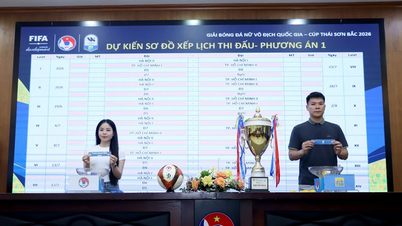
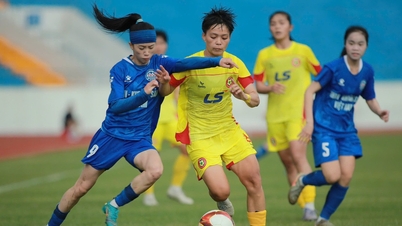
Not so long ago, just last year, the 2022 National Women's Football Championship, supposedly with 7 participating teams, saw Hanoi and Ho Chi Minh City occupy 4 of them, divided into Hanoi I, Hanoi II, Ho Chi Minh City I, and Ho Chi Minh City II; the remaining teams were Vietnam Coal and Mineral Corporation, Phong Phu Ha Nam, and Thai Nguyen. This is without even considering the fact that Vietnamese female players are increasingly smaller in stature compared to their predecessors. Furthermore, finding sponsors for women's football has long been a difficult problem for sports leaders.
In recent years, women's football in Vietnam has received more attention, and the lives of the players have gradually improved. However, the media still doesn't pay much attention to the sport, and when writing about women's football, they often just complain about poverty and hardship, causing headaches for the coaches. In one conversation, Coach Doan Thi Kim Chi shared: "When the press talks about women's football, please don't complain about us. Because when reporters write like that, parents are afraid and don't let their children pursue football, making it very difficult for us to recruit players."
Ahead of the 2023 Women's World Cup, many businesses sponsored the Vietnamese women's national team and its players. However, after the tournament in Australia and New Zealand concluded, whether the Vietnamese women's football team and women's football in Vietnam would continue to receive the attention and support of society remains a big question. Coach Mai Duc Chung shared: "After the 2023 Women's World Cup, we still have a lot of work to do if we want to continue participating in the biggest tournament on the planet. In the future, female players must improve their height, and Vietnamese women's football needs to develop more through school sports movements..."
Hopefully, Vietnamese women's football will not fall into the trap of only applauding when things go well.
DO TUAN
* Please visit the Sports section to view related news and articles.
Source
![[Photo] General Secretary and President To Lam works with the Party Committee of the Ministry of Health on the work of Vietnamese traditional medicine.](https://vphoto.vietnam.vn/thumb/1200x675/vietnam/resource/IMAGE/2026/05/20/1779294323718_a1-bnd-2978-3319-jpg.webp)
![[Image] "Journey of Hope" promotes the organ and tissue donation movement in Vietnam.](https://vphoto.vietnam.vn/thumb/1200x675/vietnam/resource/IMAGE/2026/05/20/1779294400833_1-8910-jpg.webp)




























































Comment (0)