

Comprehensive assessment for the development of NDC 3.0
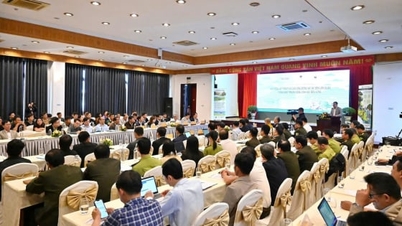
On December 29th, in Hanoi, the Climate Change Department ( Ministry of Agriculture and Environment ) organized a workshop on "The implementation status of the Nationally Determined Contributions (NDC) in 2022".
According to Mr. Le Ngoc Tuan, Deputy Director of the Climate Change Department, Vietnam, along with other countries participating in the United Nations Framework Convention on Climate Change (UNFCCC), submitted its Intended Nationally Determined Contribution (INDC) to the Convention Secretariat in 2015. After the Paris Agreement came into effect in 2016, the Intended Nationally Determined Contribution officially became the first Intended Nationally Determined Contribution (NDC) and is required to be updated periodically. Vietnam has updated its NDC twice, in 2020 and 2022, fulfilling its responsibilities as a member state of the Paris Agreement on climate change.
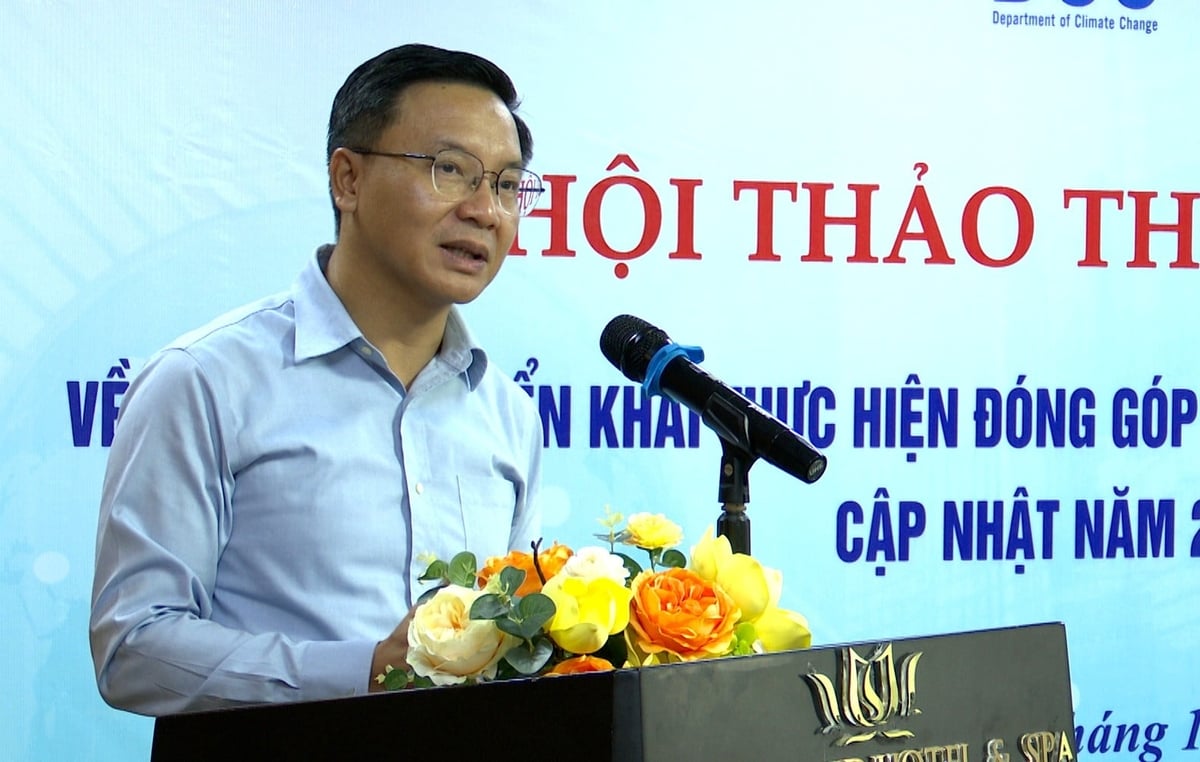
Mr. Le Ngoc Tuan, Deputy Director of the Climate Change Department, provided information on Vietnam's NDC updates. Photo: Khanh Ly.
The updated 2022 NDC clearly reflects Vietnam's utmost efforts in perfecting its policies and fulfilling its international responsibilities in responding to climate change. The greenhouse gas emission reduction targets have been updated to be higher and state a crucial political commitment: Vietnam strives to achieve net-zero emissions by 2050.
In the context of Vietnam preparing to update its third Nationally Determined Contribution (NDC 3.0) with a vision to 2035, an objective assessment of the achievements, difficulties, and obstacles in implementing the 2022 NDC is an urgent requirement.
Clarifying the international context, Mr. Luong Quang Huy, Head of the Greenhouse Gas Emission Management and Ozone Layer Protection Department (Climate Change Agency), stated: At the COP28 conference, the UNFCCC participating parties adopted the results of the first Global Stabilization Assessment (GST), affirming that current efforts are still insufficient to achieve the goal of limiting the global temperature increase to 1.5°C compared to pre-industrial levels.
Based on this, the international community is calling on countries to develop NDCs with a higher level of ambition, encompassing all sectors of the economy and all types of greenhouse gases. The concept of NDC 3.0 has been officially used since 2024 and has become a central requirement at the COP30 conference in 2025.

Mr. Luong Quang Huy, Head of the Greenhouse Gas Emission Management and Ozone Layer Protection Department (Climate Change Agency), provided information on the requirements for NDC 3. (Photo: Khanh Ly. )
Besides requiring a higher level of commitment to emission reduction, NDC 3.0 also places stricter demands on the Measurement, Reporting, and Verification (MRV) system for regularly monitoring and evaluating emission reduction results. To achieve this, Vietnam must continue to improve its emission inventory and accounting methods according to international standards, while ensuring sufficient input data for developing emission reduction scenarios and calculations.
There are still gaps in data and calculation methods.
Mr. Luong Quang Huy stated that, in the past period, the Climate Change Department, together with domestic experts and with the support of the VNSIPA Project, has reviewed and assessed the progress of implementing the 2022 NDC. Specifically, expert groups have conducted research and evaluated the progress of implementing greenhouse gas emission reduction measures in the 2022 NDC for five sectors: energy, industrial processes, waste, agriculture and land use, and forestry (LULUCF).
Preliminary results indicate that the emission reduction measures in the NDCs of various sectors still have significant gaps, mainly related to input data, calculation assumptions, and the degree of alignment with practical implementation.

Experts provide information on the results of the progress assessment of measures to reduce greenhouse gas emissions in 5 sectors according to the NDC 2022. Photo: Khanh Ly.
The biggest gap lies in the data and calculation methods. Some operational data has not been fully collected or consistently aggregated nationwide. For example, in the energy sector, estimates of output, capacity, and operating efficiency of energy facilities rely heavily on assumptions, while actual data fluctuates by locality and period. This directly affects the reliability of emission reduction estimates. Furthermore, some assumptions in the 2022 NDC are considered inaccurate for implementation. Given limited financial resources, technology, and management capacity, many assumptions need to be adjusted to accurately reflect the situation. The actual progress of projects is also affected by many factors such as investment procedures, pricing mechanisms, infrastructure, etc.
Furthermore, the lack of a sufficiently robust MRV system makes it difficult to verify the results of emission reduction measures, while also reducing transparency and comparability as required internationally.
Based on the aforementioned gaps, experts suggest the need to further improve the emission reduction database for various sectors, ensuring the complete, consistent, and regularly updated collection of data from facilities and projects. Simultaneously, it is necessary to review and adjust the assumptions in emission reduction calculations towards greater caution, closely adhering to actual capacity and the current policy roadmap. Addressing these gaps will be crucial for improving the quality of emission reduction measures in the energy sector, contributing to ensuring that the next phase of the NDC reflects the necessary level of ambition while also being feasible and effective in practical implementation.
Source: https://nongnghiepmoitruong.vn/chuan-bi-cho-muc-tieu-giam-phat-thai-giai-doan-moi-d791825.html
![[Photo] Ba Lang An Lighthouse - the "eye of the sea" amidst the "rock museum" of Quang Ngai province.](https://vphoto.vietnam.vn/thumb/1200x675/vietnam/resource/IMAGE/2026/05/29/1780038698840_anh-man-hinh-2026-05-29-luc-14-10-42.png)

![[Image] Pleasant weather helps students enter the 10th grade entrance exam with confidence.](https://vphoto.vietnam.vn/thumb/1200x675/vietnam/resource/IMAGE/2026/05/29/1780034401612_ngay-1-thi-lop-10-minh-duy-8-5009-jpg.webp)
















































































Comment (0)